

8.6 Magnetism, II. Ferromagnetism
465
H N = − J
n.n.
ˆ
s iz ˆ
s jz − μB
N
i=1
ˆ
s iz ,
(8.6.1a)
in which ˆ
s iz , ˆ
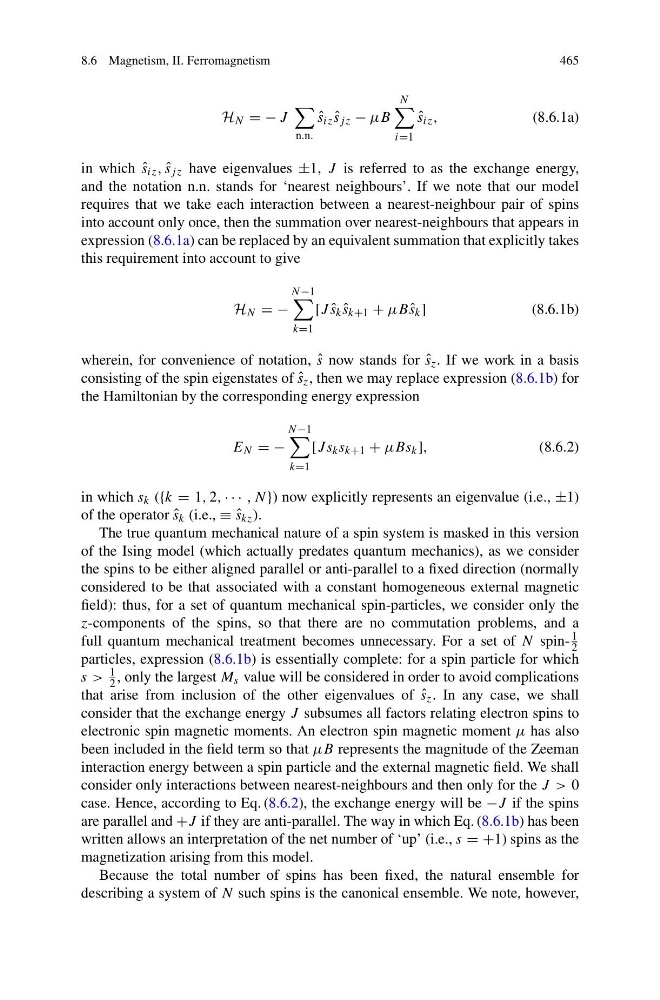
s jz have eigenvalues ±1, J is referred to as the exchange energy,
and the notation n.n. stands for ‘nearest neighbours’. If we note that our model
requires that we take each interaction between a nearest-neighbour pair of spins
into account only once, then the summation over nearest-neighbours that appears in
expression (8.6.1a) can be replaced by an equivalent summation that explicitly takes
this requirement into account to give
H N = −
N −1
k=1
[J ˆ
s k ˆ
s k+1 + μB ˆ
s k ]
(8.6.1b)
wherein, for convenience of notation, ˆ
s now stands for ˆ
s z . If we work in a basis
consisting of the spin eigenstates of ˆ
s z , then we may replace expression (8.6.1b) for
the Hamiltonian by the corresponding energy expression
E N = −
N −1
k=1
[J s k s k+1 + μBs k ],
(8.6.2)
in which s k ({k = 1, 2, · · · , N}) now explicitly represents an eigenvalue (i.e., ±1)
of the operator ˆ
s k (i.e., ≡ ˆ
s kz ).
The true quantum mechanical nature of a spin system is masked in this version
of the Ising model (which actually predates quantum mechanics), as we consider
the spins to be either aligned parallel or anti-parallel to a fixed direction (normally
considered to be that associated with a constant homogeneous external magnetic
field): thus, for a set of quantum mechanical spin-particles, we consider only the
z-components of the spins, so that there are no commutation problems, and a
full quantum mechanical treatment becomes unnecessary. For a set of N spin1
2
particles, expression (8.6.1b) is essentially complete: for a spin particle for which
s >
1
2 , only the largest M s value will be considered in order to avoid complications
that arise from inclusion of the other eigenvalues of ˆ
s z . In any case, we shall
consider that the exchange energy J subsumes all factors relating electron spins to
electronic spin magnetic moments. An electron spin magnetic moment μ has also
been included in the field term so that μB represents the magnitude of the Zeeman
interaction energy between a spin particle and the external magnetic field. We shall
consider only interactions between nearest-neighbours and then only for the J > 0
case. Hence, according to Eq. (8.6.2), the exchange energy will be −J if the spins
are parallel and +J if they are anti-parallel. The way in which Eq. (8.6.1b) has been
written allows an interpretation of the net number of ‘up’ (i.e., s = +1) spins as the
magnetization arising from this model.
Because the total number of spins has been fixed, the natural ensemble for
describing a system of N such spins is the canonical ensemble. We note, however,
465
H N = − J
n.n.
ˆ
s iz ˆ
s jz − μB
N
i=1
ˆ
s iz ,
(8.6.1a)
in which ˆ
s iz , ˆ
s jz have eigenvalues ±1, J is referred to as the exchange energy,
and the notation n.n. stands for ‘nearest neighbours’. If we note that our model
requires that we take each interaction between a nearest-neighbour pair of spins
into account only once, then the summation over nearest-neighbours that appears in
expression (8.6.1a) can be replaced by an equivalent summation that explicitly takes
this requirement into account to give
H N = −
N −1
k=1
[J ˆ
s k ˆ
s k+1 + μB ˆ
s k ]
(8.6.1b)
wherein, for convenience of notation, ˆ
s now stands for ˆ
s z . If we work in a basis
consisting of the spin eigenstates of ˆ
s z , then we may replace expression (8.6.1b) for
the Hamiltonian by the corresponding energy expression
E N = −
N −1
k=1
[J s k s k+1 + μBs k ],
(8.6.2)
in which s k ({k = 1, 2, · · · , N}) now explicitly represents an eigenvalue (i.e., ±1)
of the operator ˆ
s k (i.e., ≡ ˆ
s kz ).
The true quantum mechanical nature of a spin system is masked in this version
of the Ising model (which actually predates quantum mechanics), as we consider
the spins to be either aligned parallel or anti-parallel to a fixed direction (normally
considered to be that associated with a constant homogeneous external magnetic
field): thus, for a set of quantum mechanical spin-particles, we consider only the
z-components of the spins, so that there are no commutation problems, and a
full quantum mechanical treatment becomes unnecessary. For a set of N spin1
2
particles, expression (8.6.1b) is essentially complete: for a spin particle for which
s >
1
2 , only the largest M s value will be considered in order to avoid complications
that arise from inclusion of the other eigenvalues of ˆ
s z . In any case, we shall
consider that the exchange energy J subsumes all factors relating electron spins to
electronic spin magnetic moments. An electron spin magnetic moment μ has also
been included in the field term so that μB represents the magnitude of the Zeeman
interaction energy between a spin particle and the external magnetic field. We shall
consider only interactions between nearest-neighbours and then only for the J > 0
case. Hence, according to Eq. (8.6.2), the exchange energy will be −J if the spins
are parallel and +J if they are anti-parallel. The way in which Eq. (8.6.1b) has been
written allows an interpretation of the net number of ‘up’ (i.e., s = +1) spins as the
magnetization arising from this model.
Because the total number of spins has been fixed, the natural ensemble for
describing a system of N such spins is the canonical ensemble. We note, however,