

450
8 Electric and Magnetic Phenomena
and β is, as usual, (k B T ) −1 . Corresponding fractional populations p J M J (T , B) for
the (no longer degenerate) magnetic states are then given accordingly by
p J M J (T , B) =
e −βg J (L,S)μ B BM J
z mag (T , B)
.
(8.5.38)
We note, in passing, that the fractional populations of Eq. (8.5.38) do not involve
the original term energy E J (L, S): this is another manifestation of the arbitrariness
of the zero of energy in the determination of fractional populations. Note also that
much of the following derivation does not require the Zeeman energy to be small
relative to k B T .
To obtain an expression for the magnetization for an individual atom or ion, let
us begin by calculating μ J (T , B) as
μ J (T , B) ≡
+J
M J =−J
μ JM J (L, S) p J M J (T , B).
(8.5.39)
Upon employing Eq. (8.5.38) for the fractional populations for the Zeeman states,
we obtain
μ J (T , B) =
1
z mag (T , B)
+J
m J =−J
g J (L, S)M J μ B e
−βg J (L,S)μ B M J B .
(8.5.40)
By noting that the prefactor in the summation can be generated by taking the
partial derivative with respect to the field strength B of the exponential, we obtain
μ J (T , B) as
μ J (T , B) =
1
z mag (T , B)
+J
M J =−J
−k B T
∂
∂B
e
−βg J μ B M J B
= −
k B T
z mag (T , B)
∂
∂B
⎛
⎝
+J
M J =−J
e
−βg J μ B M J B
⎞
⎠ .
(8.5.41)
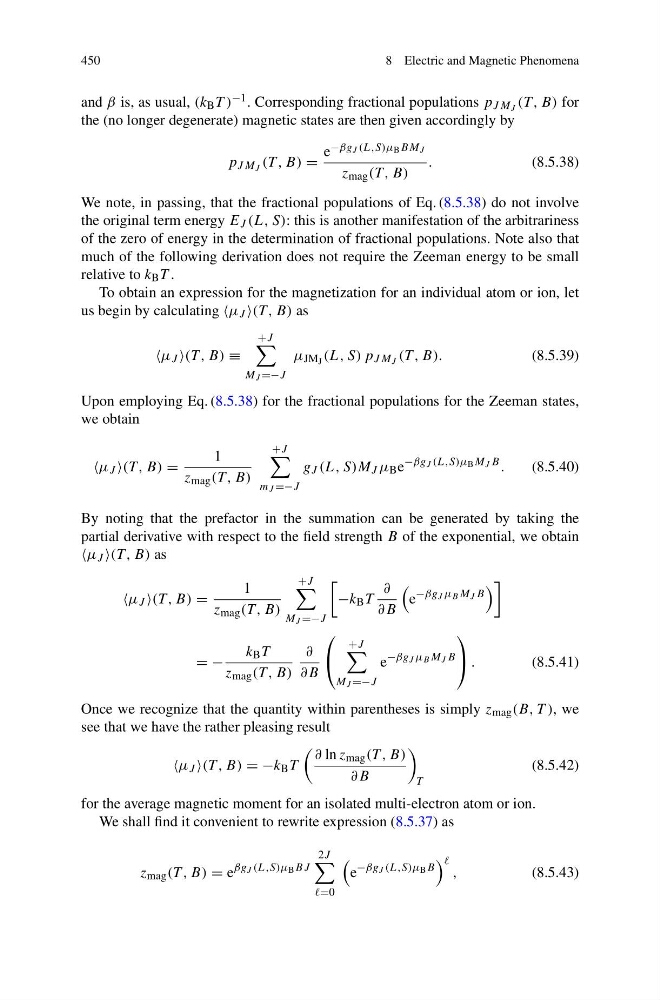
Once we recognize that the quantity within parentheses is simply z mag (B, T ), we
see that we have the rather pleasing result
μ J (T , B) = −k B T
∂ ln z mag (T , B)
∂B
T
(8.5.42)
for the average magnetic moment for an isolated multi-electron atom or ion.
We shall find it convenient to rewrite expression (8.5.37) as
z mag (T , B) = e
βg J (L,S)μ B BJ
2J
=0
e
−βg J (L,S)μ B B
,
(8.5.43)
8 Electric and Magnetic Phenomena
and β is, as usual, (k B T ) −1 . Corresponding fractional populations p J M J (T , B) for
the (no longer degenerate) magnetic states are then given accordingly by
p J M J (T , B) =
e −βg J (L,S)μ B BM J
z mag (T , B)
.
(8.5.38)
We note, in passing, that the fractional populations of Eq. (8.5.38) do not involve
the original term energy E J (L, S): this is another manifestation of the arbitrariness
of the zero of energy in the determination of fractional populations. Note also that
much of the following derivation does not require the Zeeman energy to be small
relative to k B T .
To obtain an expression for the magnetization for an individual atom or ion, let
us begin by calculating μ J (T , B) as
μ J (T , B) ≡
+J
M J =−J
μ JM J (L, S) p J M J (T , B).
(8.5.39)
Upon employing Eq. (8.5.38) for the fractional populations for the Zeeman states,
we obtain
μ J (T , B) =
1
z mag (T , B)
+J
m J =−J
g J (L, S)M J μ B e
−βg J (L,S)μ B M J B .
(8.5.40)
By noting that the prefactor in the summation can be generated by taking the
partial derivative with respect to the field strength B of the exponential, we obtain
μ J (T , B) as
μ J (T , B) =
1
z mag (T , B)
+J
M J =−J
−k B T
∂
∂B
e
−βg J μ B M J B
= −
k B T
z mag (T , B)
∂
∂B
⎛
⎝
+J
M J =−J
e
−βg J μ B M J B
⎞
⎠ .
(8.5.41)
Once we recognize that the quantity within parentheses is simply z mag (B, T ), we
see that we have the rather pleasing result
μ J (T , B) = −k B T
∂ ln z mag (T , B)
∂B
T
(8.5.42)
for the average magnetic moment for an isolated multi-electron atom or ion.
We shall find it convenient to rewrite expression (8.5.37) as
z mag (T , B) = e
βg J (L,S)μ B BJ
2J
=0
e
−βg J (L,S)μ B B
,
(8.5.43)