

2.2 An Introduction to Thermodynamics
33
expressed as the work, W , done on the system. If the forces involved in such
a process of energy transfer (between two subsystems) are only infinitesimally
unbalanced at any time during the process in which energy is transferred as work,
then that process is said to be reversible. We should always understand, however,
that true reversibility is an idealization that cannot be fully accomplished.
Experimentally, it is known that a change of the thermodynamic state of a system
separated from its surroundings by walls that allow energy to pass through them can
be effected simply by raising or lowering the temperature of the surroundings, with
no work performed either on or by the system. This mode of energy exchange,
associated with a temperature difference (gradient) between the system and its
surroundings, is called heat transfer. The amount of energy thereby transferred
between the system and its surroundings is referred to as the heat, Q, and is taken
to be positive if it represents an energy input to the system. Note that because heat
and work are defined in terms of specific processes and represent modes of energy
transfer, they are not thermodynamic state functions. Moreover, as they both depend,
in general, upon the specific process employed or, equivalently, on the path taken,
their differentials are designated by δQ and δW , respectively, rather than by dQ and
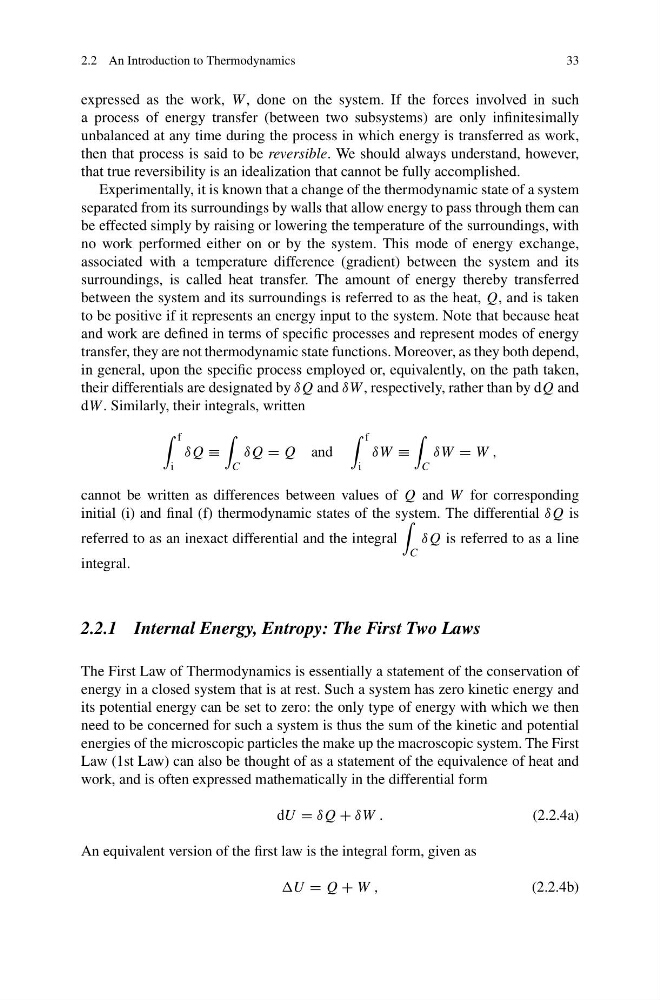
dW . Similarly, their integrals, written
f
i
δQ ≡
C
δQ = Q and
f
i
δW ≡
C
δW = W ,
cannot be written as differences between values of Q and W for corresponding
initial (i) and final (f) thermodynamic states of the system. The differential δQ is
referred to as an inexact differential and the integral
C
δQ is referred to as a line
integral.
2.2.1 Internal Energy, Entropy: The First Two Laws
The First Law of Thermodynamics is essentially a statement of the conservation of
energy in a closed system that is at rest. Such a system has zero kinetic energy and
its potential energy can be set to zero: the only type of energy with which we then
need to be concerned for such a system is thus the sum of the kinetic and potential
energies of the microscopic particles the make up the macroscopic system. The First
Law (1st Law) can also be thought of as a statement of the equivalence of heat and
work, and is often expressed mathematically in the differential form
dU = δQ + δW .
(2.2.4a)
An equivalent version of the first law is the integral form, given as
U = Q + W ,
(2.2.4b)
33
expressed as the work, W , done on the system. If the forces involved in such
a process of energy transfer (between two subsystems) are only infinitesimally
unbalanced at any time during the process in which energy is transferred as work,
then that process is said to be reversible. We should always understand, however,
that true reversibility is an idealization that cannot be fully accomplished.
Experimentally, it is known that a change of the thermodynamic state of a system
separated from its surroundings by walls that allow energy to pass through them can
be effected simply by raising or lowering the temperature of the surroundings, with
no work performed either on or by the system. This mode of energy exchange,
associated with a temperature difference (gradient) between the system and its
surroundings, is called heat transfer. The amount of energy thereby transferred
between the system and its surroundings is referred to as the heat, Q, and is taken
to be positive if it represents an energy input to the system. Note that because heat
and work are defined in terms of specific processes and represent modes of energy
transfer, they are not thermodynamic state functions. Moreover, as they both depend,
in general, upon the specific process employed or, equivalently, on the path taken,
their differentials are designated by δQ and δW , respectively, rather than by dQ and
dW . Similarly, their integrals, written
f
i
δQ ≡
C
δQ = Q and
f
i
δW ≡
C
δW = W ,
cannot be written as differences between values of Q and W for corresponding
initial (i) and final (f) thermodynamic states of the system. The differential δQ is
referred to as an inexact differential and the integral
C
δQ is referred to as a line
integral.
2.2.1 Internal Energy, Entropy: The First Two Laws
The First Law of Thermodynamics is essentially a statement of the conservation of
energy in a closed system that is at rest. Such a system has zero kinetic energy and
its potential energy can be set to zero: the only type of energy with which we then
need to be concerned for such a system is thus the sum of the kinetic and potential
energies of the microscopic particles the make up the macroscopic system. The First
Law (1st Law) can also be thought of as a statement of the equivalence of heat and
work, and is often expressed mathematically in the differential form
dU = δQ + δW .
(2.2.4a)
An equivalent version of the first law is the integral form, given as
U = Q + W ,
(2.2.4b)