

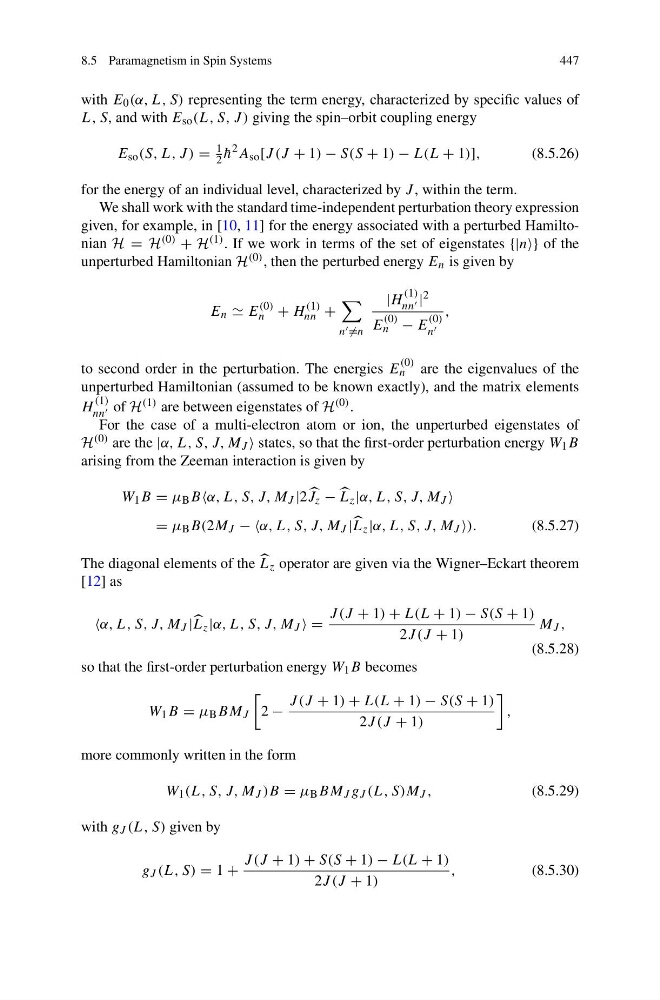
8.5 Paramagnetism in Spin Systems
447
with E 0 (α, L, S) representing the term energy, characterized by specific values of
L, S, and with E so (L, S, J ) giving the spin–orbit coupling energy
E so (S, L, J ) =
1
2 ¯
h
2 A so [J (J + 1) − S(S + 1) − L(L + 1)],
(8.5.26)
for the energy of an individual level, characterized by J , within the term.
We shall work with the standard time-independent perturbation theory expression
given, for example, in [10, 11] for the energy associated with a perturbed Hamiltonian H = H (0) + H (1) . If we work in terms of the set of eigenstates {|n} of the
unperturbed Hamiltonian H (0) , then the perturbed energy E n is given by
E n E
(0)
n + H
(1)
nn +
n =n
|H
(1)
nn | 2
E
(0)
n − E
(0)
n
,
to second order in the perturbation. The energies E
(0)
n are the eigenvalues of the
unperturbed Hamiltonian (assumed to be known exactly), and the matrix elements
H
(1)
nn of H (1) are between eigenstates of H (0) .
For the case of a multi-electron atom or ion, the unperturbed eigenstates of
H (0) are the |α, L, S, J, M J states, so that the first-order perturbation energy W 1 B
arising from the Zeeman interaction is given by
W 1 B = μ B Bα, L, S, J, M J |2
J z −
L z |α, L, S, J, M J
= μ B B(2M J − −α, L, S, J, M J |
L z |α, L, S, J, M J ).
(8.5.27)
The diagonal elements of the
L z operator are given via the Wigner–Eckart theorem
[12] as
α, L, S, J, M J |
L z |α, L, S, J, M J =
J (J + 1) + L(L + 1) − S(S + 1)
2J (J + 1)
M J ,
(8.5.28)
so that the first-order perturbation energy W 1 B becomes
W 1 B = μ B BM J
2 −
J (J + 1) + L(L + 1) − S(S + 1)
2J (J + 1)
,
more commonly written in the form
W 1 (L, S, J, M J )B = μ B BM J g J (L, S)M J ,
(8.5.29)
with g J (L, S) given by
g J (L, S) = 1 +
J (J + 1) + S(S + 1) − L(L + 1)
2J (J + 1)
,
(8.5.30)
447
with E 0 (α, L, S) representing the term energy, characterized by specific values of
L, S, and with E so (L, S, J ) giving the spin–orbit coupling energy
E so (S, L, J ) =
1
2 ¯
h
2 A so [J (J + 1) − S(S + 1) − L(L + 1)],
(8.5.26)
for the energy of an individual level, characterized by J , within the term.
We shall work with the standard time-independent perturbation theory expression
given, for example, in [10, 11] for the energy associated with a perturbed Hamiltonian H = H (0) + H (1) . If we work in terms of the set of eigenstates {|n} of the
unperturbed Hamiltonian H (0) , then the perturbed energy E n is given by
E n E
(0)
n + H
(1)
nn +
n =n
|H
(1)
nn | 2
E
(0)
n − E
(0)
n
,
to second order in the perturbation. The energies E
(0)
n are the eigenvalues of the
unperturbed Hamiltonian (assumed to be known exactly), and the matrix elements
H
(1)
nn of H (1) are between eigenstates of H (0) .
For the case of a multi-electron atom or ion, the unperturbed eigenstates of
H (0) are the |α, L, S, J, M J states, so that the first-order perturbation energy W 1 B
arising from the Zeeman interaction is given by
W 1 B = μ B Bα, L, S, J, M J |2
J z −
L z |α, L, S, J, M J
= μ B B(2M J − −α, L, S, J, M J |
L z |α, L, S, J, M J ).
(8.5.27)
The diagonal elements of the
L z operator are given via the Wigner–Eckart theorem
[12] as
α, L, S, J, M J |
L z |α, L, S, J, M J =
J (J + 1) + L(L + 1) − S(S + 1)
2J (J + 1)
M J ,
(8.5.28)
so that the first-order perturbation energy W 1 B becomes
W 1 B = μ B BM J
2 −
J (J + 1) + L(L + 1) − S(S + 1)
2J (J + 1)
,
more commonly written in the form
W 1 (L, S, J, M J )B = μ B BM J g J (L, S)M J ,
(8.5.29)
with g J (L, S) given by
g J (L, S) = 1 +
J (J + 1) + S(S + 1) − L(L + 1)
2J (J + 1)
,
(8.5.30)