

2.2 An Introduction to Thermodynamics
31
dU =
dU
dT
dT .
We shall write this expression as
dU = C V dT ,
(2.2.2b)
in which C V (T ) is defined as
C V (T ) ≡
∂U
∂T
V
,
and is known as the heat capacity at constant volume. This definition arises more
generally from the (total) differential in the internal energy dU obtained when U is
a function of T and V (such as occurs for a nonideal gas, for example), i.e.,
dU =
∂U
∂T
V
dT +
∂U
∂V
T
dV = C V dT +
∂U
∂V
T
dV .
We have also seen in Sect. 1.2 that for an adiabatic change (in which there is no
direct energy exchange between the thermodynamic system and its surroundings)
the change in the internal energy of an ideal gas will be given by the work δW done
on the ideal gas in compressing it, so that dU is also given by the work δW as
dU = −P dV .
(2.2.2c)
Upon equating expressions (2.2.2b) and (2.2.2c) for dU , we obtain the constraint
C V dT + P dV = 0 .
(2.2.2d)
If we now replace the pressure in terms of T and V from the ideal gas law
expression, we may rearrange Eq. (2.2.2d) into the form
C V
dT
T
+ Nk B
dV
V
= 0 ,
(2.2.2e)
from which we obtain, upon integration over T and V from initial, i, to final, f,
(thermodynamic) states, the condition
C V ln
T f
T i
+ Nk B ln
V f
V i
= 0 .
(2.2.3)
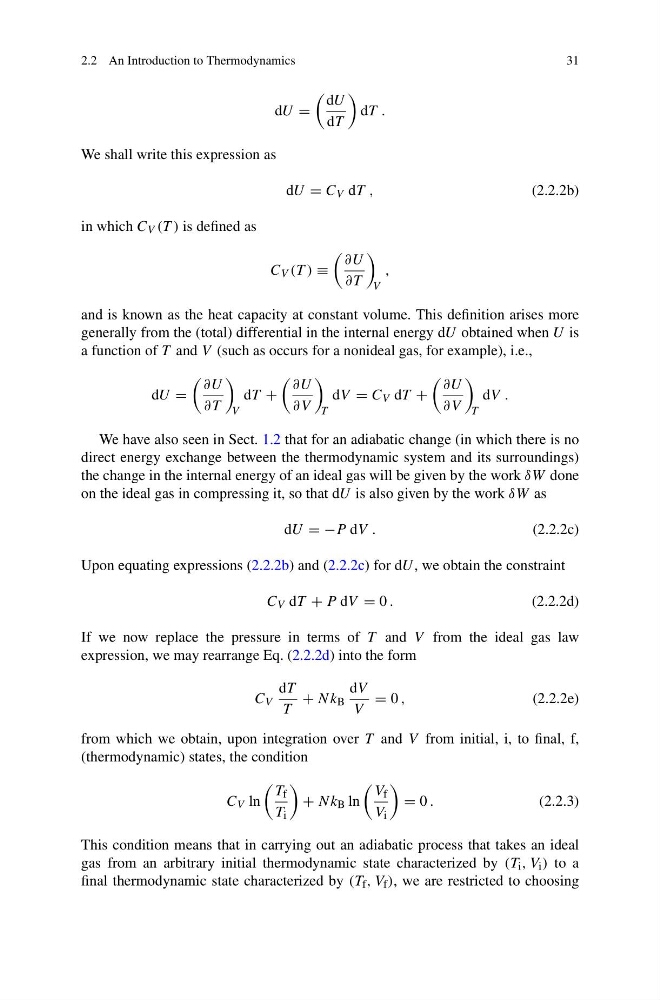
This condition means that in carrying out an adiabatic process that takes an ideal
gas from an arbitrary initial thermodynamic state characterized by (T i , V i ) to a
final thermodynamic state characterized by (T f , V f ), we are restricted to choosing
31
dU =
dU
dT
dT .
We shall write this expression as
dU = C V dT ,
(2.2.2b)
in which C V (T ) is defined as
C V (T ) ≡
∂U
∂T
V
,
and is known as the heat capacity at constant volume. This definition arises more
generally from the (total) differential in the internal energy dU obtained when U is
a function of T and V (such as occurs for a nonideal gas, for example), i.e.,
dU =
∂U
∂T
V
dT +
∂U
∂V
T
dV = C V dT +
∂U
∂V
T
dV .
We have also seen in Sect. 1.2 that for an adiabatic change (in which there is no
direct energy exchange between the thermodynamic system and its surroundings)
the change in the internal energy of an ideal gas will be given by the work δW done
on the ideal gas in compressing it, so that dU is also given by the work δW as
dU = −P dV .
(2.2.2c)
Upon equating expressions (2.2.2b) and (2.2.2c) for dU , we obtain the constraint
C V dT + P dV = 0 .
(2.2.2d)
If we now replace the pressure in terms of T and V from the ideal gas law
expression, we may rearrange Eq. (2.2.2d) into the form
C V
dT
T
+ Nk B
dV
V
= 0 ,
(2.2.2e)
from which we obtain, upon integration over T and V from initial, i, to final, f,
(thermodynamic) states, the condition
C V ln
T f
T i
+ Nk B ln
V f
V i
= 0 .
(2.2.3)
This condition means that in carrying out an adiabatic process that takes an ideal
gas from an arbitrary initial thermodynamic state characterized by (T i , V i ) to a
final thermodynamic state characterized by (T f , V f ), we are restricted to choosing