

416
8 Electric and Magnetic Phenomena
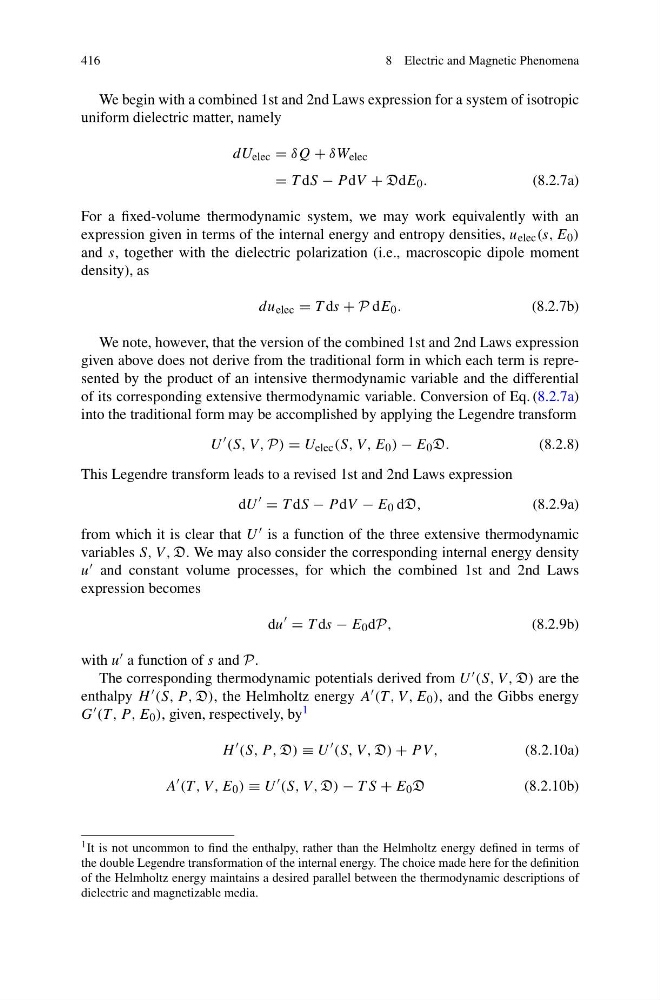
We begin with a combined 1st and 2nd Laws expression for a system of isotropic
uniform dielectric matter, namely
dU elec = δQ + δW elec
= T dS − P dV + DdE 0 .
(8.2.7a)
For a fixed-volume thermodynamic system, we may work equivalently with an
expression given in terms of the internal energy and entropy densities, u elec (s, E 0 )
and s, together with the dielectric polarization (i.e., macroscopic dipole moment
density), as
du elec = T ds + P dE 0 .
(8.2.7b)
We note, however, that the version of the combined 1st and 2nd Laws expression
given above does not derive from the traditional form in which each term is represented by the product of an intensive thermodynamic variable and the differential
of its corresponding extensive thermodynamic variable. Conversion of Eq. (8.2.7a)
into the traditional form may be accomplished by applying the Legendre transform
U
(S, V , P) = U elec (S, V , E 0 ) − E 0 D.
(8.2.8)
This Legendre transform leads to a revised 1st and 2nd Laws expression
dU
= T dS − P dV − E 0 dD,
(8.2.9a)
from which it is clear that U is a function of the three extensive thermodynamic
variables S, V , D. We may also consider the corresponding internal energy density
u and constant volume processes, for which the combined 1st and 2nd Laws
expression becomes
du
= T ds − E 0 dP,
(8.2.9b)
with u a function of s and P.
The corresponding thermodynamic potentials derived from U (S, V , D) are the
enthalpy H (S, P , D), the Helmholtz energy A (T , V , E 0 ), and the Gibbs energy
G (T , P , E 0 ), given, respectively, by 1
H
(S, P , D) ≡ U
(S, V , D) + P V ,
(8.2.10a)
A
(T , V , E 0 ) ≡ U
(S, V , D) − T S + E 0 D
(8.2.10b)
1 It is not uncommon to find the enthalpy, rather than the Helmholtz energy defined in terms of
the double Legendre transformation of the internal energy. The choice made here for the definition
of the Helmholtz energy maintains a desired parallel between the thermodynamic descriptions of
dielectric and magnetizable media.
8 Electric and Magnetic Phenomena
We begin with a combined 1st and 2nd Laws expression for a system of isotropic
uniform dielectric matter, namely
dU elec = δQ + δW elec
= T dS − P dV + DdE 0 .
(8.2.7a)
For a fixed-volume thermodynamic system, we may work equivalently with an
expression given in terms of the internal energy and entropy densities, u elec (s, E 0 )
and s, together with the dielectric polarization (i.e., macroscopic dipole moment
density), as
du elec = T ds + P dE 0 .
(8.2.7b)
We note, however, that the version of the combined 1st and 2nd Laws expression
given above does not derive from the traditional form in which each term is represented by the product of an intensive thermodynamic variable and the differential
of its corresponding extensive thermodynamic variable. Conversion of Eq. (8.2.7a)
into the traditional form may be accomplished by applying the Legendre transform
U
(S, V , P) = U elec (S, V , E 0 ) − E 0 D.
(8.2.8)
This Legendre transform leads to a revised 1st and 2nd Laws expression
dU
= T dS − P dV − E 0 dD,
(8.2.9a)
from which it is clear that U is a function of the three extensive thermodynamic
variables S, V , D. We may also consider the corresponding internal energy density
u and constant volume processes, for which the combined 1st and 2nd Laws
expression becomes
du
= T ds − E 0 dP,
(8.2.9b)
with u a function of s and P.
The corresponding thermodynamic potentials derived from U (S, V , D) are the
enthalpy H (S, P , D), the Helmholtz energy A (T , V , E 0 ), and the Gibbs energy
G (T , P , E 0 ), given, respectively, by 1
H
(S, P , D) ≡ U
(S, V , D) + P V ,
(8.2.10a)
A
(T , V , E 0 ) ≡ U
(S, V , D) − T S + E 0 D
(8.2.10b)
1 It is not uncommon to find the enthalpy, rather than the Helmholtz energy defined in terms of
the double Legendre transformation of the internal energy. The choice made here for the definition
of the Helmholtz energy maintains a desired parallel between the thermodynamic descriptions of
dielectric and magnetizable media.