

404
7 Classical Statistical Mechanics
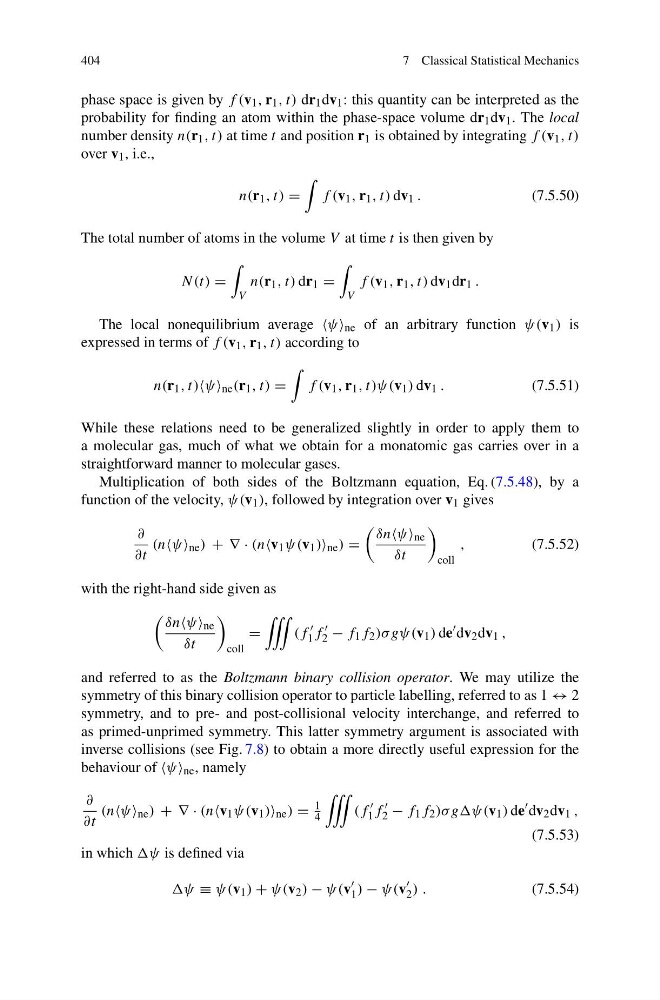
phase space is given by f (v 1 , r 1 , t) dr 1 dv 1 : this quantity can be interpreted as the
probability for finding an atom within the phase-space volume dr 1 dv 1 . The local
number density n(r 1 , t) at time t and position r 1 is obtained by integrating f (v 1 , t)
over v 1 , i.e.,
n(r 1 , t) =
f (v 1 , r 1 , t) dv 1 .
(7.5.50)
The total number of atoms in the volume V at time t is then given by
N(t) =
V
n(r 1 , t) dr 1 =
V
f (v 1 , r 1 , t) dv 1 dr 1 .
The local nonequilibrium average ψ ne of an arbitrary function ψ(v 1 ) is
expressed in terms of f (v 1 , r 1 , t) according to
n(r 1 , t)ψ ne (r 1 , t) =
f (v 1 , r 1 , t)ψ(v 1 ) dv 1 .
(7.5.51)
While these relations need to be generalized slightly in order to apply them to
a molecular gas, much of what we obtain for a monatomic gas carries over in a
straightforward manner to molecular gases.
Multiplication of both sides of the Boltzmann equation, Eq. (7.5.48), by a
function of the velocity, ψ(v 1 ), followed by integration over v 1 gives
∂
∂t
(nψ ne ) + ∇ · (nv 1 ψ(v 1 ) ne ) =
δnψ ne
δt
coll
,
(7.5.52)
with the right-hand side given as
δnψ ne
δt
coll
=
(f
1 f
2 − f 1 f 2 )σ gψ(v 1 ) de
dv 2 dv 1 ,
and referred to as the Boltzmann binary collision operator. We may utilize the
symmetry of this binary collision operator to particle labelling, referred to as 1 ↔ 2
symmetry, and to pre- and post-collisional velocity interchange, and referred to
as primed-unprimed symmetry. This latter symmetry argument is associated with
inverse collisions (see Fig. 7.8) to obtain a more directly useful expression for the
behaviour of ψ ne , namely
∂
∂t
(nψ ne ) + ∇ · (nv 1 ψ(v 1 ) ne ) =
1
4
(f
1 f
2 − f 1 f 2 )σ ggψ(v 1 ) de
dv 2 dv 1 ,
(7.5.53)
in which ψ is defined via
ψ ≡ ψ(v 1 ) + ψ(v 2 ) − ψ(v
1 ) − ψ(v
2 ) .
(7.5.54)
7 Classical Statistical Mechanics
phase space is given by f (v 1 , r 1 , t) dr 1 dv 1 : this quantity can be interpreted as the
probability for finding an atom within the phase-space volume dr 1 dv 1 . The local
number density n(r 1 , t) at time t and position r 1 is obtained by integrating f (v 1 , t)
over v 1 , i.e.,
n(r 1 , t) =
f (v 1 , r 1 , t) dv 1 .
(7.5.50)
The total number of atoms in the volume V at time t is then given by
N(t) =
V
n(r 1 , t) dr 1 =
V
f (v 1 , r 1 , t) dv 1 dr 1 .
The local nonequilibrium average ψ ne of an arbitrary function ψ(v 1 ) is
expressed in terms of f (v 1 , r 1 , t) according to
n(r 1 , t)ψ ne (r 1 , t) =
f (v 1 , r 1 , t)ψ(v 1 ) dv 1 .
(7.5.51)
While these relations need to be generalized slightly in order to apply them to
a molecular gas, much of what we obtain for a monatomic gas carries over in a
straightforward manner to molecular gases.
Multiplication of both sides of the Boltzmann equation, Eq. (7.5.48), by a
function of the velocity, ψ(v 1 ), followed by integration over v 1 gives
∂
∂t
(nψ ne ) + ∇ · (nv 1 ψ(v 1 ) ne ) =
δnψ ne
δt
coll
,
(7.5.52)
with the right-hand side given as
δnψ ne
δt
coll
=
(f
1 f
2 − f 1 f 2 )σ gψ(v 1 ) de
dv 2 dv 1 ,
and referred to as the Boltzmann binary collision operator. We may utilize the
symmetry of this binary collision operator to particle labelling, referred to as 1 ↔ 2
symmetry, and to pre- and post-collisional velocity interchange, and referred to
as primed-unprimed symmetry. This latter symmetry argument is associated with
inverse collisions (see Fig. 7.8) to obtain a more directly useful expression for the
behaviour of ψ ne , namely
∂
∂t
(nψ ne ) + ∇ · (nv 1 ψ(v 1 ) ne ) =
1
4
(f
1 f
2 − f 1 f 2 )σ ggψ(v 1 ) de
dv 2 dv 1 ,
(7.5.53)
in which ψ is defined via
ψ ≡ ψ(v 1 ) + ψ(v 2 ) − ψ(v
1 ) − ψ(v
2 ) .
(7.5.54)