

386
7 Classical Statistical Mechanics
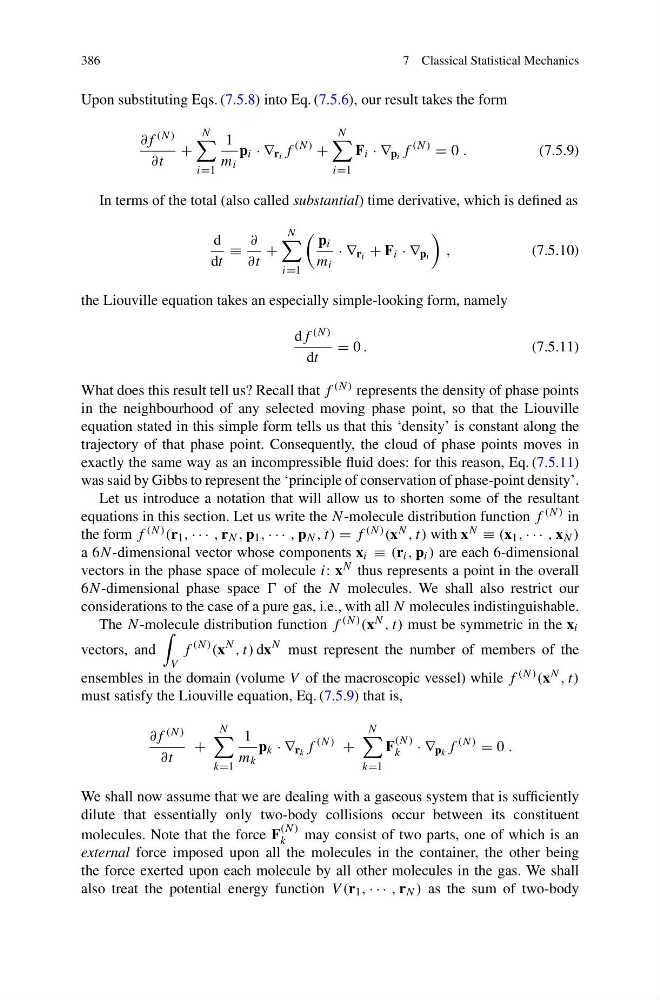
Upon substituting Eqs. (7.5.8) into Eq. (7.5.6), our result takes the form
∂f (N )
∂t
+
N
i=1
1
m i
p i · ∇ r i f
(N )
+
N
i=1
F i · ∇ p i f
(N )
= 0 .
(7.5.9)
In terms of the total (also called substantial) time derivative, which is defined as
d
dt
≡
∂
∂t
+
N
i=1
p i
m i
· ∇ r i + F i · ∇ p i
,
(7.5.10)
the Liouville equation takes an especially simple-looking form, namely
df (N )
dt
= 0 .
(7.5.11)
What does this result tell us? Recall that f (N ) represents the density of phase points
in the neighbourhood of any selected moving phase point, so that the Liouville
equation stated in this simple form tells us that this ‘density’ is constant along the
trajectory of that phase point. Consequently, the cloud of phase points moves in
exactly the same way as an incompressible fluid does: for this reason, Eq. (7.5.11)
was said by Gibbs to represent the ‘principle of conservation of phase-point density’.
Let us introduce a notation that will allow us to shorten some of the resultant
equations in this section. Let us write the N-molecule distribution function f (N ) in
the form f (N ) (r 1 , · · · , r N , p 1 , · · · , p N , t) = f (N ) (x N , t) with x N ≡ (x 1 , · · · , x N )
a 6N-dimensional vector whose components x i ≡ (r i , p i ) are each 6-dimensional
vectors in the phase space of molecule i: x N thus represents a point in the overall
6N -dimensional phase space of the N molecules. We shall also restrict our
considerations to the case of a pure gas, i.e., with all N molecules indistinguishable.
The N -molecule distribution function f (N ) (x N , t) must be symmetric in the x i
vectors, and
V
f
(N ) (x
N , t) dx
N must represent the number of members of the
ensembles in the domain (volume V of the macroscopic vessel) while f (N ) (x N , t)
must satisfy the Liouville equation, Eq. (7.5.9) that is,
∂f (N )
∂t
+
N
k=1
1
m k
p k · ∇ r k f
(N )
+
N
k=1
F
(N )
k · ∇ p k f
(N )
= 0 .
We shall now assume that we are dealing with a gaseous system that is sufficiently
dilute that essentially only two-body collisions occur between its constituent
molecules. Note that the force F
(N )
k
may consist of two parts, one of which is an
external force imposed upon all the molecules in the container, the other being
the force exerted upon each molecule by all other molecules in the gas. We shall
also treat the potential energy function V (r 1 , · · · , r N ) as the sum of two-body
7 Classical Statistical Mechanics
Upon substituting Eqs. (7.5.8) into Eq. (7.5.6), our result takes the form
∂f (N )
∂t
+
N
i=1
1
m i
p i · ∇ r i f
(N )
+
N
i=1
F i · ∇ p i f
(N )
= 0 .
(7.5.9)
In terms of the total (also called substantial) time derivative, which is defined as
d
dt
≡
∂
∂t
+
N
i=1
p i
m i
· ∇ r i + F i · ∇ p i
,
(7.5.10)
the Liouville equation takes an especially simple-looking form, namely
df (N )
dt
= 0 .
(7.5.11)
What does this result tell us? Recall that f (N ) represents the density of phase points
in the neighbourhood of any selected moving phase point, so that the Liouville
equation stated in this simple form tells us that this ‘density’ is constant along the
trajectory of that phase point. Consequently, the cloud of phase points moves in
exactly the same way as an incompressible fluid does: for this reason, Eq. (7.5.11)
was said by Gibbs to represent the ‘principle of conservation of phase-point density’.
Let us introduce a notation that will allow us to shorten some of the resultant
equations in this section. Let us write the N-molecule distribution function f (N ) in
the form f (N ) (r 1 , · · · , r N , p 1 , · · · , p N , t) = f (N ) (x N , t) with x N ≡ (x 1 , · · · , x N )
a 6N-dimensional vector whose components x i ≡ (r i , p i ) are each 6-dimensional
vectors in the phase space of molecule i: x N thus represents a point in the overall
6N -dimensional phase space of the N molecules. We shall also restrict our
considerations to the case of a pure gas, i.e., with all N molecules indistinguishable.
The N -molecule distribution function f (N ) (x N , t) must be symmetric in the x i
vectors, and
V
f
(N ) (x
N , t) dx
N must represent the number of members of the
ensembles in the domain (volume V of the macroscopic vessel) while f (N ) (x N , t)
must satisfy the Liouville equation, Eq. (7.5.9) that is,
∂f (N )
∂t
+
N
k=1
1
m k
p k · ∇ r k f
(N )
+
N
k=1
F
(N )
k · ∇ p k f
(N )
= 0 .
We shall now assume that we are dealing with a gaseous system that is sufficiently
dilute that essentially only two-body collisions occur between its constituent
molecules. Note that the force F
(N )
k
may consist of two parts, one of which is an
external force imposed upon all the molecules in the container, the other being
the force exerted upon each molecule by all other molecules in the gas. We shall
also treat the potential energy function V (r 1 , · · · , r N ) as the sum of two-body