

7.2 The Virial Equation of State
373
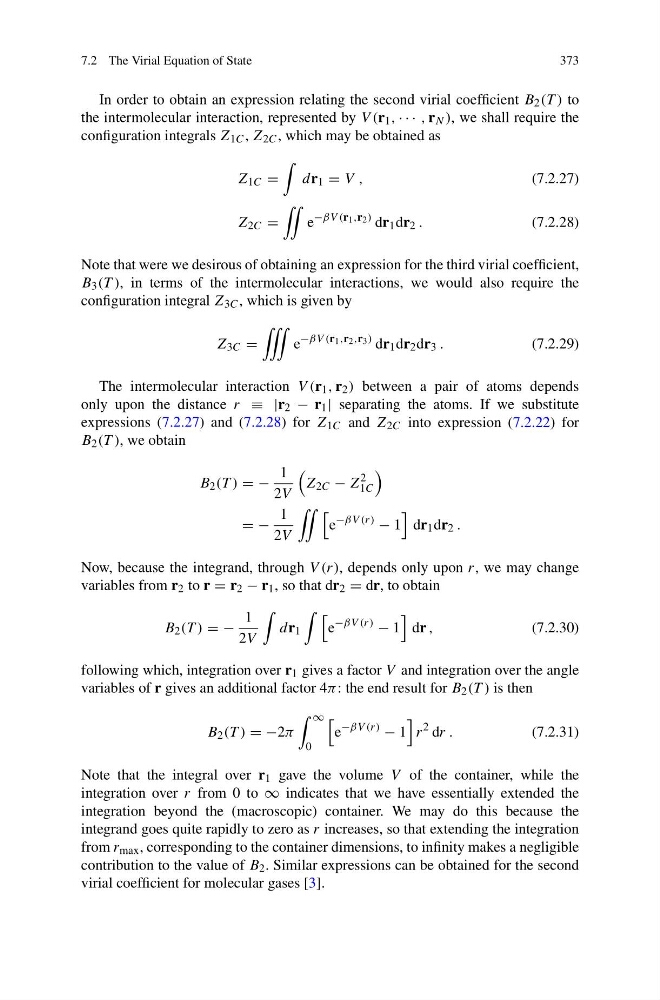
In order to obtain an expression relating the second virial coefficient B 2 (T ) to
the intermolecular interaction, represented by V (r 1 , · · · , r N ), we shall require the
configuration integrals Z 1C , Z 2C , which may be obtained as
Z 1C =
dr 1 = V ,
(7.2.27)
Z 2C =
e
−βV (r 1 ,r 2 ) dr 1 dr 2 .
(7.2.28)
Note that were we desirous of obtaining an expression for the third virial coefficient,
B 3 (T ), in terms of the intermolecular interactions, we would also require the
configuration integral Z 3C , which is given by
Z 3C =
e
−βV (r 1 ,r 2 ,r 3 ) dr 1 dr 2 dr 3 .
(7.2.29)
The intermolecular interaction V (r 1 , r 2 ) between a pair of atoms depends
only upon the distance r ≡ |r 2 − r 1 | separating the atoms. If we substitute
expressions (7.2.27) and (7.2.28) for Z 1C and Z 2C into expression (7.2.22) for
B 2 (T ), we obtain
B 2 (T ) = −
1
2V
Z 2C − Z
2
1C
= −
1
2V
e
−βV (r)
− 1
dr 1 dr 2 .
Now, because the integrand, through V (r), depends only upon r, we may change
variables from r 2 to r = r 2 − r 1 , so that dr 2 = dr, to obtain
B 2 (T ) = −
1
2V
dr 1
e
−βV (r)
− 1
dr ,
(7.2.30)
following which, integration over r 1 gives a factor V and integration over the angle
variables of r gives an additional factor 4π : the end result for B 2 (T ) is then
B 2 (T ) = −2π
∞
0
e
−βV (r)
− 1
r
2 dr .
(7.2.31)
Note that the integral over r 1 gave the volume V of the container, while the
integration over r from 0 to ∞ indicates that we have essentially extended the
integration beyond the (macroscopic) container. We may do this because the
integrand goes quite rapidly to zero as r increases, so that extending the integration
from r max , corresponding to the container dimensions, to infinity makes a negligible
contribution to the value of B 2 . Similar expressions can be obtained for the second
virial coefficient for molecular gases [3].
373
In order to obtain an expression relating the second virial coefficient B 2 (T ) to
the intermolecular interaction, represented by V (r 1 , · · · , r N ), we shall require the
configuration integrals Z 1C , Z 2C , which may be obtained as
Z 1C =
dr 1 = V ,
(7.2.27)
Z 2C =
e
−βV (r 1 ,r 2 ) dr 1 dr 2 .
(7.2.28)
Note that were we desirous of obtaining an expression for the third virial coefficient,
B 3 (T ), in terms of the intermolecular interactions, we would also require the
configuration integral Z 3C , which is given by
Z 3C =
e
−βV (r 1 ,r 2 ,r 3 ) dr 1 dr 2 dr 3 .
(7.2.29)
The intermolecular interaction V (r 1 , r 2 ) between a pair of atoms depends
only upon the distance r ≡ |r 2 − r 1 | separating the atoms. If we substitute
expressions (7.2.27) and (7.2.28) for Z 1C and Z 2C into expression (7.2.22) for
B 2 (T ), we obtain
B 2 (T ) = −
1
2V
Z 2C − Z
2
1C
= −
1
2V
e
−βV (r)
− 1
dr 1 dr 2 .
Now, because the integrand, through V (r), depends only upon r, we may change
variables from r 2 to r = r 2 − r 1 , so that dr 2 = dr, to obtain
B 2 (T ) = −
1
2V
dr 1
e
−βV (r)
− 1
dr ,
(7.2.30)
following which, integration over r 1 gives a factor V and integration over the angle
variables of r gives an additional factor 4π : the end result for B 2 (T ) is then
B 2 (T ) = −2π
∞
0
e
−βV (r)
− 1
r
2 dr .
(7.2.31)
Note that the integral over r 1 gave the volume V of the container, while the
integration over r from 0 to ∞ indicates that we have essentially extended the
integration beyond the (macroscopic) container. We may do this because the
integrand goes quite rapidly to zero as r increases, so that extending the integration
from r max , corresponding to the container dimensions, to infinity makes a negligible
contribution to the value of B 2 . Similar expressions can be obtained for the second
virial coefficient for molecular gases [3].