

7.1 Introduction
359
p ≤ p +
1
2 dp, the number of accessible phase-space points will be proportional to
the volume of that region of phase space in which the particle is to be found, i.e.,
to drdp. The argument presented above from the comparison between Eqs. (7.1.1)
and (7.1.2) identifies the proportionality constant as h −3 .
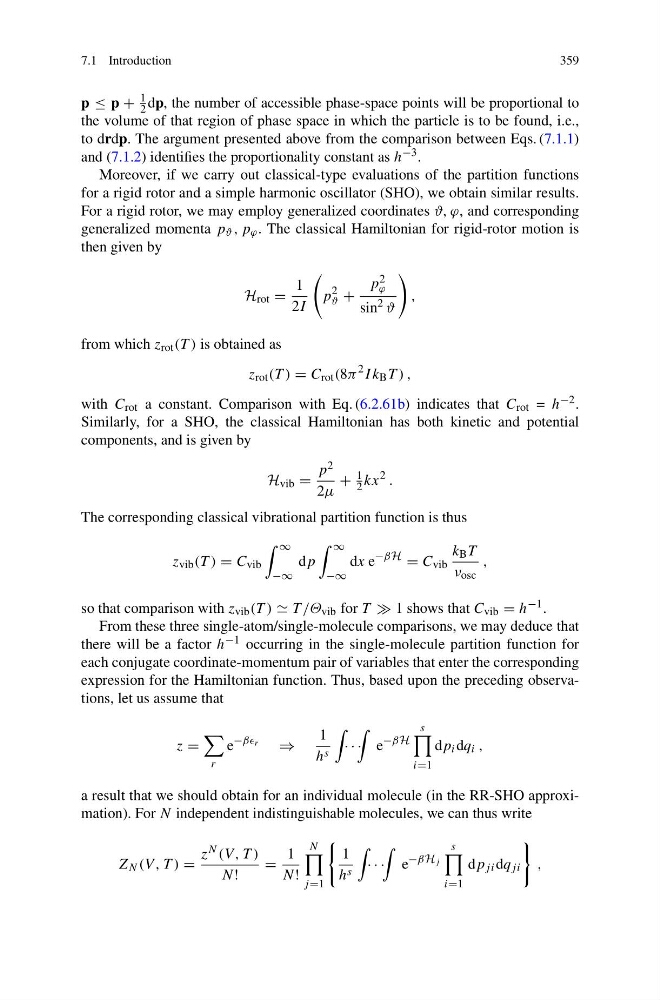
Moreover, if we carry out classical-type evaluations of the partition functions
for a rigid rotor and a simple harmonic oscillator (SHO), we obtain similar results.
For a rigid rotor, we may employ generalized coordinates ϑ, ϕ, and corresponding
generalized momenta p ϑ , p ϕ . The classical Hamiltonian for rigid-rotor motion is
then given by
H rot =
1
2I
p
2
ϑ +
p 2
ϕ
sin
2 ϑ
,
from which z rot (T ) is obtained as
z rot (T ) = C rot (8π
2 I k B T ) ,
with C rot a constant. Comparison with Eq. (6.2.61b) indicates that C rot = h −2 .
Similarly, for a SHO, the classical Hamiltonian has both kinetic and potential
components, and is given by
H vib =
p 2
2μ
+
1
2 kx
2 .
The corresponding classical vibrational partition function is thus
z vib (T ) = C vib
∞
−∞
dp
∞
−∞
dx e
−βH
= C vib
k B T
ν osc
,
so that comparison with z vib (T ) T /Θ vib for T 1 shows that C vib = h −1 .
From these three single-atom/single-molecule comparisons, we may deduce that
there will be a factor h −1 occurring in the single-molecule partition function for
each conjugate coordinate-momentum pair of variables that enter the corresponding
expression for the Hamiltonian function. Thus, based upon the preceding observations, let us assume that
z =
r
e
−ββ r
⇒
1
h s
· · ·
e
−βH
s
i=1
dp i dq i ,
a result that we should obtain for an individual molecule (in the RR-SHO approximation). For N independent indistinguishable molecules, we can thus write
Z N (V , T ) =
z N (V , T )
N!
=
1
N!
N
j =1
1
h s
· · ·
e
−βH j
s
i=1
dp ji dq ji
,
359
p ≤ p +
1
2 dp, the number of accessible phase-space points will be proportional to
the volume of that region of phase space in which the particle is to be found, i.e.,
to drdp. The argument presented above from the comparison between Eqs. (7.1.1)
and (7.1.2) identifies the proportionality constant as h −3 .
Moreover, if we carry out classical-type evaluations of the partition functions
for a rigid rotor and a simple harmonic oscillator (SHO), we obtain similar results.
For a rigid rotor, we may employ generalized coordinates ϑ, ϕ, and corresponding
generalized momenta p ϑ , p ϕ . The classical Hamiltonian for rigid-rotor motion is
then given by
H rot =
1
2I
p
2
ϑ +
p 2
ϕ
sin
2 ϑ
,
from which z rot (T ) is obtained as
z rot (T ) = C rot (8π
2 I k B T ) ,
with C rot a constant. Comparison with Eq. (6.2.61b) indicates that C rot = h −2 .
Similarly, for a SHO, the classical Hamiltonian has both kinetic and potential
components, and is given by
H vib =
p 2
2μ
+
1
2 kx
2 .
The corresponding classical vibrational partition function is thus
z vib (T ) = C vib
∞
−∞
dp
∞
−∞
dx e
−βH
= C vib
k B T
ν osc
,
so that comparison with z vib (T ) T /Θ vib for T 1 shows that C vib = h −1 .
From these three single-atom/single-molecule comparisons, we may deduce that
there will be a factor h −1 occurring in the single-molecule partition function for
each conjugate coordinate-momentum pair of variables that enter the corresponding
expression for the Hamiltonian function. Thus, based upon the preceding observations, let us assume that
z =
r
e
−ββ r
⇒
1
h s
· · ·
e
−βH
s
i=1
dp i dq i ,
a result that we should obtain for an individual molecule (in the RR-SHO approximation). For N independent indistinguishable molecules, we can thus write
Z N (V , T ) =
z N (V , T )
N!
=
1
N!
N
j =1
1
h s
· · ·
e
−βH j
s
i=1
dp ji dq ji
,