

352
6 Molecular Systems
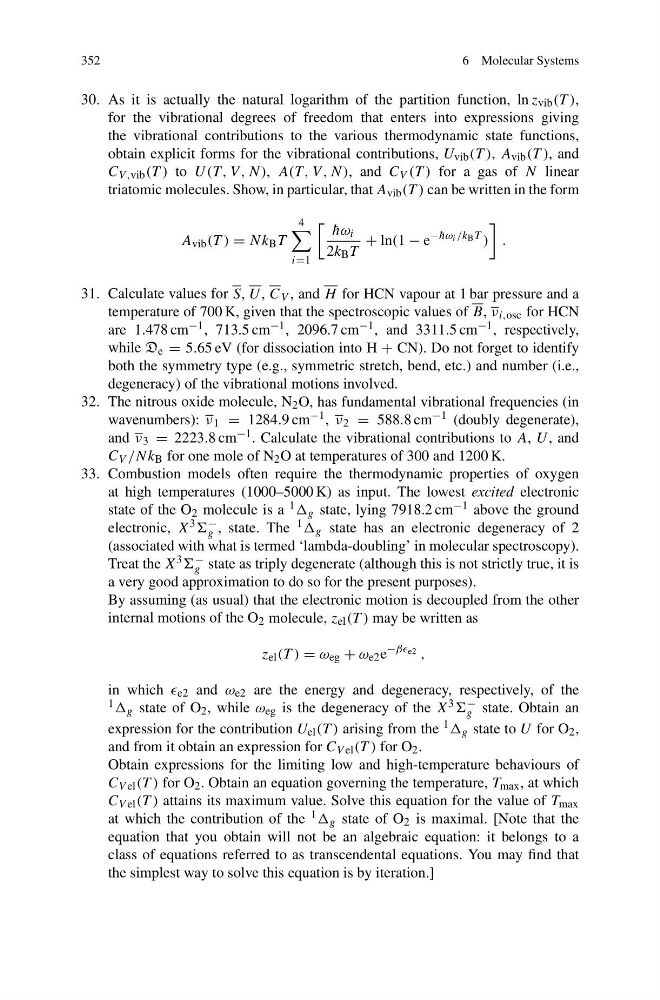
30. As it is actually the natural logarithm of the partition function, ln z vib (T ),
for the vibrational degrees of freedom that enters into expressions giving
the vibrational contributions to the various thermodynamic state functions,
obtain explicit forms for the vibrational contributions, U vib (T ), A vib (T ), and
C V ,vib (T ) to U(T , V , N), A(T , V , N), and C V (T ) for a gas of N linear
triatomic molecules. Show, in particular, that A vib (T ) can be written in the form
A vib (T ) = Nk B T
4
i=1
¯
hω i
2k B T
+ ln(1 − e
−¯ hω i /k B T )
.
31. Calculate values for S, U , C V , and H for HCN vapour at 1 bar pressure and a
temperature of 700 K, given that the spectroscopic values of B, ν i,osc for HCN
are 1.478 cm −1 , 713.5 cm −1 , 2096.7 cm −1 , and 3311.5 cm −1 , respectively,
while D e = 5.65 eV (for dissociation into H + CN). Do not forget to identify
both the symmetry type (e.g., symmetric stretch, bend, etc.) and number (i.e.,
degeneracy) of the vibrational motions involved.
32. The nitrous oxide molecule, N 2 O, has fundamental vibrational frequencies (in
wavenumbers): ν 1 = 1284.9 cm −1 , ν 2 = 588.8 cm −1 (doubly degenerate),
and ν 3 = 2223.8 cm −1 . Calculate the vibrational contributions to A, U , and
C V /N k B for one mole of N 2 O at temperatures of 300 and 1200 K.
33. Combustion models often require the thermodynamic properties of oxygen
at high temperatures (1000–5000 K) as input. The lowest excited electronic
state of the O 2 molecule is a 1 g state, lying 7918.2 cm −1 above the ground
electronic, X 3 −
g , state. The 1 g state has an electronic degeneracy of 2
(associated with what is termed ‘lambda-doubling’ in molecular spectroscopy).
Treat the X 3 −
g state as triply degenerate (although this is not strictly true, it is
a very good approximation to do so for the present purposes).
By assuming (as usual) that the electronic motion is decoupled from the other
internal motions of the O 2 molecule, z el (T ) may be written as
z el (T ) = ω eg + ω e2 e
−ββ e2 ,
in which e2 and ω e2 are the energy and degeneracy, respectively, of the
1 g state of O 2 , while ω eg is the degeneracy of the X 3 −
g state. Obtain an
expression for the contribution U el (T ) arising from the 1 g state to U for O 2 ,
and from it obtain an expression for C V el (T ) for O 2 .
Obtain expressions for the limiting low and high-temperature behaviours of
C V el (T ) for O 2 . Obtain an equation governing the temperature, T max , at which
C V el (T ) attains its maximum value. Solve this equation for the value of T max
at which the contribution of the 1 g state of O 2 is maximal. [Note that the
equation that you obtain will not be an algebraic equation: it belongs to a
class of equations referred to as transcendental equations. You may find that
the simplest way to solve this equation is by iteration.]
6 Molecular Systems
30. As it is actually the natural logarithm of the partition function, ln z vib (T ),
for the vibrational degrees of freedom that enters into expressions giving
the vibrational contributions to the various thermodynamic state functions,
obtain explicit forms for the vibrational contributions, U vib (T ), A vib (T ), and
C V ,vib (T ) to U(T , V , N), A(T , V , N), and C V (T ) for a gas of N linear
triatomic molecules. Show, in particular, that A vib (T ) can be written in the form
A vib (T ) = Nk B T
4
i=1
¯
hω i
2k B T
+ ln(1 − e
−¯ hω i /k B T )
.
31. Calculate values for S, U , C V , and H for HCN vapour at 1 bar pressure and a
temperature of 700 K, given that the spectroscopic values of B, ν i,osc for HCN
are 1.478 cm −1 , 713.5 cm −1 , 2096.7 cm −1 , and 3311.5 cm −1 , respectively,
while D e = 5.65 eV (for dissociation into H + CN). Do not forget to identify
both the symmetry type (e.g., symmetric stretch, bend, etc.) and number (i.e.,
degeneracy) of the vibrational motions involved.
32. The nitrous oxide molecule, N 2 O, has fundamental vibrational frequencies (in
wavenumbers): ν 1 = 1284.9 cm −1 , ν 2 = 588.8 cm −1 (doubly degenerate),
and ν 3 = 2223.8 cm −1 . Calculate the vibrational contributions to A, U , and
C V /N k B for one mole of N 2 O at temperatures of 300 and 1200 K.
33. Combustion models often require the thermodynamic properties of oxygen
at high temperatures (1000–5000 K) as input. The lowest excited electronic
state of the O 2 molecule is a 1 g state, lying 7918.2 cm −1 above the ground
electronic, X 3 −
g , state. The 1 g state has an electronic degeneracy of 2
(associated with what is termed ‘lambda-doubling’ in molecular spectroscopy).
Treat the X 3 −
g state as triply degenerate (although this is not strictly true, it is
a very good approximation to do so for the present purposes).
By assuming (as usual) that the electronic motion is decoupled from the other
internal motions of the O 2 molecule, z el (T ) may be written as
z el (T ) = ω eg + ω e2 e
−ββ e2 ,
in which e2 and ω e2 are the energy and degeneracy, respectively, of the
1 g state of O 2 , while ω eg is the degeneracy of the X 3 −
g state. Obtain an
expression for the contribution U el (T ) arising from the 1 g state to U for O 2 ,
and from it obtain an expression for C V el (T ) for O 2 .
Obtain expressions for the limiting low and high-temperature behaviours of
C V el (T ) for O 2 . Obtain an equation governing the temperature, T max , at which
C V el (T ) attains its maximum value. Solve this equation for the value of T max
at which the contribution of the 1 g state of O 2 is maximal. [Note that the
equation that you obtain will not be an algebraic equation: it belongs to a
class of equations referred to as transcendental equations. You may find that
the simplest way to solve this equation is by iteration.]