

348
6 Molecular Systems
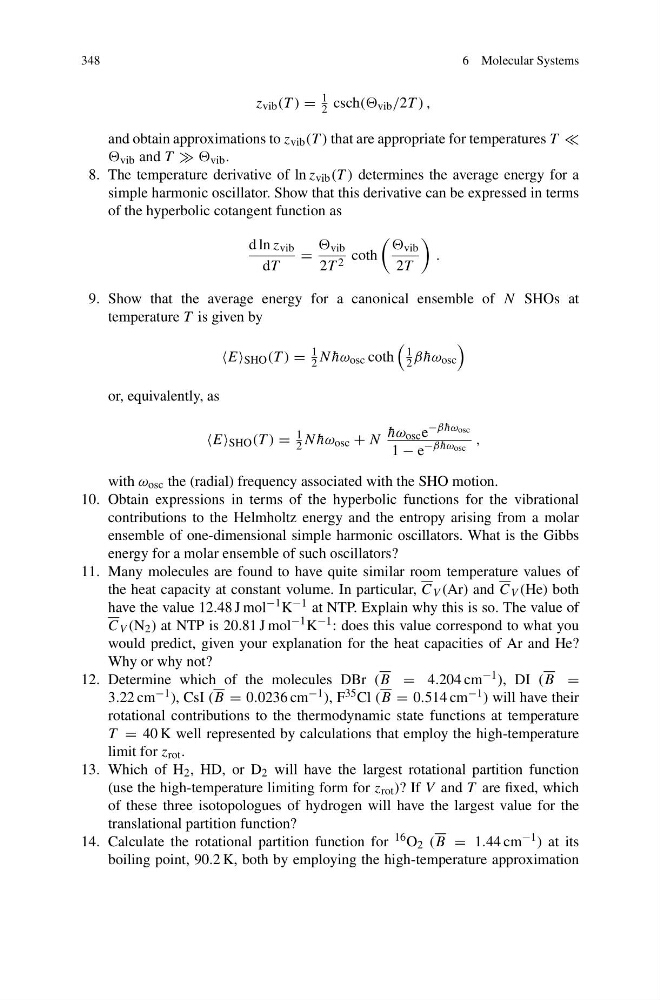
z vib (T ) =
1
2 csch(( vib /2T ) ,
and obtain approximations to z vib (T ) that are appropriate for temperatures T
vib and T vib .
8. The temperature derivative of ln z vib (T ) determines the average energy for a
simple harmonic oscillator. Show that this derivative can be expressed in terms
of the hyperbolic cotangent function as
d ln z vib
dT
=
vib
2T 2 coth
vib
2T
.
9. Show that the average energy for a canonical ensemble of N SHOs at
temperature T is given by
E SHO (T ) =
1
2 N ¯
hω osc coth
1
2 β ¯
hω osc
or, equivalently, as
E SHO (T ) =
1
2 N ¯
hω osc + N ¯
hω osc e
−β ¯
hω osc
1 − e
−β ¯
hω osc
,
with ω osc the (radial) frequency associated with the SHO motion.
10. Obtain expressions in terms of the hyperbolic functions for the vibrational
contributions to the Helmholtz energy and the entropy arising from a molar
ensemble of one-dimensional simple harmonic oscillators. What is the Gibbs
energy for a molar ensemble of such oscillators?
11. Many molecules are found to have quite similar room temperature values of
the heat capacity at constant volume. In particular, C V (Ar) and C V (He) both
have the value 12.48 J mol
−1 K −1 at NTP. Explain why this is so. The value of
C V (N 2 ) at NTP is 20.81 J mol
−1 K −1 : does this value correspond to what you
would predict, given your explanation for the heat capacities of Ar and He?
Why or why not?
12. Determine which of the molecules DBr (B = 4.204 cm −1 ), DI (B =
3.22 cm −1 ), CsI (B = 0.0236 cm −1 ), F 35 Cl (B = 0.514 cm −1 ) will have their
rotational contributions to the thermodynamic state functions at temperature
T = 40 K well represented by calculations that employ the high-temperature
limit for z rot .
13. Which of H 2 , HD, or D 2 will have the largest rotational partition function
(use the high-temperature limiting form for z rot )? If V and T are fixed, which
of these three isotopologues of hydrogen will have the largest value for the
translational partition function?
14. Calculate the rotational partition function for 16 O 2 (B = 1.44 cm −1 ) at its
boiling point, 90.2 K, both by employing the high-temperature approximation
6 Molecular Systems
z vib (T ) =
1
2 csch(( vib /2T ) ,
and obtain approximations to z vib (T ) that are appropriate for temperatures T
vib and T vib .
8. The temperature derivative of ln z vib (T ) determines the average energy for a
simple harmonic oscillator. Show that this derivative can be expressed in terms
of the hyperbolic cotangent function as
d ln z vib
dT
=
vib
2T 2 coth
vib
2T
.
9. Show that the average energy for a canonical ensemble of N SHOs at
temperature T is given by
E SHO (T ) =
1
2 N ¯
hω osc coth
1
2 β ¯
hω osc
or, equivalently, as
E SHO (T ) =
1
2 N ¯
hω osc + N ¯
hω osc e
−β ¯
hω osc
1 − e
−β ¯
hω osc
,
with ω osc the (radial) frequency associated with the SHO motion.
10. Obtain expressions in terms of the hyperbolic functions for the vibrational
contributions to the Helmholtz energy and the entropy arising from a molar
ensemble of one-dimensional simple harmonic oscillators. What is the Gibbs
energy for a molar ensemble of such oscillators?
11. Many molecules are found to have quite similar room temperature values of
the heat capacity at constant volume. In particular, C V (Ar) and C V (He) both
have the value 12.48 J mol
−1 K −1 at NTP. Explain why this is so. The value of
C V (N 2 ) at NTP is 20.81 J mol
−1 K −1 : does this value correspond to what you
would predict, given your explanation for the heat capacities of Ar and He?
Why or why not?
12. Determine which of the molecules DBr (B = 4.204 cm −1 ), DI (B =
3.22 cm −1 ), CsI (B = 0.0236 cm −1 ), F 35 Cl (B = 0.514 cm −1 ) will have their
rotational contributions to the thermodynamic state functions at temperature
T = 40 K well represented by calculations that employ the high-temperature
limit for z rot .
13. Which of H 2 , HD, or D 2 will have the largest rotational partition function
(use the high-temperature limiting form for z rot )? If V and T are fixed, which
of these three isotopologues of hydrogen will have the largest value for the
translational partition function?
14. Calculate the rotational partition function for 16 O 2 (B = 1.44 cm −1 ) at its
boiling point, 90.2 K, both by employing the high-temperature approximation