

6.6 Effect of Hindered Rotational Motions
343
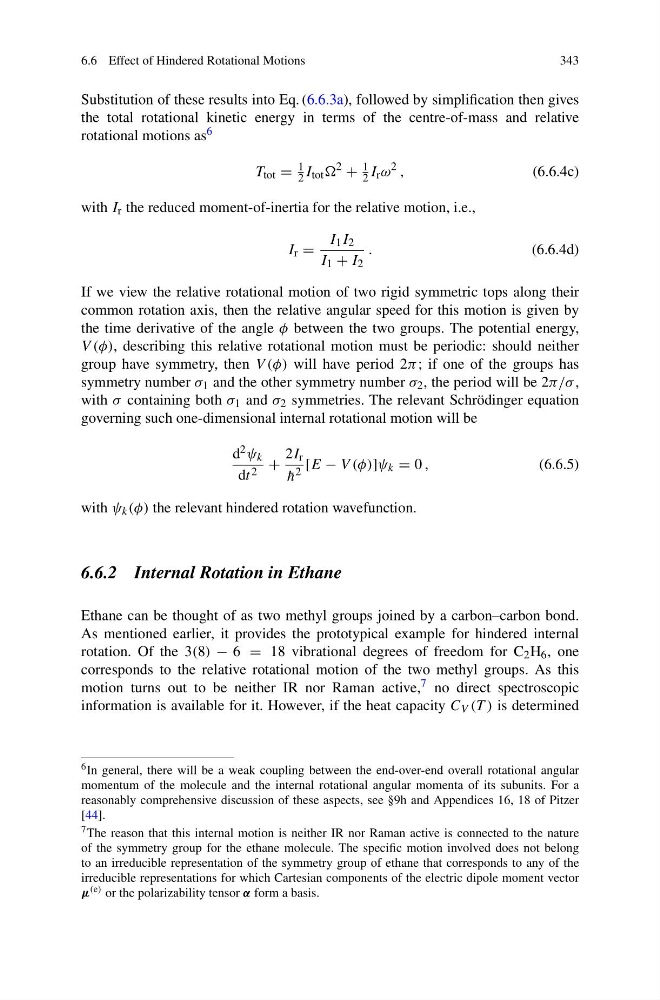
Substitution of these results into Eq. (6.6.3a), followed by simplification then gives
the total rotational kinetic energy in terms of the centre-of-mass and relative
rotational motions as 6
T tot =
1
2 I tot
2
+
1
2 I r ω
2 ,
(6.6.4c)
with I r the reduced moment-of-inertia for the relative motion, i.e.,
I r =
I 1 I 2
I 1 + I 2
.
(6.6.4d)
If we view the relative rotational motion of two rigid symmetric tops along their
common rotation axis, then the relative angular speed for this motion is given by
the time derivative of the angle φ between the two groups. The potential energy,
V (φ), describing this relative rotational motion must be periodic: should neither
group have symmetry, then V (φ) will have period 2π ; if one of the groups has
symmetry number σ 1 and the other symmetry number σ 2 , the period will be 2π/σ ,
with σ containing both σ 1 and σ 2 symmetries. The relevant Schrödinger equation
governing such one-dimensional internal rotational motion will be
d 2 ψ k
dt 2 +
2I r
¯
h 2 [E − V (φ)]ψ k = 0 ,
(6.6.5)
with ψ k (φ) the relevant hindered rotation wavefunction.
6.6.2 Internal Rotation in Ethane
Ethane can be thought of as two methyl groups joined by a carbon–carbon bond.
As mentioned earlier, it provides the prototypical example for hindered internal
rotation. Of the 3(8) − 6 = 18 vibrational degrees of freedom for C 2 H 6 , one
corresponds to the relative rotational motion of the two methyl groups. As this
motion turns out to be neither IR nor Raman active, 7 no direct spectroscopic
information is available for it. However, if the heat capacity C V (T ) is determined
6 In general, there will be a weak coupling between the end-over-end overall rotational angular
momentum of the molecule and the internal rotational angular momenta of its subunits. For a
reasonably comprehensive discussion of these aspects, see §9h and Appendices 16, 18 of Pitzer
[44].
7 The reason that this internal motion is neither IR nor Raman active is connected to the nature
of the symmetry group for the ethane molecule. The specific motion involved does not belong
to an irreducible representation of the symmetry group of ethane that corresponds to any of the
irreducible representations for which Cartesian components of the electric dipole moment vector
μ (e) or the polarizability tensor α form a basis.
343
Substitution of these results into Eq. (6.6.3a), followed by simplification then gives
the total rotational kinetic energy in terms of the centre-of-mass and relative
rotational motions as 6
T tot =
1
2 I tot
2
+
1
2 I r ω
2 ,
(6.6.4c)
with I r the reduced moment-of-inertia for the relative motion, i.e.,
I r =
I 1 I 2
I 1 + I 2
.
(6.6.4d)
If we view the relative rotational motion of two rigid symmetric tops along their
common rotation axis, then the relative angular speed for this motion is given by
the time derivative of the angle φ between the two groups. The potential energy,
V (φ), describing this relative rotational motion must be periodic: should neither
group have symmetry, then V (φ) will have period 2π ; if one of the groups has
symmetry number σ 1 and the other symmetry number σ 2 , the period will be 2π/σ ,
with σ containing both σ 1 and σ 2 symmetries. The relevant Schrödinger equation
governing such one-dimensional internal rotational motion will be
d 2 ψ k
dt 2 +
2I r
¯
h 2 [E − V (φ)]ψ k = 0 ,
(6.6.5)
with ψ k (φ) the relevant hindered rotation wavefunction.
6.6.2 Internal Rotation in Ethane
Ethane can be thought of as two methyl groups joined by a carbon–carbon bond.
As mentioned earlier, it provides the prototypical example for hindered internal
rotation. Of the 3(8) − 6 = 18 vibrational degrees of freedom for C 2 H 6 , one
corresponds to the relative rotational motion of the two methyl groups. As this
motion turns out to be neither IR nor Raman active, 7 no direct spectroscopic
information is available for it. However, if the heat capacity C V (T ) is determined
6 In general, there will be a weak coupling between the end-over-end overall rotational angular
momentum of the molecule and the internal rotational angular momenta of its subunits. For a
reasonably comprehensive discussion of these aspects, see §9h and Appendices 16, 18 of Pitzer
[44].
7 The reason that this internal motion is neither IR nor Raman active is connected to the nature
of the symmetry group for the ethane molecule. The specific motion involved does not belong
to an irreducible representation of the symmetry group of ethane that corresponds to any of the
irreducible representations for which Cartesian components of the electric dipole moment vector
μ (e) or the polarizability tensor α form a basis.