

340
6 Molecular Systems
(iv) under ordinary conditions the interaction of non-adjacent molecules is not such
as to appreciably stabilize any one of the many configurations satisfying the
first three conditions with reference to the others.
An ice crystal can change from one configuration to another by rotation of some
of the molecules or by the motion of some of the hydrogen nuclei, each moving
a distance of about 0.86 Å from a potential minimum 0.95 Å from one O atom
to another potential minimum situated a distance 0.95 Å from another adjacent
O atom. It is likely that both processes occur. We shall designate the number of
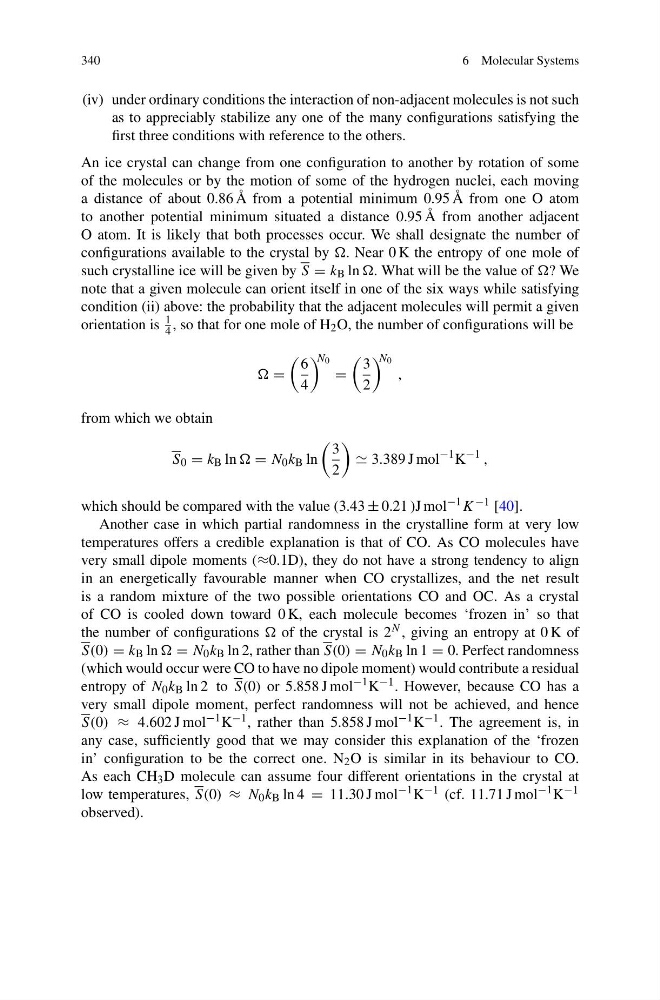
configurations available to the crystal by . Near 0 K the entropy of one mole of
such crystalline ice will be given by S = k B ln . What will be the value of ? We
note that a given molecule can orient itself in one of the six ways while satisfying
condition (ii) above: the probability that the adjacent molecules will permit a given
orientation is
1
4 , so that for one mole of H 2 O, the number of configurations will be
=
6
4
N 0
=
3
2
N 0
,
from which we obtain
S 0 = k B ln = N 0 k B ln
3
2
3.389 J mol
−1 K
−1 ,
which should be compared with the value (3.43 ± 0.21 )J mol
−1 K −1 [40].
Another case in which partial randomness in the crystalline form at very low
temperatures offers a credible explanation is that of CO. As CO molecules have
very small dipole moments (≈0.1D), they do not have a strong tendency to align
in an energetically favourable manner when CO crystallizes, and the net result
is a random mixture of the two possible orientations CO and OC. As a crystal
of CO is cooled down toward 0 K, each molecule becomes ‘frozen in’ so that
the number of configurations of the crystal is 2 N , giving an entropy at 0 K of
S(0) = k B ln = N 0 k B ln 2, rather than S(0) = N 0 k B ln 1 = 0. Perfect randomness
(which would occur were CO to have no dipole moment) would contribute a residual
entropy of N 0 k B ln 2 to S(0) or 5.858 J mol
−1 K −1 . However, because CO has a
very small dipole moment, perfect randomness will not be achieved, and hence
S(0) ≈ 4.602 J mol
−1 K −1 , rather than 5.858 J mol
−1 K −1 . The agreement is, in
any case, sufficiently good that we may consider this explanation of the ‘frozen
in’ configuration to be the correct one. N 2 O is similar in its behaviour to CO.
As each CH 3 D molecule can assume four different orientations in the crystal at
low temperatures, S(0) ≈ N 0 k B ln 4 = 11.30 J mol
−1 K −1 (cf. 11.71 J mol
−1 K −1
observed).
6 Molecular Systems
(iv) under ordinary conditions the interaction of non-adjacent molecules is not such
as to appreciably stabilize any one of the many configurations satisfying the
first three conditions with reference to the others.
An ice crystal can change from one configuration to another by rotation of some
of the molecules or by the motion of some of the hydrogen nuclei, each moving
a distance of about 0.86 Å from a potential minimum 0.95 Å from one O atom
to another potential minimum situated a distance 0.95 Å from another adjacent
O atom. It is likely that both processes occur. We shall designate the number of
configurations available to the crystal by . Near 0 K the entropy of one mole of
such crystalline ice will be given by S = k B ln . What will be the value of ? We
note that a given molecule can orient itself in one of the six ways while satisfying
condition (ii) above: the probability that the adjacent molecules will permit a given
orientation is
1
4 , so that for one mole of H 2 O, the number of configurations will be
=
6
4
N 0
=
3
2
N 0
,
from which we obtain
S 0 = k B ln = N 0 k B ln
3
2
3.389 J mol
−1 K
−1 ,
which should be compared with the value (3.43 ± 0.21 )J mol
−1 K −1 [40].
Another case in which partial randomness in the crystalline form at very low
temperatures offers a credible explanation is that of CO. As CO molecules have
very small dipole moments (≈0.1D), they do not have a strong tendency to align
in an energetically favourable manner when CO crystallizes, and the net result
is a random mixture of the two possible orientations CO and OC. As a crystal
of CO is cooled down toward 0 K, each molecule becomes ‘frozen in’ so that
the number of configurations of the crystal is 2 N , giving an entropy at 0 K of
S(0) = k B ln = N 0 k B ln 2, rather than S(0) = N 0 k B ln 1 = 0. Perfect randomness
(which would occur were CO to have no dipole moment) would contribute a residual
entropy of N 0 k B ln 2 to S(0) or 5.858 J mol
−1 K −1 . However, because CO has a
very small dipole moment, perfect randomness will not be achieved, and hence
S(0) ≈ 4.602 J mol
−1 K −1 , rather than 5.858 J mol
−1 K −1 . The agreement is, in
any case, sufficiently good that we may consider this explanation of the ‘frozen
in’ configuration to be the correct one. N 2 O is similar in its behaviour to CO.
As each CH 3 D molecule can assume four different orientations in the crystal at
low temperatures, S(0) ≈ N 0 k B ln 4 = 11.30 J mol
−1 K −1 (cf. 11.71 J mol
−1 K −1
observed).