

336
6 Molecular Systems
z rot−nuc (T ) =
(2I a + 1) 4
12
∞
j =0
(2j + 1)
2 e
−αj (j +1)
+
(2I a + 1) 2
4
∞
j =0
(−1)
j (2j + 1)e
−αj (j +1)
+
4(2I a + 1) 2
3
√
3
∞
j =0
(2j + 1) sin
(2j + 1)π
3
e
−αj (j +1) .
(6.4.8)
It will be clear from this expression for z rot−nuc (T ) that it will not lead to a simple
intensity alternation pattern of the type that we obtained for centrosymmetric linear
molecules. The intensity pattern will be quite subtle, and it will likely be difficult
to obtain spectra with sufficiently well-determined absolute intensities for much to
be learned from them. In any case, such deliberations lie beyond the scope of the
present discussion.
6.5 Third-Law Entropy and Residual Entropy
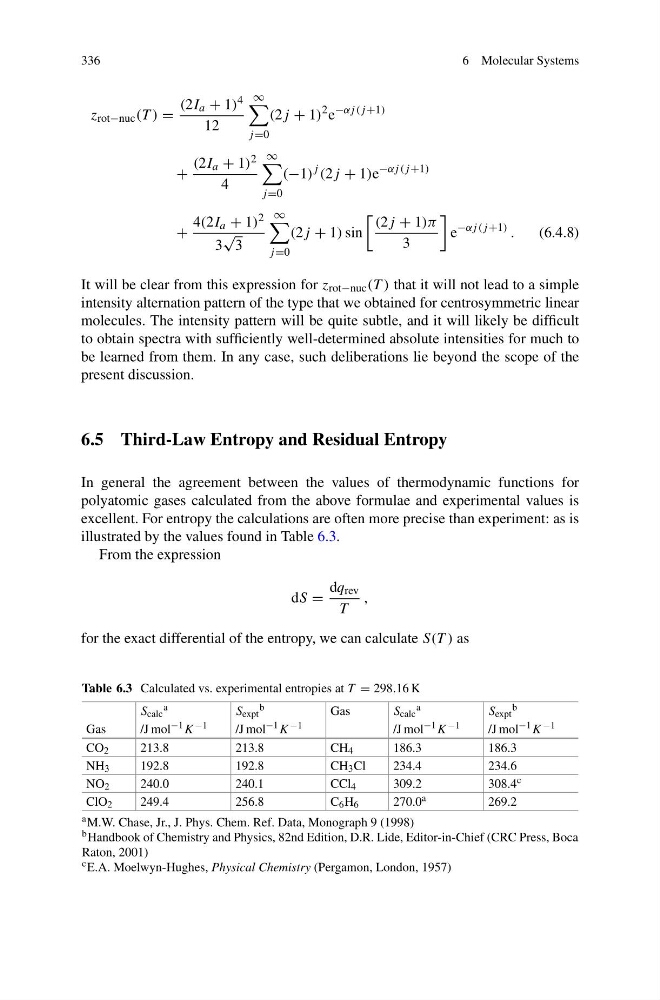
In general the agreement between the values of thermodynamic functions for
polyatomic gases calculated from the above formulae and experimental values is
excellent. For entropy the calculations are often more precise than experiment: as is
illustrated by the values found in Table 6.3.
From the expression
dS =
dq rev
T
,
for the exact differential of the entropy, we can calculate S(T ) as
Table 6.3 Calculated vs. experimental entropies at T = 298.16 K
S calc
a
S expt
b
Gas
S calc
a
S expt
b
Gas
/J mol
−1 K −1
/J mol
−1 K −1
/J mol
−1 K −1
/J mol
−1 K −1
CO 2
213.8
213.8
CH 4
186.3
186.3
NH 3
192.8
192.8
CH 3 Cl
234.4
234.6
NO 2
240.0
240.1
CCl 4
309.2
308.4 c
ClO 2
249.4
256.8
C 6 H 6
270.0 a
269.2
a M.W. Chase, Jr., J. Phys. Chem. Ref. Data, Monograph 9 (1998)
b Handbook of Chemistry and Physics, 82nd Edition, D.R. Lide, Editor-in-Chief (CRC Press, Boca
Raton, 2001)
c E.A. Moelwyn-Hughes, Physical Chemistry (Pergamon, London, 1957)
6 Molecular Systems
z rot−nuc (T ) =
(2I a + 1) 4
12
∞
j =0
(2j + 1)
2 e
−αj (j +1)
+
(2I a + 1) 2
4
∞
j =0
(−1)
j (2j + 1)e
−αj (j +1)
+
4(2I a + 1) 2
3
√
3
∞
j =0
(2j + 1) sin
(2j + 1)π
3
e
−αj (j +1) .
(6.4.8)
It will be clear from this expression for z rot−nuc (T ) that it will not lead to a simple
intensity alternation pattern of the type that we obtained for centrosymmetric linear
molecules. The intensity pattern will be quite subtle, and it will likely be difficult
to obtain spectra with sufficiently well-determined absolute intensities for much to
be learned from them. In any case, such deliberations lie beyond the scope of the
present discussion.
6.5 Third-Law Entropy and Residual Entropy
In general the agreement between the values of thermodynamic functions for
polyatomic gases calculated from the above formulae and experimental values is
excellent. For entropy the calculations are often more precise than experiment: as is
illustrated by the values found in Table 6.3.
From the expression
dS =
dq rev
T
,
for the exact differential of the entropy, we can calculate S(T ) as
Table 6.3 Calculated vs. experimental entropies at T = 298.16 K
S calc
a
S expt
b
Gas
S calc
a
S expt
b
Gas
/J mol
−1 K −1
/J mol
−1 K −1
/J mol
−1 K −1
/J mol
−1 K −1
CO 2
213.8
213.8
CH 4
186.3
186.3
NH 3
192.8
192.8
CH 3 Cl
234.4
234.6
NO 2
240.0
240.1
CCl 4
309.2
308.4 c
ClO 2
249.4
256.8
C 6 H 6
270.0 a
269.2
a M.W. Chase, Jr., J. Phys. Chem. Ref. Data, Monograph 9 (1998)
b Handbook of Chemistry and Physics, 82nd Edition, D.R. Lide, Editor-in-Chief (CRC Press, Boca
Raton, 2001)
c E.A. Moelwyn-Hughes, Physical Chemistry (Pergamon, London, 1957)