

6.4 Molecular Spectra: Nuclear Spin Effects
321
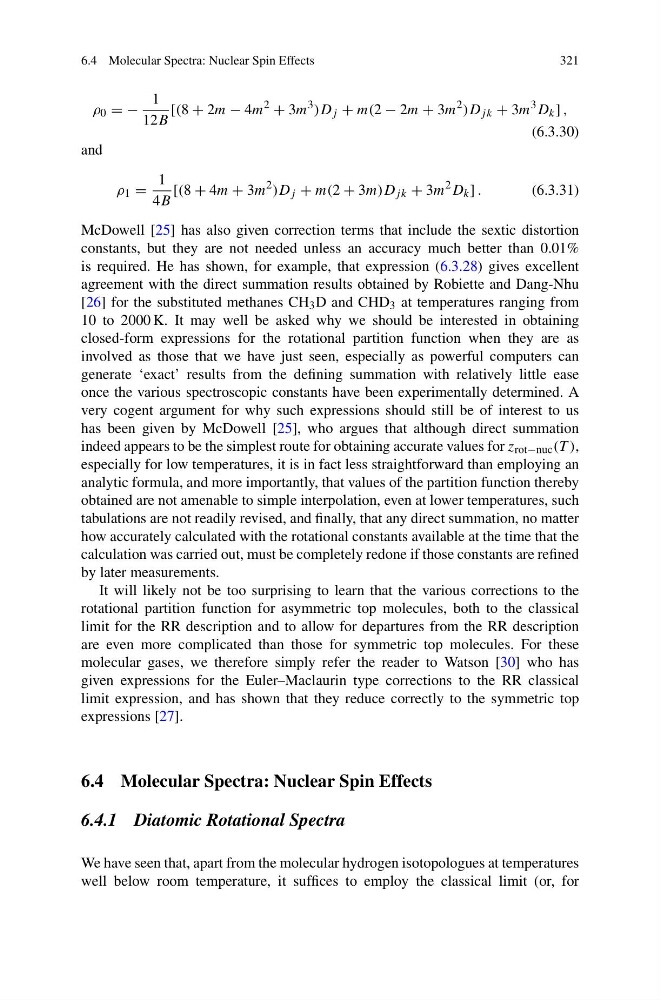
ρ 0 = −
1
12B
[(8 + 2m − 4m
2
+ 3m
3 )D j + m(2 − 2m + 3m
2 )D jk + 3m
3 D k ] ,
(6.3.30)
and
ρ 1 =
1
4B
[(8 + 4m + 3m
2 )D j + m(2 + 3m)D jk + 3m
2 D k ] .
(6.3.31)
McDowell [25] has also given correction terms that include the sextic distortion
constants, but they are not needed unless an accuracy much better than 0.01%
is required. He has shown, for example, that expression (6.3.28) gives excellent
agreement with the direct summation results obtained by Robiette and Dang-Nhu
[26] for the substituted methanes CH 3 D and CHD 3 at temperatures ranging from
10 to 2000 K. It may well be asked why we should be interested in obtaining
closed-form expressions for the rotational partition function when they are as
involved as those that we have just seen, especially as powerful computers can
generate ‘exact’ results from the defining summation with relatively little ease
once the various spectroscopic constants have been experimentally determined. A
very cogent argument for why such expressions should still be of interest to us
has been given by McDowell [25], who argues that although direct summation
indeed appears to be the simplest route for obtaining accurate values for z rot−nuc (T ),
especially for low temperatures, it is in fact less straightforward than employing an
analytic formula, and more importantly, that values of the partition function thereby
obtained are not amenable to simple interpolation, even at lower temperatures, such
tabulations are not readily revised, and finally, that any direct summation, no matter
how accurately calculated with the rotational constants available at the time that the
calculation was carried out, must be completely redone if those constants are refined
by later measurements.
It will likely not be too surprising to learn that the various corrections to the
rotational partition function for asymmetric top molecules, both to the classical
limit for the RR description and to allow for departures from the RR description
are even more complicated than those for symmetric top molecules. For these
molecular gases, we therefore simply refer the reader to Watson [30] who has
given expressions for the Euler–Maclaurin type corrections to the RR classical
limit expression, and has shown that they reduce correctly to the symmetric top
expressions [27].
6.4 Molecular Spectra: Nuclear Spin Effects
6.4.1 Diatomic Rotational Spectra
We have seen that, apart from the molecular hydrogen isotopologues at temperatures
well below room temperature, it suffices to employ the classical limit (or, for
321
ρ 0 = −
1
12B
[(8 + 2m − 4m
2
+ 3m
3 )D j + m(2 − 2m + 3m
2 )D jk + 3m
3 D k ] ,
(6.3.30)
and
ρ 1 =
1
4B
[(8 + 4m + 3m
2 )D j + m(2 + 3m)D jk + 3m
2 D k ] .
(6.3.31)
McDowell [25] has also given correction terms that include the sextic distortion
constants, but they are not needed unless an accuracy much better than 0.01%
is required. He has shown, for example, that expression (6.3.28) gives excellent
agreement with the direct summation results obtained by Robiette and Dang-Nhu
[26] for the substituted methanes CH 3 D and CHD 3 at temperatures ranging from
10 to 2000 K. It may well be asked why we should be interested in obtaining
closed-form expressions for the rotational partition function when they are as
involved as those that we have just seen, especially as powerful computers can
generate ‘exact’ results from the defining summation with relatively little ease
once the various spectroscopic constants have been experimentally determined. A
very cogent argument for why such expressions should still be of interest to us
has been given by McDowell [25], who argues that although direct summation
indeed appears to be the simplest route for obtaining accurate values for z rot−nuc (T ),
especially for low temperatures, it is in fact less straightforward than employing an
analytic formula, and more importantly, that values of the partition function thereby
obtained are not amenable to simple interpolation, even at lower temperatures, such
tabulations are not readily revised, and finally, that any direct summation, no matter
how accurately calculated with the rotational constants available at the time that the
calculation was carried out, must be completely redone if those constants are refined
by later measurements.
It will likely not be too surprising to learn that the various corrections to the
rotational partition function for asymmetric top molecules, both to the classical
limit for the RR description and to allow for departures from the RR description
are even more complicated than those for symmetric top molecules. For these
molecular gases, we therefore simply refer the reader to Watson [30] who has
given expressions for the Euler–Maclaurin type corrections to the RR classical
limit expression, and has shown that they reduce correctly to the symmetric top
expressions [27].
6.4 Molecular Spectra: Nuclear Spin Effects
6.4.1 Diatomic Rotational Spectra
We have seen that, apart from the molecular hydrogen isotopologues at temperatures
well below room temperature, it suffices to employ the classical limit (or, for