

306
6 Molecular Systems
6.2.5 Overall Summary for Diatomic Molecules
The thermodynamic functions for the most commonly occurring case are given
below. This case is for translational and rotational degrees of freedom fully excited,
so that they can be treated classically, the vibrational mode treated quantum
mechanically, and electronic degrees of freedom unexcited (i.e., all molecules are in
the ground electronic state). Characteristic energy differences associated with two
adjacent energy levels for each of the types of motion mentioned above are given by
tr ∼ 10 −18 eV, ,, rot ∼ 10 −4 eV
vib ∼ 10 −1 eV, ,, el ∼ 5 eV
cf. k B T ∼ 10
−2 eV for T ∼ 300 K.
Basically, we may treat the degrees of freedom for a particular motion classically
when the energy level separations associated with them are small in comparison with
k B T , i.e., k B T . Unexcited implies that k B T ; otherwise, the degrees
of freedom must be treated quantum mechanically. For the set of characteristic
energy values listed above this means that we can treat the translational and
rotational degrees of freedom classically, the vibrational degree of freedom quantum
mechanically, and the electronic degrees of freedom as unexcited. Such a procedure
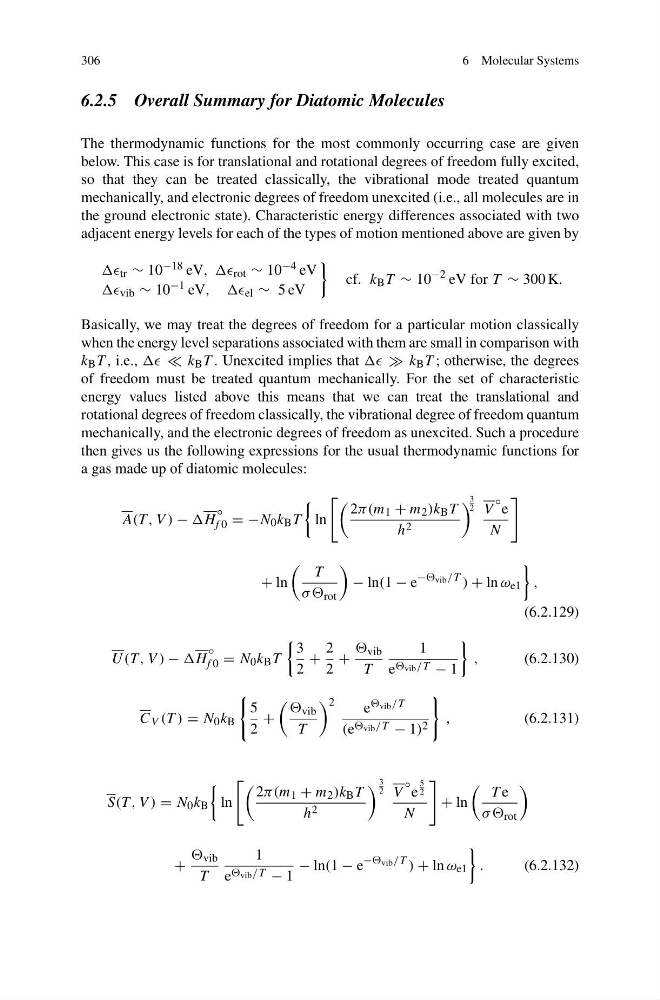
then gives us the following expressions for the usual thermodynamic functions for
a gas made up of diatomic molecules:
A(T , V ) − H
◦
f 0 = −N 0 k B T
ln
2π(m 1 + m 2 )k B T
h 2
3
2 V
◦ e
N
+ ln
T
σ σ rot
− ln(1 − e
− vib /T ) + ln ω e1
,
(6.2.129)
U(T , V ) − H
◦
f 0 = N 0 k B T
3
2
+
2
2
+
vib
T
1
e vib /T − 1
,
(6.2.130)
C V (T ) = N 0 k B
5
2
+
vib
T
2
e vib /T
(e vib /T − 1) 2
,
(6.2.131)
S(T , V ) = N 0 k B
ln
2π(m 1 + m 2 )k B T
h 2
3
2 V
◦ e
5
2
N
+ ln
T e
σ σ rot
+
vib
T
1
e vib /T − 1
− ln(1 − e
− vib /T ) + ln ω e1
.
(6.2.132)
6 Molecular Systems
6.2.5 Overall Summary for Diatomic Molecules
The thermodynamic functions for the most commonly occurring case are given
below. This case is for translational and rotational degrees of freedom fully excited,
so that they can be treated classically, the vibrational mode treated quantum
mechanically, and electronic degrees of freedom unexcited (i.e., all molecules are in
the ground electronic state). Characteristic energy differences associated with two
adjacent energy levels for each of the types of motion mentioned above are given by
tr ∼ 10 −18 eV, ,, rot ∼ 10 −4 eV
vib ∼ 10 −1 eV, ,, el ∼ 5 eV
cf. k B T ∼ 10
−2 eV for T ∼ 300 K.
Basically, we may treat the degrees of freedom for a particular motion classically
when the energy level separations associated with them are small in comparison with
k B T , i.e., k B T . Unexcited implies that k B T ; otherwise, the degrees
of freedom must be treated quantum mechanically. For the set of characteristic
energy values listed above this means that we can treat the translational and
rotational degrees of freedom classically, the vibrational degree of freedom quantum
mechanically, and the electronic degrees of freedom as unexcited. Such a procedure
then gives us the following expressions for the usual thermodynamic functions for
a gas made up of diatomic molecules:
A(T , V ) − H
◦
f 0 = −N 0 k B T
ln
2π(m 1 + m 2 )k B T
h 2
3
2 V
◦ e
N
+ ln
T
σ σ rot
− ln(1 − e
− vib /T ) + ln ω e1
,
(6.2.129)
U(T , V ) − H
◦
f 0 = N 0 k B T
3
2
+
2
2
+
vib
T
1
e vib /T − 1
,
(6.2.130)
C V (T ) = N 0 k B
5
2
+
vib
T
2
e vib /T
(e vib /T − 1) 2
,
(6.2.131)
S(T , V ) = N 0 k B
ln
2π(m 1 + m 2 )k B T
h 2
3
2 V
◦ e
5
2
N
+ ln
T e
σ σ rot
+
vib
T
1
e vib /T − 1
− ln(1 − e
− vib /T ) + ln ω e1
.
(6.2.132)