

6.2 Diatomic Molecules
279
Θ
0.0
0.5
1.0
1.5
2.0
2.5
3.0
3.5
4.0
0.0
0.2
0.4
0.6
0.8
1.0
1.2
(01,10)
(12,21)
(03,30)
(13,31)
(02,20)
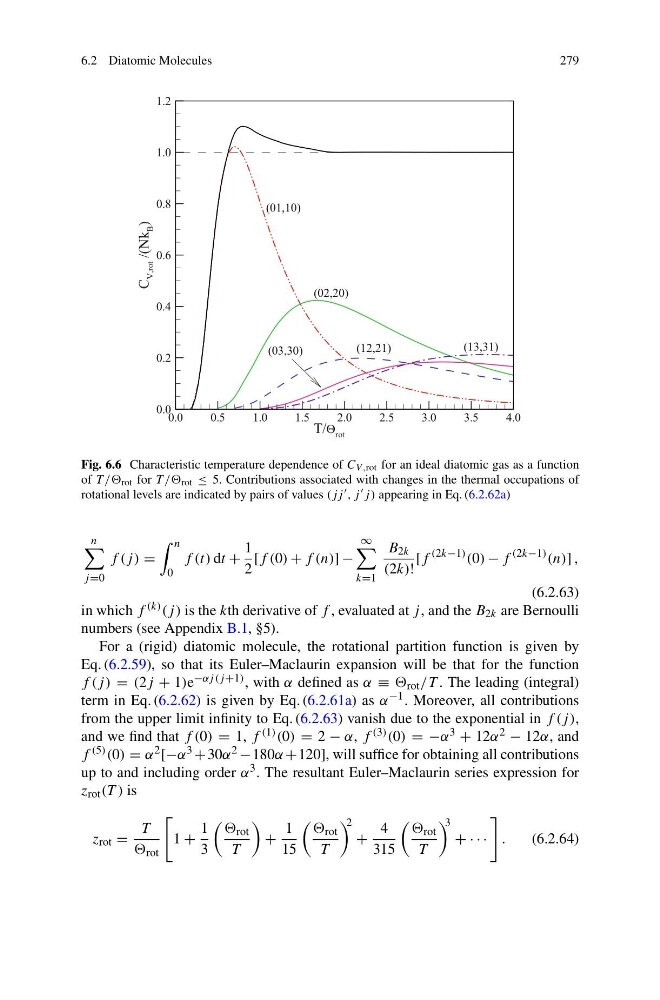
Fig. 6.6 Characteristic temperature dependence of C V ,rot for an ideal diatomic gas as a function
of T // rot for T // rot ≤ 5. Contributions associated with changes in the thermal occupations of
rotational levels are indicated by pairs of values (jj , j j) appearing in Eq. (6.2.62a)
n
j =0
f (j) =
n
0
f (t) dt +
1
2
[f (0) + f (n)] −
∞
k=1
B 2k
(2k)!
[f
(2k−1) (0) − f
(2k−1) (n)] ,
(6.2.63)
in which f (k) (j ) is the kth derivative of f , evaluated at j , and the B 2k are Bernoulli
numbers (see Appendix B.1, §5).
For a (rigid) diatomic molecule, the rotational partition function is given by
Eq. (6.2.59), so that its Euler–Maclaurin expansion will be that for the function
f (j) = (2j + 1)e −αj (j +1) , with α defined as α ≡ rot /T . The leading (integral)
term in Eq. (6.2.62) is given by Eq. (6.2.61a) as α −1 . Moreover, all contributions
from the upper limit infinity to Eq. (6.2.63) vanish due to the exponential in f (j),
and we find that f (0) = 1, f (1) (0) = 2 − α, f (3) (0) = −α 3 + 12α 2 − 12α, and
f (5) (0) = α 2 [−α 3 +30α 2 −180α +120], will suffice for obtaining all contributions
up to and including order α 3 . The resultant Euler–Maclaurin series expression for
z rot (T ) is
z rot =
T
rot
1 +
1
3
rot
T
+
1
15
rot
T
2
+
4
315
rot
T
3
+ · · ·
.
(6.2.64)
279
Θ
0.0
0.5
1.0
1.5
2.0
2.5
3.0
3.5
4.0
0.0
0.2
0.4
0.6
0.8
1.0
1.2
(01,10)
(12,21)
(03,30)
(13,31)
(02,20)
Fig. 6.6 Characteristic temperature dependence of C V ,rot for an ideal diatomic gas as a function
of T // rot for T // rot ≤ 5. Contributions associated with changes in the thermal occupations of
rotational levels are indicated by pairs of values (jj , j j) appearing in Eq. (6.2.62a)
n
j =0
f (j) =
n
0
f (t) dt +
1
2
[f (0) + f (n)] −
∞
k=1
B 2k
(2k)!
[f
(2k−1) (0) − f
(2k−1) (n)] ,
(6.2.63)
in which f (k) (j ) is the kth derivative of f , evaluated at j , and the B 2k are Bernoulli
numbers (see Appendix B.1, §5).
For a (rigid) diatomic molecule, the rotational partition function is given by
Eq. (6.2.59), so that its Euler–Maclaurin expansion will be that for the function
f (j) = (2j + 1)e −αj (j +1) , with α defined as α ≡ rot /T . The leading (integral)
term in Eq. (6.2.62) is given by Eq. (6.2.61a) as α −1 . Moreover, all contributions
from the upper limit infinity to Eq. (6.2.63) vanish due to the exponential in f (j),
and we find that f (0) = 1, f (1) (0) = 2 − α, f (3) (0) = −α 3 + 12α 2 − 12α, and
f (5) (0) = α 2 [−α 3 +30α 2 −180α +120], will suffice for obtaining all contributions
up to and including order α 3 . The resultant Euler–Maclaurin series expression for
z rot (T ) is
z rot =
T
rot
1 +
1
3
rot
T
+
1
15
rot
T
2
+
4
315
rot
T
3
+ · · ·
.
(6.2.64)