

16
1 Basic Background Material
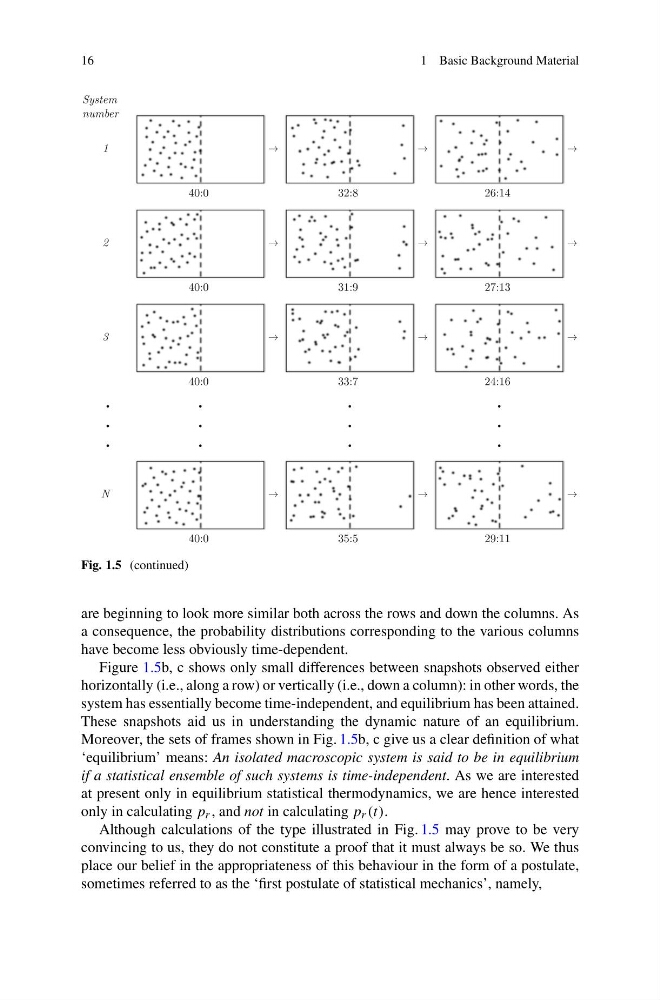
Fig. 1.5 (continued)
are beginning to look more similar both across the rows and down the columns. As
a consequence, the probability distributions corresponding to the various columns
have become less obviously time-dependent.
Figure 1.5b, c shows only small differences between snapshots observed either
horizontally (i.e., along a row) or vertically (i.e., down a column): in other words, the
system has essentially become time-independent, and equilibrium has been attained.
These snapshots aid us in understanding the dynamic nature of an equilibrium.
Moreover, the sets of frames shown in Fig. 1.5b, c give us a clear definition of what
‘equilibrium’ means: An isolated macroscopic system is said to be in equilibrium
if a statistical ensemble of such systems is time-independent. As we are interested
at present only in equilibrium statistical thermodynamics, we are hence interested
only in calculating p r , and not in calculating p r (t).
Although calculations of the type illustrated in Fig. 1.5 may prove to be very
convincing to us, they do not constitute a proof that it must always be so. We thus
place our belief in the appropriateness of this behaviour in the form of a postulate,
sometimes referred to as the ‘first postulate of statistical mechanics’, namely,
1 Basic Background Material
Fig. 1.5 (continued)
are beginning to look more similar both across the rows and down the columns. As
a consequence, the probability distributions corresponding to the various columns
have become less obviously time-dependent.
Figure 1.5b, c shows only small differences between snapshots observed either
horizontally (i.e., along a row) or vertically (i.e., down a column): in other words, the
system has essentially become time-independent, and equilibrium has been attained.
These snapshots aid us in understanding the dynamic nature of an equilibrium.
Moreover, the sets of frames shown in Fig. 1.5b, c give us a clear definition of what
‘equilibrium’ means: An isolated macroscopic system is said to be in equilibrium
if a statistical ensemble of such systems is time-independent. As we are interested
at present only in equilibrium statistical thermodynamics, we are hence interested
only in calculating p r , and not in calculating p r (t).
Although calculations of the type illustrated in Fig. 1.5 may prove to be very
convincing to us, they do not constitute a proof that it must always be so. We thus
place our belief in the appropriateness of this behaviour in the form of a postulate,
sometimes referred to as the ‘first postulate of statistical mechanics’, namely,