

6.2 Diatomic Molecules
277
or, equivalently, as
z
cl
rot (T )
2I k B T
¯
h 2 ,
(6.2.61b)
in terms of the moment-of-inertia of the molecule.
It is often stated that the classical formula (6.2.61a) may be employed safely
for temperatures greater than approximately ten times the characteristic rotational
temperature. To test this statement, we shall examine z rot (10 rot ) to see how well
the classical result fares. Evaluation of z rot (T ) using the first eleven terms (i.e.,
terms for which 0 ≤ j ≤ 10) of the quantum mechanical sum in Eq. (6.2.59)
gives z rot (10 rot ) = 10.3410, accurate to four decimal places. This result may be
compared with z cl
rot (10 rot ) = 10.0000 from the classical limit expression (6.2.61a),
which thus gives a 3.4% underestimation of z rot (T ) for T = 10 rot . Similarly, if
we evaluate the rotational partition function for a temperature T = 5 rot , an 8-term
(0 ≤ j ≤ 7) evaluation from the quantum expression gives z rot = 5.3472, again
accurate to four decimal places: however, in this case, the classical limit of 5.0000
for z rot (T ) underestimates the true value by 6.5%.
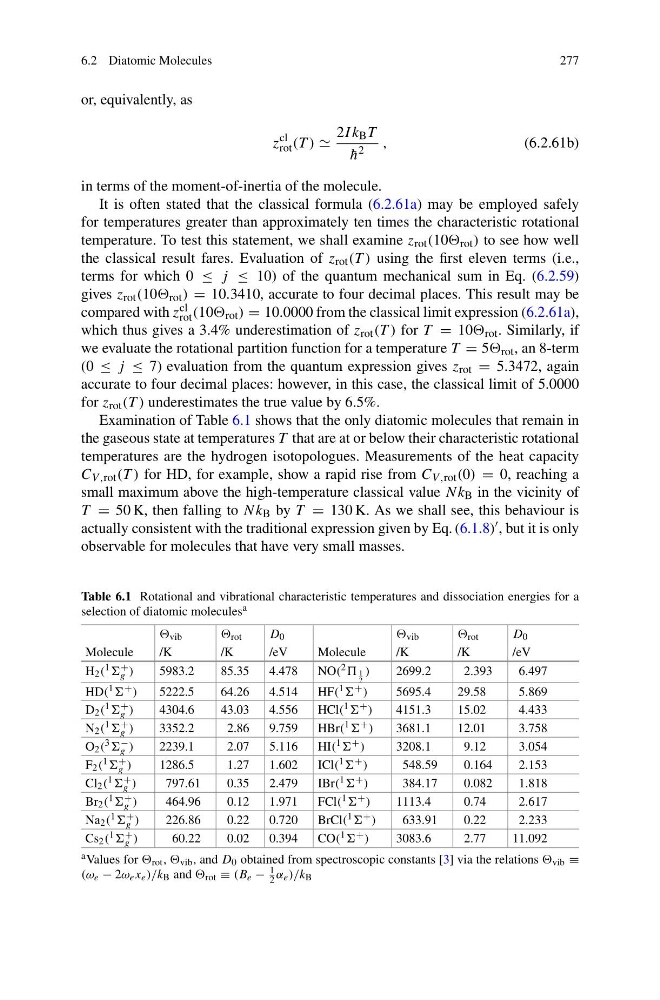
Examination of Table 6.1 shows that the only diatomic molecules that remain in
the gaseous state at temperatures T that are at or below their characteristic rotational
temperatures are the hydrogen isotopologues. Measurements of the heat capacity
C V ,rot (T ) for HD, for example, show a rapid rise from C V ,rot (0) = 0, reaching a
small maximum above the high-temperature classical value Nk B in the vicinity of
T = 50 K, then falling to Nk B by T = 130 K. As we shall see, this behaviour is
actually consistent with the traditional expression given by Eq. (6.1.8) , but it is only
observable for molecules that have very small masses.
Table 6.1 Rotational and vibrational characteristic temperatures and dissociation energies for a
selection of diatomic molecules a
vib
rot
D 0
vib
rot
D 0
Molecule
/K
/K
/eV
Molecule
/K
/K
/eV
H 2 ( 1 +
g )
5983.2
85.35
4.478
NO( 2 1
2
)
2699.2
2.393
6.497
HD( 1 + )
5222.5
64.26
4.514
HF( 1 + )
5695.4
29.58
5.869
D 2 ( 1 +
g )
4304.6
43.03
4.556
HCl( 1 + )
4151.3
15.02
4.433
N 2 ( 1 +
g )
3352.2
2.86
9.759
HBr( 1 + )
3681.1
12.01
3.758
O 2 ( 3 −
g )
2239.1
2.07
5.116
HI( 1 + )
3208.1
9.12
3.054
F 2 ( 1 +
g )
1286.5
1.27
1.602
ICl( 1 + )
548.59
0.164
2.153
Cl 2 ( 1 +
g )
797.61
0.35
2.479
IBr( 1 + )
384.17
0.082
1.818
Br 2 ( 1 +
g )
464.96
0.12
1.971
FCl( 1 + )
1113.4
0.74
2.617
Na 2 ( 1 +
g )
226.86
0.22
0.720
BrCl( 1 + )
633.91
0.22
2.233
Cs 2 ( 1 +
g )
60.22
0.02
0.394
CO( 1 + )
3083.6
2.77
11.092
a Values for rot , vib , and D 0 obtained from spectroscopic constants [3] via the relations vib ≡
(ω e − 2ω e x e )/k B and rot ≡ (B e −
1
2 α e )/k B
277
or, equivalently, as
z
cl
rot (T )
2I k B T
¯
h 2 ,
(6.2.61b)
in terms of the moment-of-inertia of the molecule.
It is often stated that the classical formula (6.2.61a) may be employed safely
for temperatures greater than approximately ten times the characteristic rotational
temperature. To test this statement, we shall examine z rot (10 rot ) to see how well
the classical result fares. Evaluation of z rot (T ) using the first eleven terms (i.e.,
terms for which 0 ≤ j ≤ 10) of the quantum mechanical sum in Eq. (6.2.59)
gives z rot (10 rot ) = 10.3410, accurate to four decimal places. This result may be
compared with z cl
rot (10 rot ) = 10.0000 from the classical limit expression (6.2.61a),
which thus gives a 3.4% underestimation of z rot (T ) for T = 10 rot . Similarly, if
we evaluate the rotational partition function for a temperature T = 5 rot , an 8-term
(0 ≤ j ≤ 7) evaluation from the quantum expression gives z rot = 5.3472, again
accurate to four decimal places: however, in this case, the classical limit of 5.0000
for z rot (T ) underestimates the true value by 6.5%.
Examination of Table 6.1 shows that the only diatomic molecules that remain in
the gaseous state at temperatures T that are at or below their characteristic rotational
temperatures are the hydrogen isotopologues. Measurements of the heat capacity
C V ,rot (T ) for HD, for example, show a rapid rise from C V ,rot (0) = 0, reaching a
small maximum above the high-temperature classical value Nk B in the vicinity of
T = 50 K, then falling to Nk B by T = 130 K. As we shall see, this behaviour is
actually consistent with the traditional expression given by Eq. (6.1.8) , but it is only
observable for molecules that have very small masses.
Table 6.1 Rotational and vibrational characteristic temperatures and dissociation energies for a
selection of diatomic molecules a
vib
rot
D 0
vib
rot
D 0
Molecule
/K
/K
/eV
Molecule
/K
/K
/eV
H 2 ( 1 +
g )
5983.2
85.35
4.478
NO( 2 1
2
)
2699.2
2.393
6.497
HD( 1 + )
5222.5
64.26
4.514
HF( 1 + )
5695.4
29.58
5.869
D 2 ( 1 +
g )
4304.6
43.03
4.556
HCl( 1 + )
4151.3
15.02
4.433
N 2 ( 1 +
g )
3352.2
2.86
9.759
HBr( 1 + )
3681.1
12.01
3.758
O 2 ( 3 −
g )
2239.1
2.07
5.116
HI( 1 + )
3208.1
9.12
3.054
F 2 ( 1 +
g )
1286.5
1.27
1.602
ICl( 1 + )
548.59
0.164
2.153
Cl 2 ( 1 +
g )
797.61
0.35
2.479
IBr( 1 + )
384.17
0.082
1.818
Br 2 ( 1 +
g )
464.96
0.12
1.971
FCl( 1 + )
1113.4
0.74
2.617
Na 2 ( 1 +
g )
226.86
0.22
0.720
BrCl( 1 + )
633.91
0.22
2.233
Cs 2 ( 1 +
g )
60.22
0.02
0.394
CO( 1 + )
3083.6
2.77
11.092
a Values for rot , vib , and D 0 obtained from spectroscopic constants [3] via the relations vib ≡
(ω e − 2ω e x e )/k B and rot ≡ (B e −
1
2 α e )/k B