

6.2 Diatomic Molecules
263
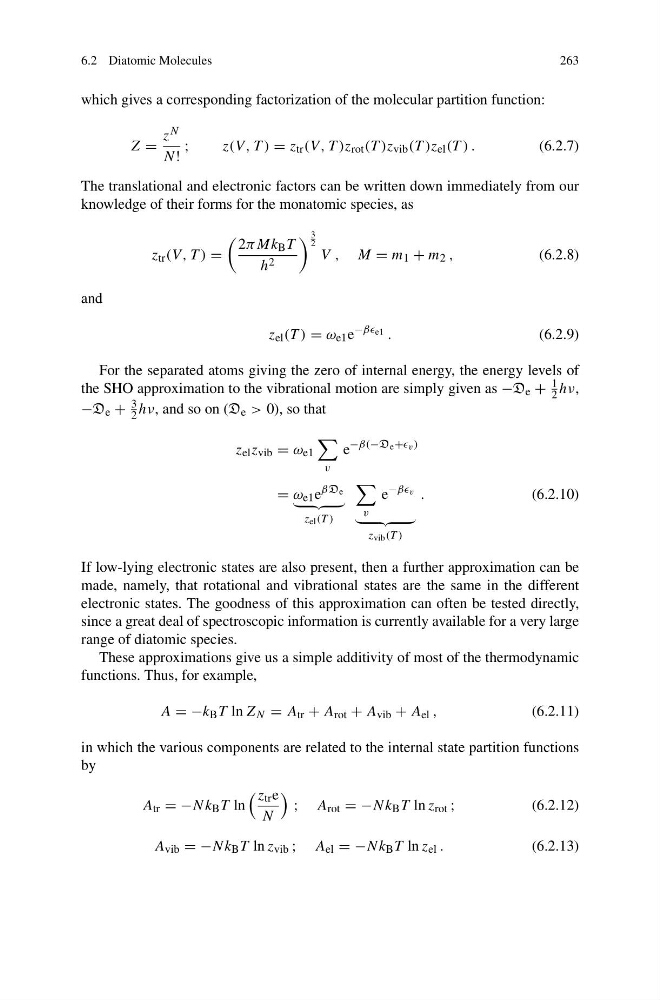
which gives a corresponding factorization of the molecular partition function:
Z =
z N
N !
;
z(V , T ) = z tr (V , T )z rot (T )z vib (T )z el (T ) .
(6.2.7)
The translational and electronic factors can be written down immediately from our
knowledge of their forms for the monatomic species, as
z tr (V , T ) =
2πMk B T
h 2
3
2
V , M = m 1 + m 2 ,
(6.2.8)
and
z el (T ) = ω e1 e
−ββ e1 .
(6.2.9)
For the separated atoms giving the zero of internal energy, the energy levels of
the SHO approximation to the vibrational motion are simply given as −D e +
1
2 hν,
−D e +
3
2 hν, and so on (D e > 0), so that
z el z vib = ω e1
v
e
−β(−D e + v )
= ω e1 e
βD e
z el (T )
v
e
−ββ v
z vib (T )
.
(6.2.10)
If low-lying electronic states are also present, then a further approximation can be
made, namely, that rotational and vibrational states are the same in the different
electronic states. The goodness of this approximation can often be tested directly,
since a great deal of spectroscopic information is currently available for a very large
range of diatomic species.
These approximations give us a simple additivity of most of the thermodynamic
functions. Thus, for example,
A = −k B T ln Z N = A tr + A rot + A vib + A el ,
(6.2.11)
in which the various components are related to the internal state partition functions
by
A tr = −Nk B T ln
z tr e
N
; A rot = −Nk B T ln z rot ;
(6.2.12)
A vib = −Nk B T ln z vib ; A el = −Nk B T ln z el .
(6.2.13)
263
which gives a corresponding factorization of the molecular partition function:
Z =
z N
N !
;
z(V , T ) = z tr (V , T )z rot (T )z vib (T )z el (T ) .
(6.2.7)
The translational and electronic factors can be written down immediately from our
knowledge of their forms for the monatomic species, as
z tr (V , T ) =
2πMk B T
h 2
3
2
V , M = m 1 + m 2 ,
(6.2.8)
and
z el (T ) = ω e1 e
−ββ e1 .
(6.2.9)
For the separated atoms giving the zero of internal energy, the energy levels of
the SHO approximation to the vibrational motion are simply given as −D e +
1
2 hν,
−D e +
3
2 hν, and so on (D e > 0), so that
z el z vib = ω e1
v
e
−β(−D e + v )
= ω e1 e
βD e
z el (T )
v
e
−ββ v
z vib (T )
.
(6.2.10)
If low-lying electronic states are also present, then a further approximation can be
made, namely, that rotational and vibrational states are the same in the different
electronic states. The goodness of this approximation can often be tested directly,
since a great deal of spectroscopic information is currently available for a very large
range of diatomic species.
These approximations give us a simple additivity of most of the thermodynamic
functions. Thus, for example,
A = −k B T ln Z N = A tr + A rot + A vib + A el ,
(6.2.11)
in which the various components are related to the internal state partition functions
by
A tr = −Nk B T ln
z tr e
N
; A rot = −Nk B T ln z rot ;
(6.2.12)
A vib = −Nk B T ln z vib ; A el = −Nk B T ln z el .
(6.2.13)