

228
5 Atomic Systems
Wilson [5] and Bethe and Jackiw [6] in their now-classic texts. For our purposes, it
will suffice to employ the empirical rules set out in 1927 by Hund [7], namely:
1. the term with the highest multiplicity (i.e., value of 2S + 1) lies lowest in energy;
2. of terms having the same multiplicity, the one having the greatest value of L lies
lowest in energy;
3. for ground configurations corresponding to electronic shells that are no more
than half-filled, the level for which J = |L − S| lies lowest in energy, while
for ground configurations corresponding to electronic shells that are more than
half-filled, the level for which J = L + S lies lowest in energy.
Although Hund’s observations were based upon spectroscopic data obtained for
ground configurations and hold strictly only for those configurations, there are
cases of excited configurations for which these same rules still give meaningful
results. Note, in particular, however, that Hund’s rules say nothing about the relative
energies of other than ground-configuration terms.
5.3.2 Excited Electronic State Contributions
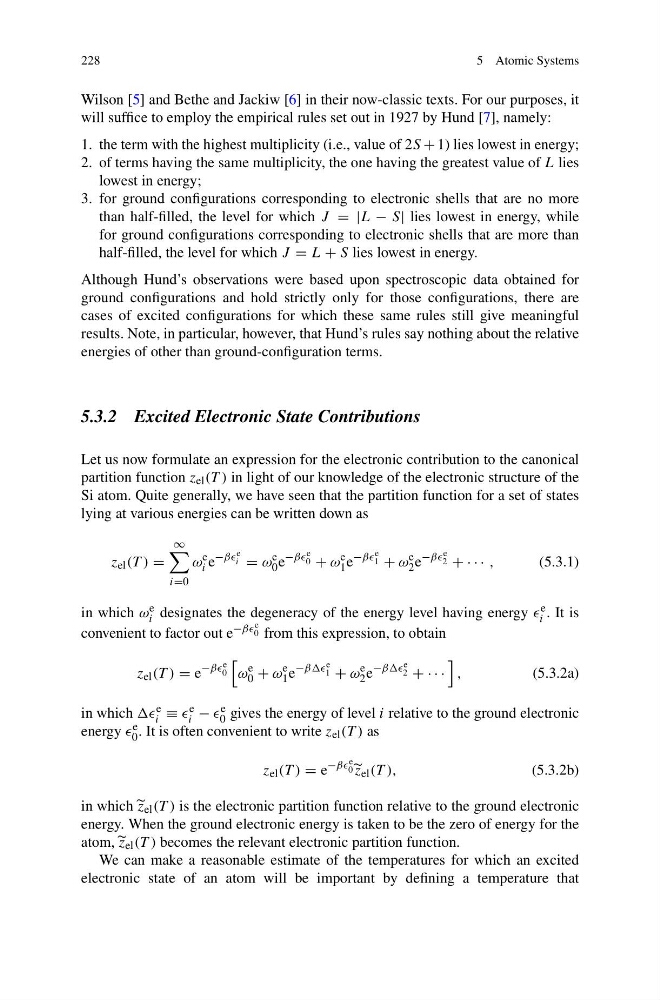
Let us now formulate an expression for the electronic contribution to the canonical
partition function z el (T ) in light of our knowledge of the electronic structure of the
Si atom. Quite generally, we have seen that the partition function for a set of states
lying at various energies can be written down as
z el (T ) =
∞
i=0
ω
e
i e
−ββ e
i = ω
e
0 e
−ββ e
0 + ω
e
1 e
−ββ e
1 + ω
e
2 e
−ββ e
2 + · · · ,
(5.3.1)
in which ω e
i designates the degeneracy of the energy level having energy e
i . It is
convenient to factor out e
−ββ e
0 from this expression, to obtain
z el (T ) = e
−ββ e
0
ω
e
0 + ω
e
1 e
−ββ e
1 + ω
e
2 e
−βββ e
2 + · · ·
,
(5.3.2a)
in which e
i ≡ e
i − e
0 gives the energy of level i relative to the ground electronic
energy e
0 . It is often convenient to write z el (T ) as
z el (T ) = e
−ββ e
0 z el (T ),
(5.3.2b)
in which z el (T ) is the electronic partition function relative to the ground electronic
energy. When the ground electronic energy is taken to be the zero of energy for the
atom, z el (T ) becomes the relevant electronic partition function.
We can make a reasonable estimate of the temperatures for which an excited
electronic state of an atom will be important by defining a temperature that
5 Atomic Systems
Wilson [5] and Bethe and Jackiw [6] in their now-classic texts. For our purposes, it
will suffice to employ the empirical rules set out in 1927 by Hund [7], namely:
1. the term with the highest multiplicity (i.e., value of 2S + 1) lies lowest in energy;
2. of terms having the same multiplicity, the one having the greatest value of L lies
lowest in energy;
3. for ground configurations corresponding to electronic shells that are no more
than half-filled, the level for which J = |L − S| lies lowest in energy, while
for ground configurations corresponding to electronic shells that are more than
half-filled, the level for which J = L + S lies lowest in energy.
Although Hund’s observations were based upon spectroscopic data obtained for
ground configurations and hold strictly only for those configurations, there are
cases of excited configurations for which these same rules still give meaningful
results. Note, in particular, however, that Hund’s rules say nothing about the relative
energies of other than ground-configuration terms.
5.3.2 Excited Electronic State Contributions
Let us now formulate an expression for the electronic contribution to the canonical
partition function z el (T ) in light of our knowledge of the electronic structure of the
Si atom. Quite generally, we have seen that the partition function for a set of states
lying at various energies can be written down as
z el (T ) =
∞
i=0
ω
e
i e
−ββ e
i = ω
e
0 e
−ββ e
0 + ω
e
1 e
−ββ e
1 + ω
e
2 e
−ββ e
2 + · · · ,
(5.3.1)
in which ω e
i designates the degeneracy of the energy level having energy e
i . It is
convenient to factor out e
−ββ e
0 from this expression, to obtain
z el (T ) = e
−ββ e
0
ω
e
0 + ω
e
1 e
−ββ e
1 + ω
e
2 e
−βββ e
2 + · · ·
,
(5.3.2a)
in which e
i ≡ e
i − e
0 gives the energy of level i relative to the ground electronic
energy e
0 . It is often convenient to write z el (T ) as
z el (T ) = e
−ββ e
0 z el (T ),
(5.3.2b)
in which z el (T ) is the electronic partition function relative to the ground electronic
energy. When the ground electronic energy is taken to be the zero of energy for the
atom, z el (T ) becomes the relevant electronic partition function.
We can make a reasonable estimate of the temperatures for which an excited
electronic state of an atom will be important by defining a temperature that