

224
5 Atomic Systems
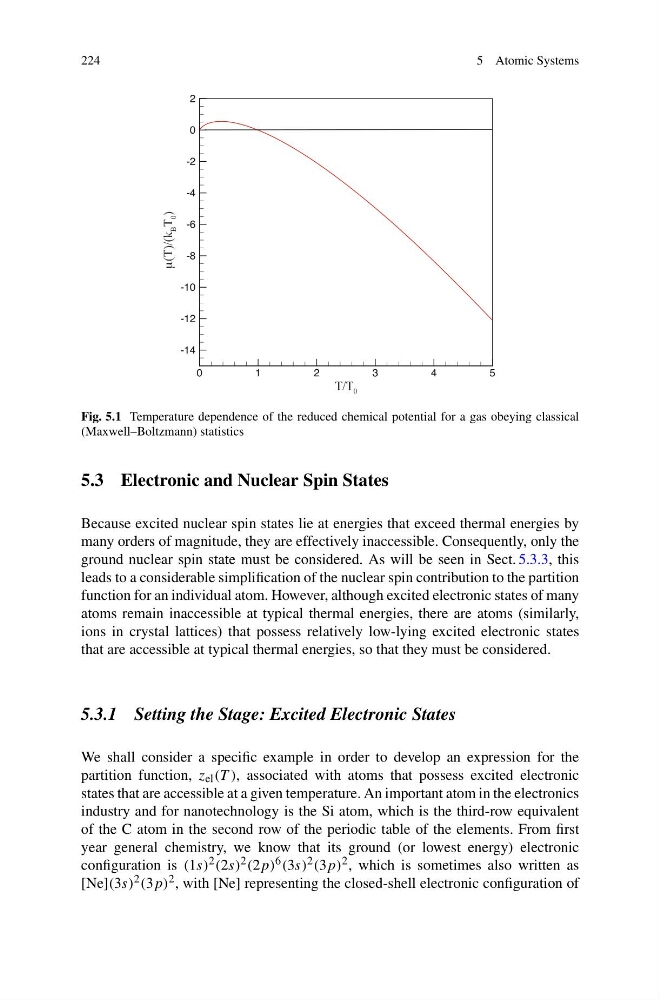
Fig. 5.1 Temperature dependence of the reduced chemical potential for a gas obeying classical
(Maxwell–Boltzmann) statistics
5.3 Electronic and Nuclear Spin States
Because excited nuclear spin states lie at energies that exceed thermal energies by
many orders of magnitude, they are effectively inaccessible. Consequently, only the
ground nuclear spin state must be considered. As will be seen in Sect. 5.3.3, this
leads to a considerable simplification of the nuclear spin contribution to the partition
function for an individual atom. However, although excited electronic states of many
atoms remain inaccessible at typical thermal energies, there are atoms (similarly,
ions in crystal lattices) that possess relatively low-lying excited electronic states
that are accessible at typical thermal energies, so that they must be considered.
5.3.1 Setting the Stage: Excited Electronic States
We shall consider a specific example in order to develop an expression for the
partition function, z el (T ), associated with atoms that possess excited electronic
states that are accessible at a given temperature. An important atom in the electronics
industry and for nanotechnology is the Si atom, which is the third-row equivalent
of the C atom in the second row of the periodic table of the elements. From first
year general chemistry, we know that its ground (or lowest energy) electronic
configuration is (1s) 2 (2s) 2 (2p) 6 (3s) 2 (3p) 2 , which is sometimes also written as
[Ne](3s) 2 (3p) 2 , with [Ne] representing the closed-shell electronic configuration of
5 Atomic Systems
Fig. 5.1 Temperature dependence of the reduced chemical potential for a gas obeying classical
(Maxwell–Boltzmann) statistics
5.3 Electronic and Nuclear Spin States
Because excited nuclear spin states lie at energies that exceed thermal energies by
many orders of magnitude, they are effectively inaccessible. Consequently, only the
ground nuclear spin state must be considered. As will be seen in Sect. 5.3.3, this
leads to a considerable simplification of the nuclear spin contribution to the partition
function for an individual atom. However, although excited electronic states of many
atoms remain inaccessible at typical thermal energies, there are atoms (similarly,
ions in crystal lattices) that possess relatively low-lying excited electronic states
that are accessible at typical thermal energies, so that they must be considered.
5.3.1 Setting the Stage: Excited Electronic States
We shall consider a specific example in order to develop an expression for the
partition function, z el (T ), associated with atoms that possess excited electronic
states that are accessible at a given temperature. An important atom in the electronics
industry and for nanotechnology is the Si atom, which is the third-row equivalent
of the C atom in the second row of the periodic table of the elements. From first
year general chemistry, we know that its ground (or lowest energy) electronic
configuration is (1s) 2 (2s) 2 (2p) 6 (3s) 2 (3p) 2 , which is sometimes also written as
[Ne](3s) 2 (3p) 2 , with [Ne] representing the closed-shell electronic configuration of