

222
5 Atomic Systems
S(N + 1) = (N + 1)k B
ln
V
N(1 +
1
N )
+
3
2
ln
4πmU (1 +
μ
U )
3Nh 2 (1 +
1
N )
+
5
2
= (N + 1)k B
ln
V
N
− ln
1 +
1
N
+
3
2
ln
4πmU
3Nh 2
+
3
2
ln
1 +
μ
U
−
3
2
ln
1 +
1
N
+
5
2
.
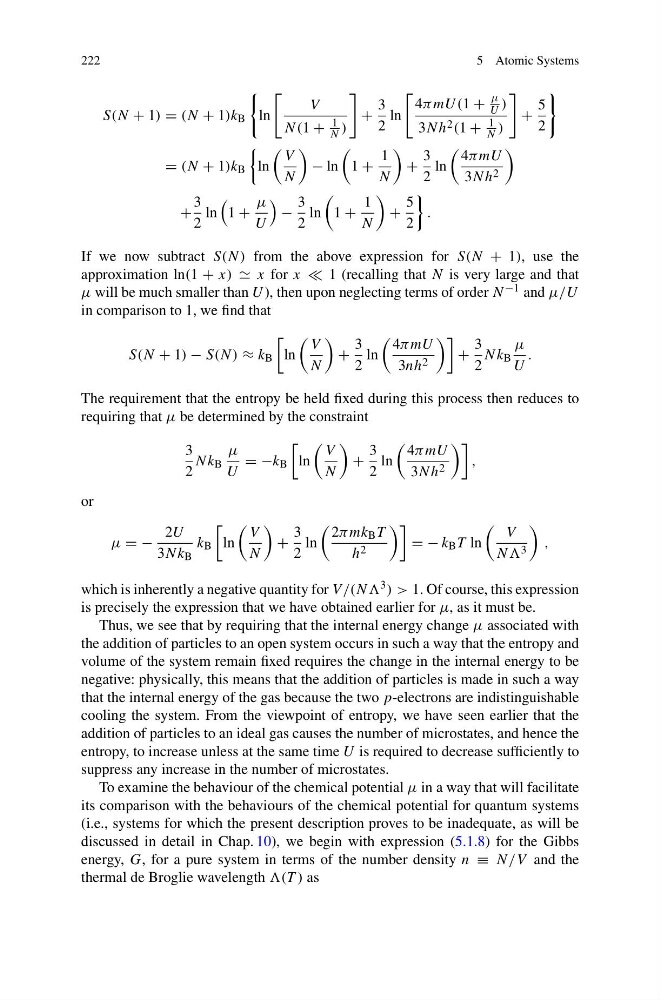
If we now subtract S(N) from the above expression for S(N + 1), use the
approximation ln(1 + x) x for x 1 (recalling that N is very large and that
μ will be much smaller than U ), then upon neglecting terms of order N −1 and μ/U
in comparison to 1, we find that
S(N + 1) − S(N) ≈ k B
ln
V
N
+
3
2
ln
4πmU
3nh 2
+
3
2
Nk B
μ
U
.
The requirement that the entropy be held fixed during this process then reduces to
requiring that μ be determined by the constraint
3
2
Nk B
μ
U
= −k B
ln
V
N
+
3
2
ln
4πmU
3Nh 2
,
or
μ = −
2U
3Nk B
k B
ln
V
N
+
3
2
ln
2πmk B T
h 2
= − k B T ln
V
NN 3
,
which is inherently a negative quantity for V /(NN 3 ) > 1. Of course, this expression
is precisely the expression that we have obtained earlier for μ, as it must be.
Thus, we see that by requiring that the internal energy change μ associated with
the addition of particles to an open system occurs in such a way that the entropy and
volume of the system remain fixed requires the change in the internal energy to be
negative: physically, this means that the addition of particles is made in such a way
that the internal energy of the gas because the two p-electrons are indistinguishable
cooling the system. From the viewpoint of entropy, we have seen earlier that the
addition of particles to an ideal gas causes the number of microstates, and hence the
entropy, to increase unless at the same time U is required to decrease sufficiently to
suppress any increase in the number of microstates.
To examine the behaviour of the chemical potential μ in a way that will facilitate
its comparison with the behaviours of the chemical potential for quantum systems
(i.e., systems for which the present description proves to be inadequate, as will be
discussed in detail in Chap. 10), we begin with expression (5.1.8) for the Gibbs
energy, G, for a pure system in terms of the number density n ≡ N/V and the
thermal de Broglie wavelength (T ) as
5 Atomic Systems
S(N + 1) = (N + 1)k B
ln
V
N(1 +
1
N )
+
3
2
ln
4πmU (1 +
μ
U )
3Nh 2 (1 +
1
N )
+
5
2
= (N + 1)k B
ln
V
N
− ln
1 +
1
N
+
3
2
ln
4πmU
3Nh 2
+
3
2
ln
1 +
μ
U
−
3
2
ln
1 +
1
N
+
5
2
.
If we now subtract S(N) from the above expression for S(N + 1), use the
approximation ln(1 + x) x for x 1 (recalling that N is very large and that
μ will be much smaller than U ), then upon neglecting terms of order N −1 and μ/U
in comparison to 1, we find that
S(N + 1) − S(N) ≈ k B
ln
V
N
+
3
2
ln
4πmU
3nh 2
+
3
2
Nk B
μ
U
.
The requirement that the entropy be held fixed during this process then reduces to
requiring that μ be determined by the constraint
3
2
Nk B
μ
U
= −k B
ln
V
N
+
3
2
ln
4πmU
3Nh 2
,
or
μ = −
2U
3Nk B
k B
ln
V
N
+
3
2
ln
2πmk B T
h 2
= − k B T ln
V
NN 3
,
which is inherently a negative quantity for V /(NN 3 ) > 1. Of course, this expression
is precisely the expression that we have obtained earlier for μ, as it must be.
Thus, we see that by requiring that the internal energy change μ associated with
the addition of particles to an open system occurs in such a way that the entropy and
volume of the system remain fixed requires the change in the internal energy to be
negative: physically, this means that the addition of particles is made in such a way
that the internal energy of the gas because the two p-electrons are indistinguishable
cooling the system. From the viewpoint of entropy, we have seen earlier that the
addition of particles to an ideal gas causes the number of microstates, and hence the
entropy, to increase unless at the same time U is required to decrease sufficiently to
suppress any increase in the number of microstates.
To examine the behaviour of the chemical potential μ in a way that will facilitate
its comparison with the behaviours of the chemical potential for quantum systems
(i.e., systems for which the present description proves to be inadequate, as will be
discussed in detail in Chap. 10), we begin with expression (5.1.8) for the Gibbs
energy, G, for a pure system in terms of the number density n ≡ N/V and the
thermal de Broglie wavelength (T ) as