

216
5 Atomic Systems
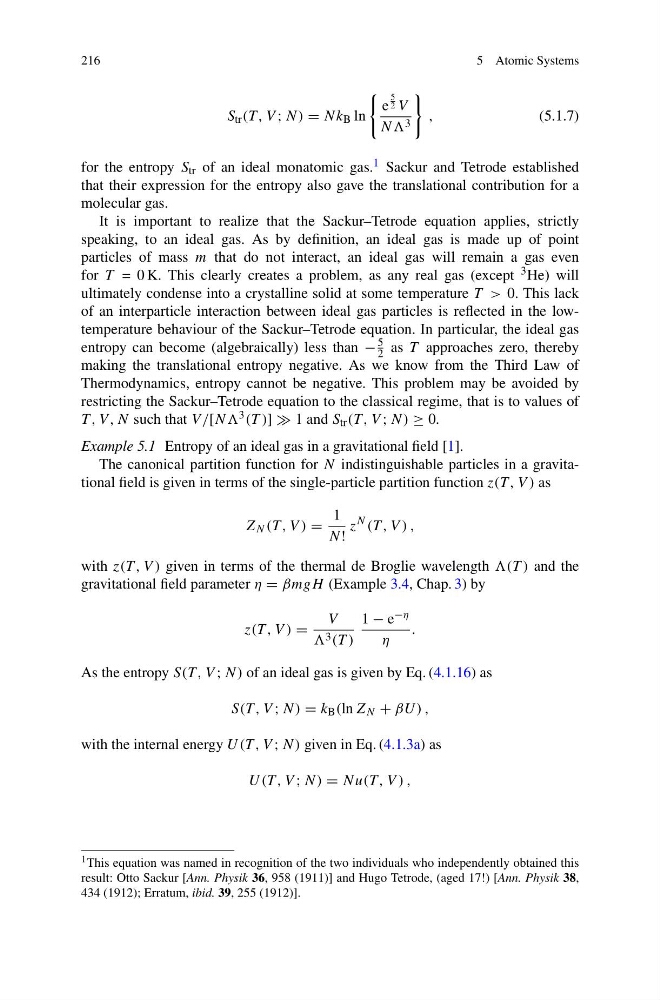
S tr (T , V ; N) = Nk B ln
e
5
2 V
NN 3
,
(5.1.7)
for the entropy S tr of an ideal monatomic gas. 1 Sackur and Tetrode established
that their expression for the entropy also gave the translational contribution for a
molecular gas.
It is important to realize that the Sackur–Tetrode equation applies, strictly
speaking, to an ideal gas. As by definition, an ideal gas is made up of point
particles of mass m that do not interact, an ideal gas will remain a gas even
for T = 0 K. This clearly creates a problem, as any real gas (except 3 He) will
ultimately condense into a crystalline solid at some temperature T > 0. This lack
of an interparticle interaction between ideal gas particles is reflected in the lowtemperature behaviour of the Sackur–Tetrode equation. In particular, the ideal gas
entropy can become (algebraically) less than −
5
2 as T approaches zero, thereby
making the translational entropy negative. As we know from the Third Law of
Thermodynamics, entropy cannot be negative. This problem may be avoided by
restricting the Sackur–Tetrode equation to the classical regime, that is to values of
T , V , N such that V /[NN 3 (T )] ] 1 and S tr (T , V ; N) ≥ 0.
Example 5.1 Entropy of an ideal gas in a gravitational field [1].
The canonical partition function for N indistinguishable particles in a gravitational field is given in terms of the single-particle partition function z(T , V ) as
Z N (T , V ) =
1
N!
z
N (T , V ) ,
with z(T , V ) given in terms of the thermal de Broglie wavelength (T ) and the
gravitational field parameter η = βmgH (Example 3.4, Chap. 3) by
z(T , V ) =
V
3 (T )
1 − e −η
η
.
As the entropy S(T , V ; N) of an ideal gas is given by Eq. (4.1.16) as
S(T , V ; N) = k B (ln Z N + βU ) ,
with the internal energy U(T , V ; N) given in Eq. (4.1.3a) as
U(T , V ; N) = Nu(T , V ) ,
1 This equation was named in recognition of the two individuals who independently obtained this
result: Otto Sackur [Ann. Physik 36, 958 (1911)] and Hugo Tetrode, (aged 17!) [Ann. Physik 38,
434 (1912); Erratum, ibid. 39, 255 (1912)].
5 Atomic Systems
S tr (T , V ; N) = Nk B ln
e
5
2 V
NN 3
,
(5.1.7)
for the entropy S tr of an ideal monatomic gas. 1 Sackur and Tetrode established
that their expression for the entropy also gave the translational contribution for a
molecular gas.
It is important to realize that the Sackur–Tetrode equation applies, strictly
speaking, to an ideal gas. As by definition, an ideal gas is made up of point
particles of mass m that do not interact, an ideal gas will remain a gas even
for T = 0 K. This clearly creates a problem, as any real gas (except 3 He) will
ultimately condense into a crystalline solid at some temperature T > 0. This lack
of an interparticle interaction between ideal gas particles is reflected in the lowtemperature behaviour of the Sackur–Tetrode equation. In particular, the ideal gas
entropy can become (algebraically) less than −
5
2 as T approaches zero, thereby
making the translational entropy negative. As we know from the Third Law of
Thermodynamics, entropy cannot be negative. This problem may be avoided by
restricting the Sackur–Tetrode equation to the classical regime, that is to values of
T , V , N such that V /[NN 3 (T )] ] 1 and S tr (T , V ; N) ≥ 0.
Example 5.1 Entropy of an ideal gas in a gravitational field [1].
The canonical partition function for N indistinguishable particles in a gravitational field is given in terms of the single-particle partition function z(T , V ) as
Z N (T , V ) =
1
N!
z
N (T , V ) ,
with z(T , V ) given in terms of the thermal de Broglie wavelength (T ) and the
gravitational field parameter η = βmgH (Example 3.4, Chap. 3) by
z(T , V ) =
V
3 (T )
1 − e −η
η
.
As the entropy S(T , V ; N) of an ideal gas is given by Eq. (4.1.16) as
S(T , V ; N) = k B (ln Z N + βU ) ,
with the internal energy U(T , V ; N) given in Eq. (4.1.3a) as
U(T , V ; N) = Nu(T , V ) ,
1 This equation was named in recognition of the two individuals who independently obtained this
result: Otto Sackur [Ann. Physik 36, 958 (1911)] and Hugo Tetrode, (aged 17!) [Ann. Physik 38,
434 (1912); Erratum, ibid. 39, 255 (1912)].