

214
5 Atomic Systems
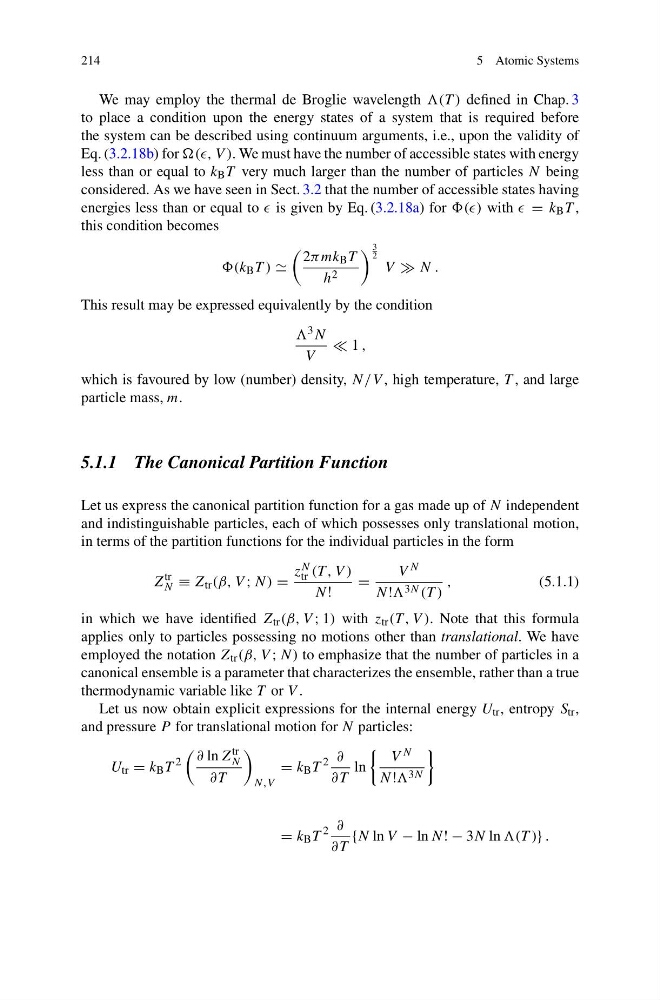
We may employ the thermal de Broglie wavelength ) defined in Chap. 3
to place a condition upon the energy states of a system that is required before
the system can be described using continuum arguments, i.e., upon the validity of
Eq. (3.2.18b) for ((, V ). We must have the number of accessible states with energy
less than or equal to k B T very much larger than the number of particles N being
considered. As we have seen in Sect. 3.2 that the number of accessible states having
energies less than or equal to is given by Eq. (3.2.18a) for with = k B T ,
this condition becomes
(k B T )
2πmk B T
h 2
3
2
V N .
This result may be expressed equivalently by the condition
3 N
V
1 ,
which is favoured by low (number) density, N/V , high temperature, T , and large
particle mass, m.
5.1.1 The Canonical Partition Function
Let us express the canonical partition function for a gas made up of N independent
and indistinguishable particles, each of which possesses only translational motion,
in terms of the partition functions for the individual particles in the form
Z
tr
N ≡ Z tr (β, V ; N) =
z N
tr (T , V )
N!
=
V N
N! 3N (T )
,
(5.1.1)
in which we have identified Z tr (β, V ; 1) with z tr (T , V ). Note that this formula
applies only to particles possessing no motions other than translational. We have
employed the notation Z tr (β, V ; N) to emphasize that the number of particles in a
canonical ensemble is a parameter that characterizes the ensemble, rather than a true
thermodynamic variable like T or V .
Let us now obtain explicit expressions for the internal energy U tr , entropy S tr ,
and pressure P for translational motion for N particles:
U tr = k B T
2
∂ ln Z tr
N
∂T
N,V
= k B T
2 ∂
∂T
ln
V N
N! 3N
= k B T
2 ∂
∂T
{N ln V − ln N! − 3N ln (T )} .
5 Atomic Systems
We may employ the thermal de Broglie wavelength ) defined in Chap. 3
to place a condition upon the energy states of a system that is required before
the system can be described using continuum arguments, i.e., upon the validity of
Eq. (3.2.18b) for ((, V ). We must have the number of accessible states with energy
less than or equal to k B T very much larger than the number of particles N being
considered. As we have seen in Sect. 3.2 that the number of accessible states having
energies less than or equal to is given by Eq. (3.2.18a) for with = k B T ,
this condition becomes
(k B T )
2πmk B T
h 2
3
2
V N .
This result may be expressed equivalently by the condition
3 N
V
1 ,
which is favoured by low (number) density, N/V , high temperature, T , and large
particle mass, m.
5.1.1 The Canonical Partition Function
Let us express the canonical partition function for a gas made up of N independent
and indistinguishable particles, each of which possesses only translational motion,
in terms of the partition functions for the individual particles in the form
Z
tr
N ≡ Z tr (β, V ; N) =
z N
tr (T , V )
N!
=
V N
N! 3N (T )
,
(5.1.1)
in which we have identified Z tr (β, V ; 1) with z tr (T , V ). Note that this formula
applies only to particles possessing no motions other than translational. We have
employed the notation Z tr (β, V ; N) to emphasize that the number of particles in a
canonical ensemble is a parameter that characterizes the ensemble, rather than a true
thermodynamic variable like T or V .
Let us now obtain explicit expressions for the internal energy U tr , entropy S tr ,
and pressure P for translational motion for N particles:
U tr = k B T
2
∂ ln Z tr
N
∂T
N,V
= k B T
2 ∂
∂T
ln
V N
N! 3N
= k B T
2 ∂
∂T
{N ln V − ln N! − 3N ln (T )} .