

210
4 Mean Values and Thermodynamics
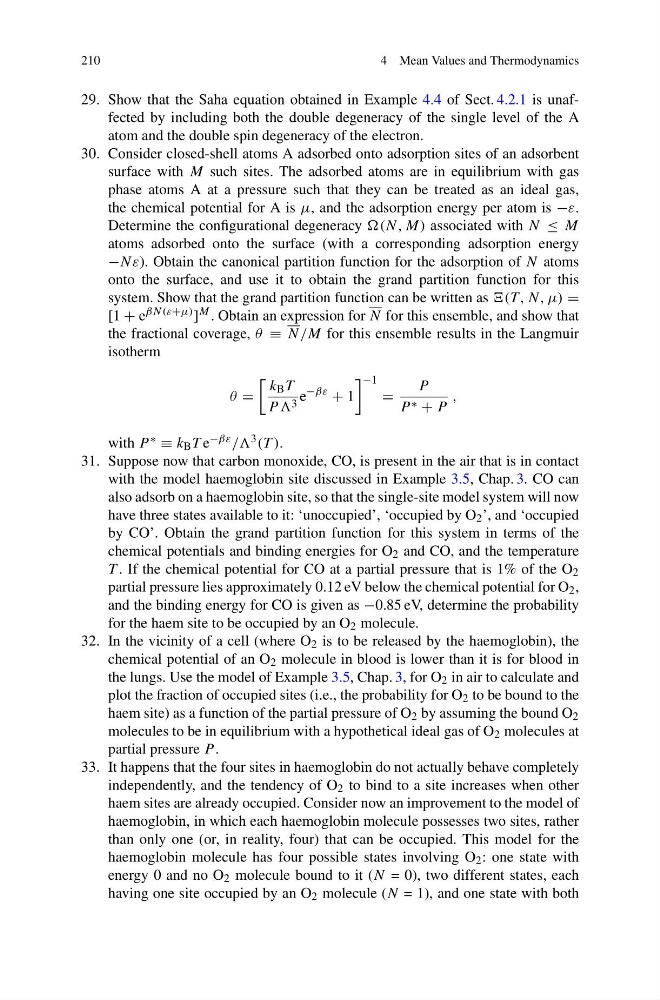
29. Show that the Saha equation obtained in Example 4.4 of Sect. 4.2.1 is unaffected by including both the double degeneracy of the single level of the A
atom and the double spin degeneracy of the electron.
30. Consider closed-shell atoms A adsorbed onto adsorption sites of an adsorbent
surface with M such sites. The adsorbed atoms are in equilibrium with gas
phase atoms A at a pressure such that they can be treated as an ideal gas,
the chemical potential for A is μ, and the adsorption energy per atom is −ε.
Determine the configurational degeneracy (N, M) associated with N ≤ M
atoms adsorbed onto the surface (with a corresponding adsorption energy
−Nε). Obtain the canonical partition function for the adsorption of N atoms
onto the surface, and use it to obtain the grand partition function for this
system. Show that the grand partition function can be written as , N, μ) =
[1 + e βN(ε+μ) ] M . Obtain an expression for N for this ensemble, and show that
the fractional coverage, θ ≡ N/M for this ensemble results in the Langmuir
isotherm
θ =
k B T
P P 3 e
−βε
+ 1
−1
=
P
P ∗ + P
,
with P ∗ ≡ k B T e −βε // 3 (T ).
31. Suppose now that carbon monoxide, CO, is present in the air that is in contact
with the model haemoglobin site discussed in Example 3.5, Chap. 3. CO can
also adsorb on a haemoglobin site, so that the single-site model system will now
have three states available to it: ‘unoccupied’, ‘occupied by O 2 ’, and ‘occupied
by CO’. Obtain the grand partition function for this system in terms of the
chemical potentials and binding energies for O 2 and CO, and the temperature
T . If the chemical potential for CO at a partial pressure that is 1% of the O 2
partial pressure lies approximately 0.12 eV below the chemical potential for O 2 ,
and the binding energy for CO is given as −0.85 eV, determine the probability
for the haem site to be occupied by an O 2 molecule.
32. In the vicinity of a cell (where O 2 is to be released by the haemoglobin), the
chemical potential of an O 2 molecule in blood is lower than it is for blood in
the lungs. Use the model of Example 3.5, Chap. 3, for O 2 in air to calculate and
plot the fraction of occupied sites (i.e., the probability for O 2 to be bound to the
haem site) as a function of the partial pressure of O 2 by assuming the bound O 2
molecules to be in equilibrium with a hypothetical ideal gas of O 2 molecules at
partial pressure P .
33. It happens that the four sites in haemoglobin do not actually behave completely
independently, and the tendency of O 2 to bind to a site increases when other
haem sites are already occupied. Consider now an improvement to the model of
haemoglobin, in which each haemoglobin molecule possesses two sites, rather
than only one (or, in reality, four) that can be occupied. This model for the
haemoglobin molecule has four possible states involving O 2 : one state with
energy 0 and no O 2 molecule bound to it (N = 0), two different states, each
having one site occupied by an O 2 molecule (N = 1), and one state with both
4 Mean Values and Thermodynamics
29. Show that the Saha equation obtained in Example 4.4 of Sect. 4.2.1 is unaffected by including both the double degeneracy of the single level of the A
atom and the double spin degeneracy of the electron.
30. Consider closed-shell atoms A adsorbed onto adsorption sites of an adsorbent
surface with M such sites. The adsorbed atoms are in equilibrium with gas
phase atoms A at a pressure such that they can be treated as an ideal gas,
the chemical potential for A is μ, and the adsorption energy per atom is −ε.
Determine the configurational degeneracy (N, M) associated with N ≤ M
atoms adsorbed onto the surface (with a corresponding adsorption energy
−Nε). Obtain the canonical partition function for the adsorption of N atoms
onto the surface, and use it to obtain the grand partition function for this
system. Show that the grand partition function can be written as , N, μ) =
[1 + e βN(ε+μ) ] M . Obtain an expression for N for this ensemble, and show that
the fractional coverage, θ ≡ N/M for this ensemble results in the Langmuir
isotherm
θ =
k B T
P P 3 e
−βε
+ 1
−1
=
P
P ∗ + P
,
with P ∗ ≡ k B T e −βε // 3 (T ).
31. Suppose now that carbon monoxide, CO, is present in the air that is in contact
with the model haemoglobin site discussed in Example 3.5, Chap. 3. CO can
also adsorb on a haemoglobin site, so that the single-site model system will now
have three states available to it: ‘unoccupied’, ‘occupied by O 2 ’, and ‘occupied
by CO’. Obtain the grand partition function for this system in terms of the
chemical potentials and binding energies for O 2 and CO, and the temperature
T . If the chemical potential for CO at a partial pressure that is 1% of the O 2
partial pressure lies approximately 0.12 eV below the chemical potential for O 2 ,
and the binding energy for CO is given as −0.85 eV, determine the probability
for the haem site to be occupied by an O 2 molecule.
32. In the vicinity of a cell (where O 2 is to be released by the haemoglobin), the
chemical potential of an O 2 molecule in blood is lower than it is for blood in
the lungs. Use the model of Example 3.5, Chap. 3, for O 2 in air to calculate and
plot the fraction of occupied sites (i.e., the probability for O 2 to be bound to the
haem site) as a function of the partial pressure of O 2 by assuming the bound O 2
molecules to be in equilibrium with a hypothetical ideal gas of O 2 molecules at
partial pressure P .
33. It happens that the four sites in haemoglobin do not actually behave completely
independently, and the tendency of O 2 to bind to a site increases when other
haem sites are already occupied. Consider now an improvement to the model of
haemoglobin, in which each haemoglobin molecule possesses two sites, rather
than only one (or, in reality, four) that can be occupied. This model for the
haemoglobin molecule has four possible states involving O 2 : one state with
energy 0 and no O 2 molecule bound to it (N = 0), two different states, each
having one site occupied by an O 2 molecule (N = 1), and one state with both