

1.2 The Ideal Gas
9
translational. Moreover, because we are considering only an ideal gas, we have just
the hard-sphere interaction potential between pairs of gas particles. We should allow
for this by replacing U by U tr , the internal energy associated with the translational
motion of the atoms/molecules of the gas. Thus, our equation of state should actually
read
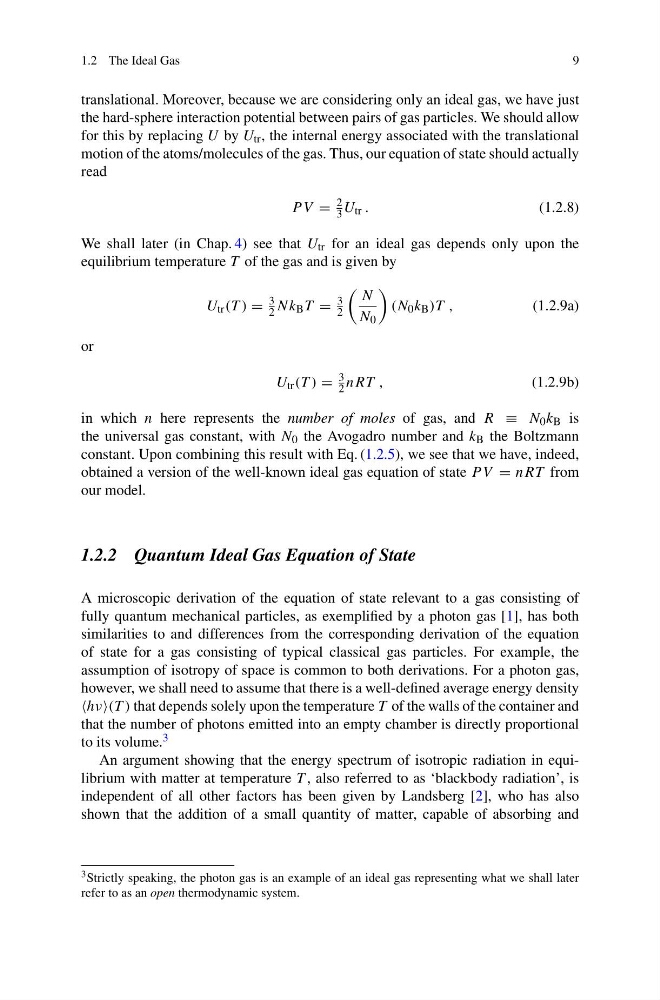
P V =
2
3 U tr .
(1.2.8)
We shall later (in Chap. 4) see that U tr for an ideal gas depends only upon the
equilibrium temperature T of the gas and is given by
U tr (T ) =
3
2 Nk B T =
3
2
N
N 0
(N 0 k B )T ,
(1.2.9a)
or
U tr (T ) =
3
2 nRT ,
(1.2.9b)
in which n here represents the number of moles of gas, and R ≡ N 0 k B is
the universal gas constant, with N 0 the Avogadro number and k B the Boltzmann
constant. Upon combining this result with Eq. (1.2.5), we see that we have, indeed,
obtained a version of the well-known ideal gas equation of state P V = nRT from
our model.
1.2.2 Quantum Ideal Gas Equation of State
A microscopic derivation of the equation of state relevant to a gas consisting of
fully quantum mechanical particles, as exemplified by a photon gas [1], has both
similarities to and differences from the corresponding derivation of the equation
of state for a gas consisting of typical classical gas particles. For example, the
assumption of isotropy of space is common to both derivations. For a photon gas,
however, we shall need to assume that there is a well-defined average energy density
hν(T ) that depends solely upon the temperature T of the walls of the container and
that the number of photons emitted into an empty chamber is directly proportional
to its volume. 3
An argument showing that the energy spectrum of isotropic radiation in equilibrium with matter at temperature T , also referred to as ‘blackbody radiation’, is
independent of all other factors has been given by Landsberg [2], who has also
shown that the addition of a small quantity of matter, capable of absorbing and
3 Strictly speaking, the photon gas is an example of an ideal gas representing what we shall later
refer to as an open thermodynamic system.
9
translational. Moreover, because we are considering only an ideal gas, we have just
the hard-sphere interaction potential between pairs of gas particles. We should allow
for this by replacing U by U tr , the internal energy associated with the translational
motion of the atoms/molecules of the gas. Thus, our equation of state should actually
read
P V =
2
3 U tr .
(1.2.8)
We shall later (in Chap. 4) see that U tr for an ideal gas depends only upon the
equilibrium temperature T of the gas and is given by
U tr (T ) =
3
2 Nk B T =
3
2
N
N 0
(N 0 k B )T ,
(1.2.9a)
or
U tr (T ) =
3
2 nRT ,
(1.2.9b)
in which n here represents the number of moles of gas, and R ≡ N 0 k B is
the universal gas constant, with N 0 the Avogadro number and k B the Boltzmann
constant. Upon combining this result with Eq. (1.2.5), we see that we have, indeed,
obtained a version of the well-known ideal gas equation of state P V = nRT from
our model.
1.2.2 Quantum Ideal Gas Equation of State
A microscopic derivation of the equation of state relevant to a gas consisting of
fully quantum mechanical particles, as exemplified by a photon gas [1], has both
similarities to and differences from the corresponding derivation of the equation
of state for a gas consisting of typical classical gas particles. For example, the
assumption of isotropy of space is common to both derivations. For a photon gas,
however, we shall need to assume that there is a well-defined average energy density
hν(T ) that depends solely upon the temperature T of the walls of the container and
that the number of photons emitted into an empty chamber is directly proportional
to its volume. 3
An argument showing that the energy spectrum of isotropic radiation in equilibrium with matter at temperature T , also referred to as ‘blackbody radiation’, is
independent of all other factors has been given by Landsberg [2], who has also
shown that the addition of a small quantity of matter, capable of absorbing and
3 Strictly speaking, the photon gas is an example of an ideal gas representing what we shall later
refer to as an open thermodynamic system.