

4.5 Problems for this Chapter
205
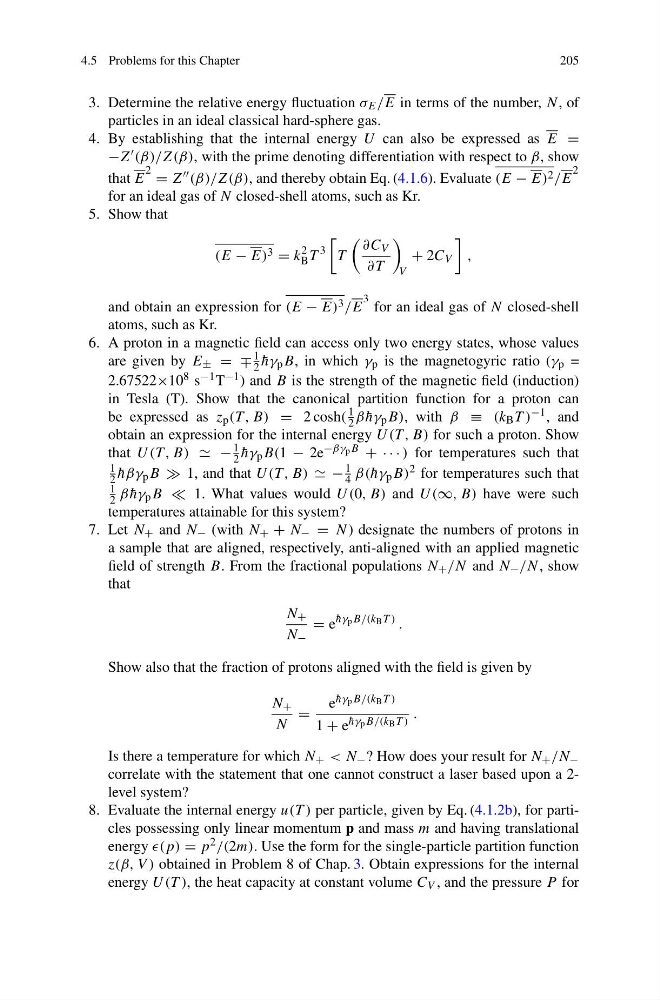
3. Determine the relative energy fluctuation σ E /E in terms of the number, N, of
particles in an ideal classical hard-sphere gas.
4. By establishing that the internal energy U can also be expressed as E =
−Z (β)/Z(β), with the prime denoting differentiation with respect to β, show
that E
2 = Z (β)/Z(β), and thereby obtain Eq. (4.1.6). Evaluate (E − E) 2 /E
2
for an ideal gas of N closed-shell atoms, such as Kr.
5. Show that
(E − E) 3 = k
2
B T
3
T
∂C V
∂T
V
+ 2C V
,
and obtain an expression for (E − E) 3 /E
3 for an ideal gas of N closed-shell
atoms, such as Kr.
6. A proton in a magnetic field can access only two energy states, whose values
are given by E ± = ∓
1
2 ¯
hγ p B, in which γ p is the magnetogyric ratio (γ p =
2.67522×10 8 s −1 T −1 ) and B is the strength of the magnetic field (induction)
in Tesla (T). Show that the canonical partition function for a proton can
be expressed as z p (T , B) = 2 cosh(
1
2 β ¯
hγ p B), with β ≡ (k B T ) −1 , and
obtain an expression for the internal energy U(T , B) for such a proton. Show
that U(T , B) −
1
2 ¯
hγ p B(1 − 2e −βγ p B + · · · ) for temperatures such that
1
2 ¯
hβγ p B 1, and that U(T , B) −
1
4 β( ¯
hγ p B) 2 for temperatures such that
1
2 β ¯
hγ p B 1. What values would U(0, B) and U(∞, B) have were such
temperatures attainable for this system?
7. Let N + and N − (with N + + N − = N) designate the numbers of protons in
a sample that are aligned, respectively, anti-aligned with an applied magnetic
field of strength B. From the fractional populations N + /N and N − /N , show
that
N +
N −
= e ¯
hγ p B/(k B T ) .
Show also that the fraction of protons aligned with the field is given by
N +
N
=
e ¯
hγ p B/(k B T )
1 + e ¯
hγ p B/(k B T )
.
Is there a temperature for which N + < N − ? How does your result for N + /N −
correlate with the statement that one cannot construct a laser based upon a 2level system?
8. Evaluate the internal energy u(T ) per particle, given by Eq. (4.1.2b), for particles possessing only linear momentum p and mass m and having translational
energy (p) = p 2 /(2m). Use the form for the single-particle partition function
z(β, V ) obtained in Problem 8 of Chap. 3. Obtain expressions for the internal
energy U(T ), the heat capacity at constant volume C V , and the pressure P for
205
3. Determine the relative energy fluctuation σ E /E in terms of the number, N, of
particles in an ideal classical hard-sphere gas.
4. By establishing that the internal energy U can also be expressed as E =
−Z (β)/Z(β), with the prime denoting differentiation with respect to β, show
that E
2 = Z (β)/Z(β), and thereby obtain Eq. (4.1.6). Evaluate (E − E) 2 /E
2
for an ideal gas of N closed-shell atoms, such as Kr.
5. Show that
(E − E) 3 = k
2
B T
3
T
∂C V
∂T
V
+ 2C V
,
and obtain an expression for (E − E) 3 /E
3 for an ideal gas of N closed-shell
atoms, such as Kr.
6. A proton in a magnetic field can access only two energy states, whose values
are given by E ± = ∓
1
2 ¯
hγ p B, in which γ p is the magnetogyric ratio (γ p =
2.67522×10 8 s −1 T −1 ) and B is the strength of the magnetic field (induction)
in Tesla (T). Show that the canonical partition function for a proton can
be expressed as z p (T , B) = 2 cosh(
1
2 β ¯
hγ p B), with β ≡ (k B T ) −1 , and
obtain an expression for the internal energy U(T , B) for such a proton. Show
that U(T , B) −
1
2 ¯
hγ p B(1 − 2e −βγ p B + · · · ) for temperatures such that
1
2 ¯
hβγ p B 1, and that U(T , B) −
1
4 β( ¯
hγ p B) 2 for temperatures such that
1
2 β ¯
hγ p B 1. What values would U(0, B) and U(∞, B) have were such
temperatures attainable for this system?
7. Let N + and N − (with N + + N − = N) designate the numbers of protons in
a sample that are aligned, respectively, anti-aligned with an applied magnetic
field of strength B. From the fractional populations N + /N and N − /N , show
that
N +
N −
= e ¯
hγ p B/(k B T ) .
Show also that the fraction of protons aligned with the field is given by
N +
N
=
e ¯
hγ p B/(k B T )
1 + e ¯
hγ p B/(k B T )
.
Is there a temperature for which N + < N − ? How does your result for N + /N −
correlate with the statement that one cannot construct a laser based upon a 2level system?
8. Evaluate the internal energy u(T ) per particle, given by Eq. (4.1.2b), for particles possessing only linear momentum p and mass m and having translational
energy (p) = p 2 /(2m). Use the form for the single-particle partition function
z(β, V ) obtained in Problem 8 of Chap. 3. Obtain expressions for the internal
energy U(T ), the heat capacity at constant volume C V , and the pressure P for