

4.2 Grand Ensemble: Open Systems
191
Example 4.4 The Saha equation for a weak plasma.
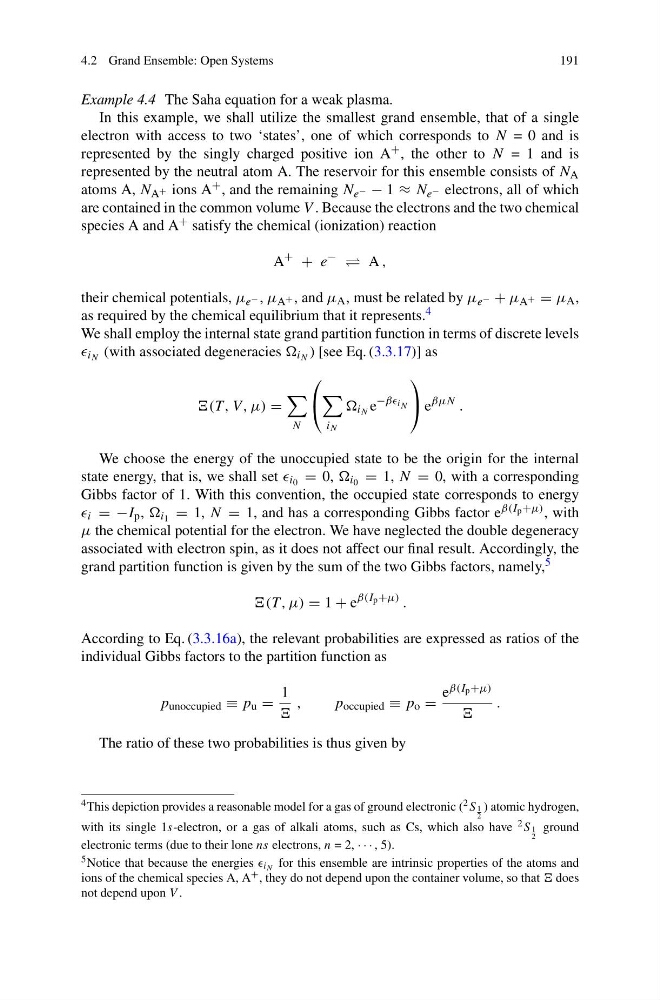
In this example, we shall utilize the smallest grand ensemble, that of a single
electron with access to two ‘states’, one of which corresponds to N = 0 and is
represented by the singly charged positive ion A + , the other to N = 1 and is
represented by the neutral atom A. The reservoir for this ensemble consists of N A
atoms A, N A + ions A + , and the remaining N e − − 1 ≈ N e − electrons, all of which
are contained in the common volume V . Because the electrons and the two chemical
species A and A + satisfy the chemical (ionization) reaction
A
+
+ e
−
A ,
their chemical potentials, μ e − , μ A + , and μ A , must be related by μ e − + μ A + = μ A ,
as required by the chemical equilibrium that it represents. 4
We shall employ the internal state grand partition function in terms of discrete levels
i N (with associated degeneracies i N ) [see Eq. (3.3.17)] as
(T , V , μ) =
N
⎛
⎝
i N
i N e
−ββ i N
⎞
⎠ e
βμN .
We choose the energy of the unoccupied state to be the origin for the internal
state energy, that is, we shall set i 0 = 0, i 0 = 1, N = 0, with a corresponding
Gibbs factor of 1. With this convention, the occupied state corresponds to energy
i = −I p , i 1 = 1, N = 1, and has a corresponding Gibbs factor e β(I p +μ) , with
μ the chemical potential for the electron. We have neglected the double degeneracy
associated with electron spin, as it does not affect our final result. Accordingly, the
grand partition function is given by the sum of the two Gibbs factors, namely, 5
, μ) = 1 + e
β(I p +μ) .
According to Eq. (3.3.16a), the relevant probabilities are expressed as ratios of the
individual Gibbs factors to the partition function as
p unoccupied ≡ p u =
1
,
p occupied ≡ p o =
e β(I p +μ)
.
The ratio of these two probabilities is thus given by
4 This depiction provides a reasonable model for a gas of ground electronic ( 2 S 1
2
) atomic hydrogen,
with its single 1s-electron, or a gas of alkali atoms, such as Cs, which also have 2 S 1
2
ground
electronic terms (due to their lone ns electrons, n = 2, · · · , 5).
5 Notice that because the energies i N for this ensemble are intrinsic properties of the atoms and
ions of the chemical species A, A + , they do not depend upon the container volume, so that does
not depend upon V .
191
Example 4.4 The Saha equation for a weak plasma.
In this example, we shall utilize the smallest grand ensemble, that of a single
electron with access to two ‘states’, one of which corresponds to N = 0 and is
represented by the singly charged positive ion A + , the other to N = 1 and is
represented by the neutral atom A. The reservoir for this ensemble consists of N A
atoms A, N A + ions A + , and the remaining N e − − 1 ≈ N e − electrons, all of which
are contained in the common volume V . Because the electrons and the two chemical
species A and A + satisfy the chemical (ionization) reaction
A
+
+ e
−
A ,
their chemical potentials, μ e − , μ A + , and μ A , must be related by μ e − + μ A + = μ A ,
as required by the chemical equilibrium that it represents. 4
We shall employ the internal state grand partition function in terms of discrete levels
i N (with associated degeneracies i N ) [see Eq. (3.3.17)] as
(T , V , μ) =
N
⎛
⎝
i N
i N e
−ββ i N
⎞
⎠ e
βμN .
We choose the energy of the unoccupied state to be the origin for the internal
state energy, that is, we shall set i 0 = 0, i 0 = 1, N = 0, with a corresponding
Gibbs factor of 1. With this convention, the occupied state corresponds to energy
i = −I p , i 1 = 1, N = 1, and has a corresponding Gibbs factor e β(I p +μ) , with
μ the chemical potential for the electron. We have neglected the double degeneracy
associated with electron spin, as it does not affect our final result. Accordingly, the
grand partition function is given by the sum of the two Gibbs factors, namely, 5
, μ) = 1 + e
β(I p +μ) .
According to Eq. (3.3.16a), the relevant probabilities are expressed as ratios of the
individual Gibbs factors to the partition function as
p unoccupied ≡ p u =
1
,
p occupied ≡ p o =
e β(I p +μ)
.
The ratio of these two probabilities is thus given by
4 This depiction provides a reasonable model for a gas of ground electronic ( 2 S 1
2
) atomic hydrogen,
with its single 1s-electron, or a gas of alkali atoms, such as Cs, which also have 2 S 1
2
ground
electronic terms (due to their lone ns electrons, n = 2, · · · , 5).
5 Notice that because the energies i N for this ensemble are intrinsic properties of the atoms and
ions of the chemical species A, A + , they do not depend upon the container volume, so that does
not depend upon V .