

182
4 Mean Values and Thermodynamics
4.1.3 Microcanonical Ensemble: Isolated System
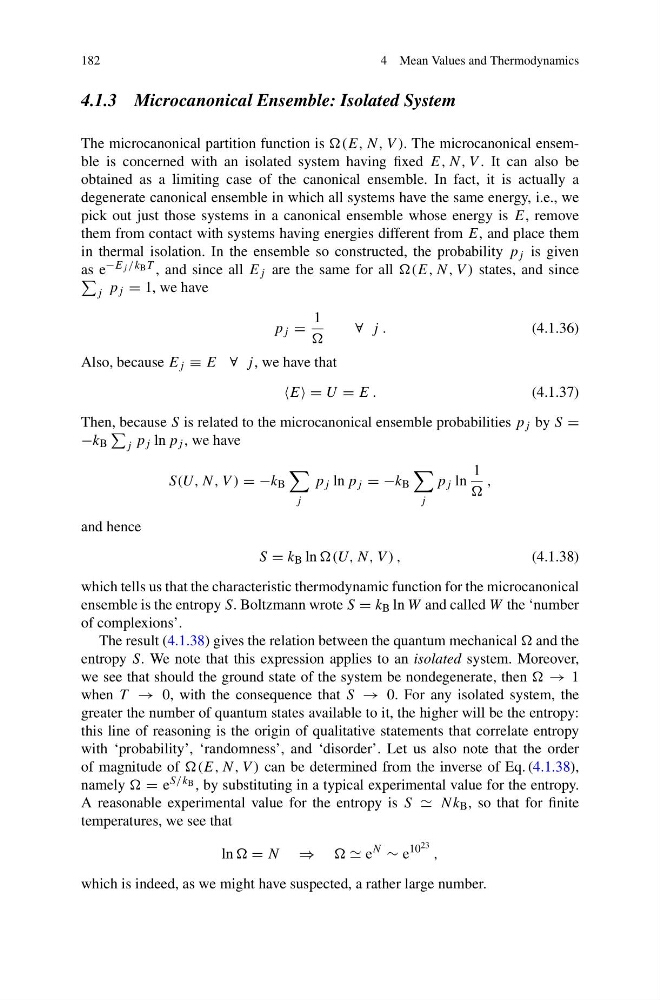
The microcanonical partition function is (E, N, V ). The microcanonical ensemble is concerned with an isolated system having fixed E, N, V . It can also be
obtained as a limiting case of the canonical ensemble. In fact, it is actually a
degenerate canonical ensemble in which all systems have the same energy, i.e., we
pick out just those systems in a canonical ensemble whose energy is E, remove
them from contact with systems having energies different from E, and place them
in thermal isolation. In the ensemble so constructed, the probability p j is given
as e −E j /k B T , and since all E j are the same for all (E, N, V ) states, and since
j p j = 1, we have
p j =
1
∀ j .
(4.1.36)
Also, because E j ≡ E ∀ j , we have that
E = U = E .
(4.1.37)
Then, because S is related to the microcanonical ensemble probabilities p j by S =
−k B
j p j ln p j , we have
S(U, N, V ) = −k B
j
p j ln p j = −k B
j
p j ln
1
,
and hence
S = k B ln (U, N, V ) ,
(4.1.38)
which tells us that the characteristic thermodynamic function for the microcanonical
ensemble is the entropy S. Boltzmann wrote S = k B ln W and called W the ‘number
of complexions’.
The result (4.1.38) gives the relation between the quantum mechanical and the
entropy S. We note that this expression applies to an isolated system. Moreover,
we see that should the ground state of the system be nondegenerate, then → 1
when T → 0, with the consequence that S → 0. For any isolated system, the
greater the number of quantum states available to it, the higher will be the entropy:
this line of reasoning is the origin of qualitative statements that correlate entropy
with ‘probability’, ‘randomness’, and ‘disorder’. Let us also note that the order
of magnitude of N, V ) can be determined from the inverse of Eq. (4.1.38),
namely = e S/k B , by substituting in a typical experimental value for the entropy.
A reasonable experimental value for the entropy is S Nk B , so that for finite
temperatures, we see that
ln = N ⇒ e
N
∼ e
10 23 ,
which is indeed, as we might have suspected, a rather large number.
4 Mean Values and Thermodynamics
4.1.3 Microcanonical Ensemble: Isolated System
The microcanonical partition function is (E, N, V ). The microcanonical ensemble is concerned with an isolated system having fixed E, N, V . It can also be
obtained as a limiting case of the canonical ensemble. In fact, it is actually a
degenerate canonical ensemble in which all systems have the same energy, i.e., we
pick out just those systems in a canonical ensemble whose energy is E, remove
them from contact with systems having energies different from E, and place them
in thermal isolation. In the ensemble so constructed, the probability p j is given
as e −E j /k B T , and since all E j are the same for all (E, N, V ) states, and since
j p j = 1, we have
p j =
1
∀ j .
(4.1.36)
Also, because E j ≡ E ∀ j , we have that
E = U = E .
(4.1.37)
Then, because S is related to the microcanonical ensemble probabilities p j by S =
−k B
j p j ln p j , we have
S(U, N, V ) = −k B
j
p j ln p j = −k B
j
p j ln
1
,
and hence
S = k B ln (U, N, V ) ,
(4.1.38)
which tells us that the characteristic thermodynamic function for the microcanonical
ensemble is the entropy S. Boltzmann wrote S = k B ln W and called W the ‘number
of complexions’.
The result (4.1.38) gives the relation between the quantum mechanical and the
entropy S. We note that this expression applies to an isolated system. Moreover,
we see that should the ground state of the system be nondegenerate, then → 1
when T → 0, with the consequence that S → 0. For any isolated system, the
greater the number of quantum states available to it, the higher will be the entropy:
this line of reasoning is the origin of qualitative statements that correlate entropy
with ‘probability’, ‘randomness’, and ‘disorder’. Let us also note that the order
of magnitude of N, V ) can be determined from the inverse of Eq. (4.1.38),
namely = e S/k B , by substituting in a typical experimental value for the entropy.
A reasonable experimental value for the entropy is S Nk B , so that for finite
temperatures, we see that
ln = N ⇒ e
N
∼ e
10 23 ,
which is indeed, as we might have suspected, a rather large number.