

178
4 Mean Values and Thermodynamics
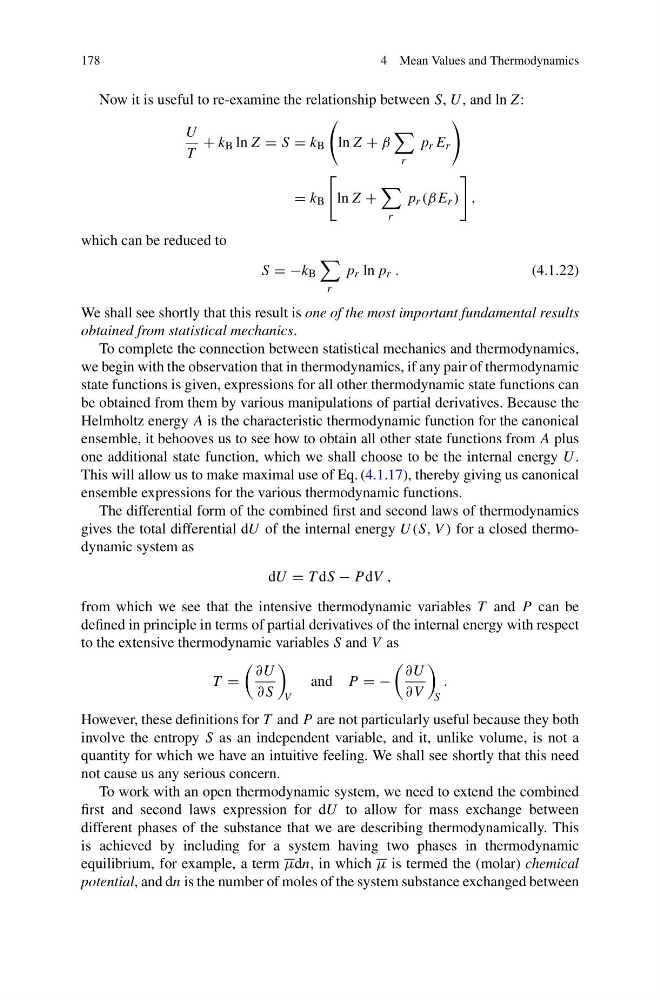
Now it is useful to re-examine the relationship between S, U , and ln Z:
U
T
+ k B ln Z = S = k B
ln Z + β
r
p r E r
= k B
ln Z +
r
p r (βE r )
,
which can be reduced to
S = −k B
r
p r ln p r .
(4.1.22)
We shall see shortly that this result is one of the most important fundamental results
obtained from statistical mechanics.
To complete the connection between statistical mechanics and thermodynamics,
we begin with the observation that in thermodynamics, if any pair of thermodynamic
state functions is given, expressions for all other thermodynamic state functions can
be obtained from them by various manipulations of partial derivatives. Because the
Helmholtz energy A is the characteristic thermodynamic function for the canonical
ensemble, it behooves us to see how to obtain all other state functions from A plus
one additional state function, which we shall choose to be the internal energy U .
This will allow us to make maximal use of Eq. (4.1.17), thereby giving us canonical
ensemble expressions for the various thermodynamic functions.
The differential form of the combined first and second laws of thermodynamics
gives the total differential dU of the internal energy U(S, V ) for a closed thermodynamic system as
dU = T dS − P dV ,
from which we see that the intensive thermodynamic variables T and P can be
defined in principle in terms of partial derivatives of the internal energy with respect
to the extensive thermodynamic variables S and V as
T =
∂U
∂S
V
and P = −
∂U
∂V
S
.
However, these definitions for T and P are not particularly useful because they both
involve the entropy S as an independent variable, and it, unlike volume, is not a
quantity for which we have an intuitive feeling. We shall see shortly that this need
not cause us any serious concern.
To work with an open thermodynamic system, we need to extend the combined
first and second laws expression for dU to allow for mass exchange between
different phases of the substance that we are describing thermodynamically. This
is achieved by including for a system having two phases in thermodynamic
equilibrium, for example, a term μdn, in which μ is termed the (molar) chemical
potential, and dn is the number of moles of the system substance exchanged between
4 Mean Values and Thermodynamics
Now it is useful to re-examine the relationship between S, U , and ln Z:
U
T
+ k B ln Z = S = k B
ln Z + β
r
p r E r
= k B
ln Z +
r
p r (βE r )
,
which can be reduced to
S = −k B
r
p r ln p r .
(4.1.22)
We shall see shortly that this result is one of the most important fundamental results
obtained from statistical mechanics.
To complete the connection between statistical mechanics and thermodynamics,
we begin with the observation that in thermodynamics, if any pair of thermodynamic
state functions is given, expressions for all other thermodynamic state functions can
be obtained from them by various manipulations of partial derivatives. Because the
Helmholtz energy A is the characteristic thermodynamic function for the canonical
ensemble, it behooves us to see how to obtain all other state functions from A plus
one additional state function, which we shall choose to be the internal energy U .
This will allow us to make maximal use of Eq. (4.1.17), thereby giving us canonical
ensemble expressions for the various thermodynamic functions.
The differential form of the combined first and second laws of thermodynamics
gives the total differential dU of the internal energy U(S, V ) for a closed thermodynamic system as
dU = T dS − P dV ,
from which we see that the intensive thermodynamic variables T and P can be
defined in principle in terms of partial derivatives of the internal energy with respect
to the extensive thermodynamic variables S and V as
T =
∂U
∂S
V
and P = −
∂U
∂V
S
.
However, these definitions for T and P are not particularly useful because they both
involve the entropy S as an independent variable, and it, unlike volume, is not a
quantity for which we have an intuitive feeling. We shall see shortly that this need
not cause us any serious concern.
To work with an open thermodynamic system, we need to extend the combined
first and second laws expression for dU to allow for mass exchange between
different phases of the substance that we are describing thermodynamically. This
is achieved by including for a system having two phases in thermodynamic
equilibrium, for example, a term μdn, in which μ is termed the (molar) chemical
potential, and dn is the number of moles of the system substance exchanged between