

4.1 Canonical Ensemble: Closed Systems
175
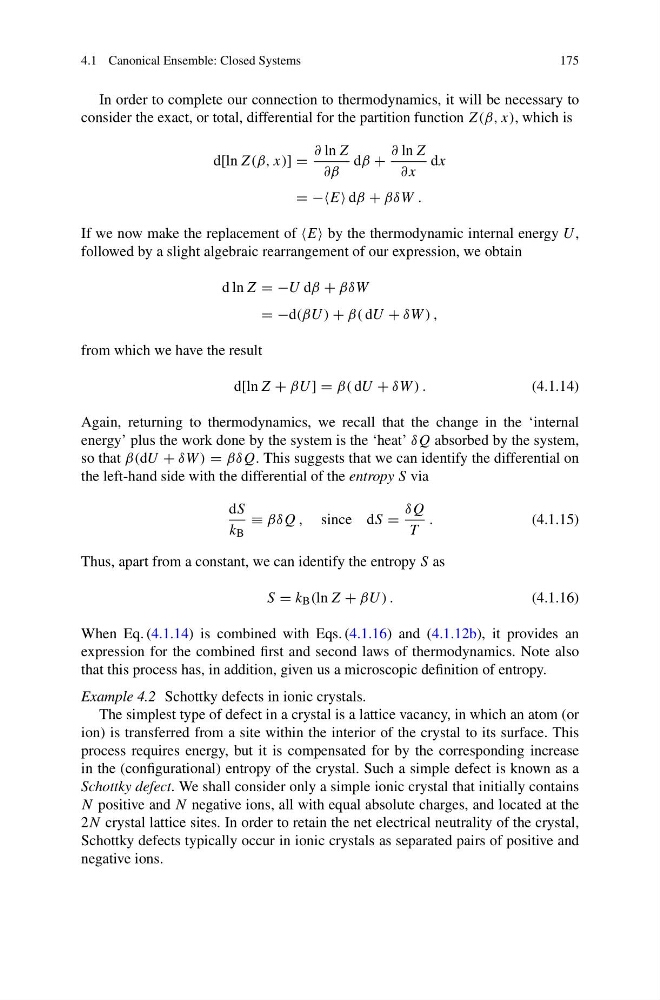
In order to complete our connection to thermodynamics, it will be necessary to
consider the exact, or total, differential for the partition function Z(β, x), which is
d[ln Z(β, x)] =
∂ ln Z
∂β
dβ +
∂ ln Z
∂x
dx
= −−E dβ + βδW .
If we now make the replacement of E by the thermodynamic internal energy U ,
followed by a slight algebraic rearrangement of our expression, we obtain
d ln Z = −U dβ + βδW
= −d(βU ) + β( dU + δW ) ,
from which we have the result
d[ln Z + βU ] = β( dU + δW ) .
(4.1.14)
Again, returning to thermodynamics, we recall that the change in the ‘internal
energy’ plus the work done by the system is the ‘heat’ δQ absorbed by the system,
so that β(dU + δW ) = βδQ. This suggests that we can identify the differential on
the left-hand side with the differential of the entropy S via
dS
k B
≡ βδQ , since dS =
δQ
T
.
(4.1.15)
Thus, apart from a constant, we can identify the entropy S as
S = k B (ln Z + βU ) .
(4.1.16)
When Eq. (4.1.14) is combined with Eqs. (4.1.16) and (4.1.12b), it provides an
expression for the combined first and second laws of thermodynamics. Note also
that this process has, in addition, given us a microscopic definition of entropy.
Example 4.2 Schottky defects in ionic crystals.
The simplest type of defect in a crystal is a lattice vacancy, in which an atom (or
ion) is transferred from a site within the interior of the crystal to its surface. This
process requires energy, but it is compensated for by the corresponding increase
in the (configurational) entropy of the crystal. Such a simple defect is known as a
Schottky defect. We shall consider only a simple ionic crystal that initially contains
N positive and N negative ions, all with equal absolute charges, and located at the
2N crystal lattice sites. In order to retain the net electrical neutrality of the crystal,
Schottky defects typically occur in ionic crystals as separated pairs of positive and
negative ions.
175
In order to complete our connection to thermodynamics, it will be necessary to
consider the exact, or total, differential for the partition function Z(β, x), which is
d[ln Z(β, x)] =
∂ ln Z
∂β
dβ +
∂ ln Z
∂x
dx
= −−E dβ + βδW .
If we now make the replacement of E by the thermodynamic internal energy U ,
followed by a slight algebraic rearrangement of our expression, we obtain
d ln Z = −U dβ + βδW
= −d(βU ) + β( dU + δW ) ,
from which we have the result
d[ln Z + βU ] = β( dU + δW ) .
(4.1.14)
Again, returning to thermodynamics, we recall that the change in the ‘internal
energy’ plus the work done by the system is the ‘heat’ δQ absorbed by the system,
so that β(dU + δW ) = βδQ. This suggests that we can identify the differential on
the left-hand side with the differential of the entropy S via
dS
k B
≡ βδQ , since dS =
δQ
T
.
(4.1.15)
Thus, apart from a constant, we can identify the entropy S as
S = k B (ln Z + βU ) .
(4.1.16)
When Eq. (4.1.14) is combined with Eqs. (4.1.16) and (4.1.12b), it provides an
expression for the combined first and second laws of thermodynamics. Note also
that this process has, in addition, given us a microscopic definition of entropy.
Example 4.2 Schottky defects in ionic crystals.
The simplest type of defect in a crystal is a lattice vacancy, in which an atom (or
ion) is transferred from a site within the interior of the crystal to its surface. This
process requires energy, but it is compensated for by the corresponding increase
in the (configurational) entropy of the crystal. Such a simple defect is known as a
Schottky defect. We shall consider only a simple ionic crystal that initially contains
N positive and N negative ions, all with equal absolute charges, and located at the
2N crystal lattice sites. In order to retain the net electrical neutrality of the crystal,
Schottky defects typically occur in ionic crystals as separated pairs of positive and
negative ions.