

170
4 Mean Values and Thermodynamics
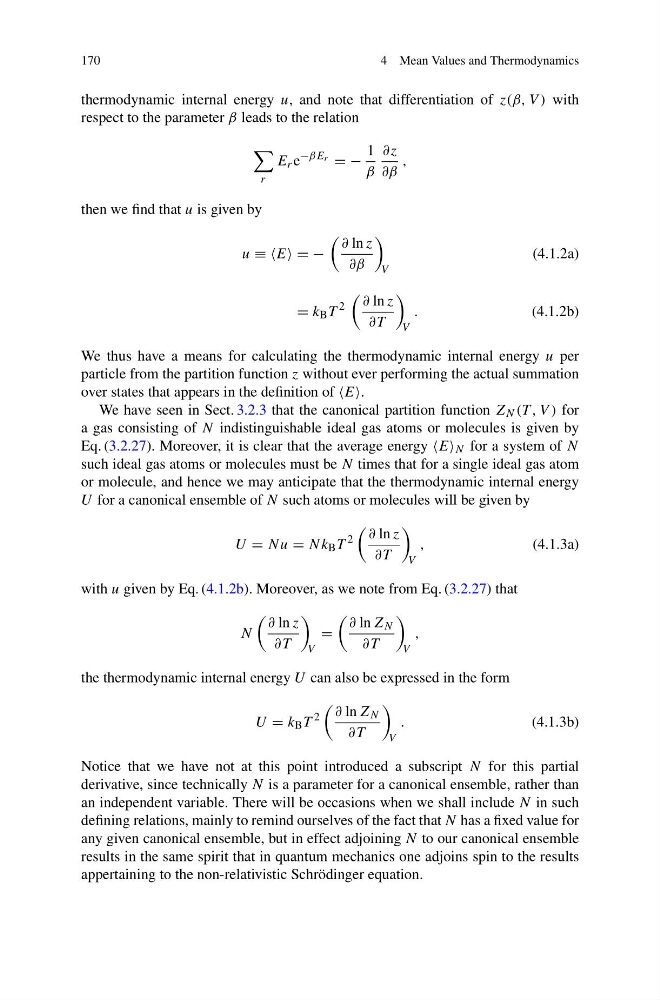
thermodynamic internal energy u, and note that differentiation of z(β, V ) with
respect to the parameter β leads to the relation
r
E r e
−βE r = −
1
β
∂z
∂β
,
then we find that u is given by
u ≡ ≡E = −
∂ ln z
∂β
V
(4.1.2a)
= k B T
2
∂ ln z
∂T
V
.
(4.1.2b)
We thus have a means for calculating the thermodynamic internal energy u per
particle from the partition function z without ever performing the actual summation
over states that appears in the definition of E.
We have seen in Sect. 3.2.3 that the canonical partition function Z N (T , V ) for
a gas consisting of N indistinguishable ideal gas atoms or molecules is given by
Eq. (3.2.27). Moreover, it is clear that the average energy E N for a system of N
such ideal gas atoms or molecules must be N times that for a single ideal gas atom
or molecule, and hence we may anticipate that the thermodynamic internal energy
U for a canonical ensemble of N such atoms or molecules will be given by
U = Nu = Nk B T
2
∂ ln z
∂T
V
,
(4.1.3a)
with u given by Eq. (4.1.2b). Moreover, as we note from Eq. (3.2.27) that
N
∂ ln z
∂T
V
=
∂ ln Z N
∂T
V
,
the thermodynamic internal energy U can also be expressed in the form
U = k B T
2
∂ ln Z N
∂T
V
.
(4.1.3b)
Notice that we have not at this point introduced a subscript N for this partial
derivative, since technically N is a parameter for a canonical ensemble, rather than
an independent variable. There will be occasions when we shall include N in such
defining relations, mainly to remind ourselves of the fact that N has a fixed value for
any given canonical ensemble, but in effect adjoining N to our canonical ensemble
results in the same spirit that in quantum mechanics one adjoins spin to the results
appertaining to the non-relativistic Schrödinger equation.
4 Mean Values and Thermodynamics
thermodynamic internal energy u, and note that differentiation of z(β, V ) with
respect to the parameter β leads to the relation
r
E r e
−βE r = −
1
β
∂z
∂β
,
then we find that u is given by
u ≡ ≡E = −
∂ ln z
∂β
V
(4.1.2a)
= k B T
2
∂ ln z
∂T
V
.
(4.1.2b)
We thus have a means for calculating the thermodynamic internal energy u per
particle from the partition function z without ever performing the actual summation
over states that appears in the definition of E.
We have seen in Sect. 3.2.3 that the canonical partition function Z N (T , V ) for
a gas consisting of N indistinguishable ideal gas atoms or molecules is given by
Eq. (3.2.27). Moreover, it is clear that the average energy E N for a system of N
such ideal gas atoms or molecules must be N times that for a single ideal gas atom
or molecule, and hence we may anticipate that the thermodynamic internal energy
U for a canonical ensemble of N such atoms or molecules will be given by
U = Nu = Nk B T
2
∂ ln z
∂T
V
,
(4.1.3a)
with u given by Eq. (4.1.2b). Moreover, as we note from Eq. (3.2.27) that
N
∂ ln z
∂T
V
=
∂ ln Z N
∂T
V
,
the thermodynamic internal energy U can also be expressed in the form
U = k B T
2
∂ ln Z N
∂T
V
.
(4.1.3b)
Notice that we have not at this point introduced a subscript N for this partial
derivative, since technically N is a parameter for a canonical ensemble, rather than
an independent variable. There will be occasions when we shall include N in such
defining relations, mainly to remind ourselves of the fact that N has a fixed value for
any given canonical ensemble, but in effect adjoining N to our canonical ensemble
results in the same spirit that in quantum mechanics one adjoins spin to the results
appertaining to the non-relativistic Schrödinger equation.