

164
3 Ensembles: Systems of Particles
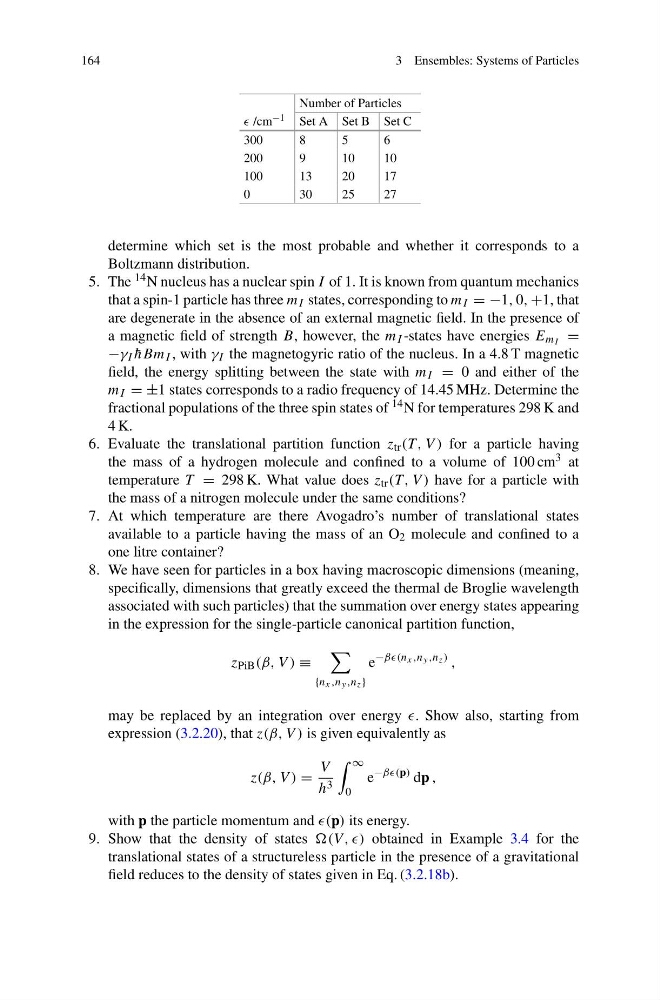
Number of Particles
/cm −1 Set A Set B Set C
300
8
5
6
200
9
10
10
100
13
20
17
0
30
25
27
determine which set is the most probable and whether it corresponds to a
Boltzmann distribution.
5. The 14 N nucleus has a nuclear spin I of 1. It is known from quantum mechanics
that a spin-1 particle has three m I states, corresponding to m I = −1, 0, +1, that
are degenerate in the absence of an external magnetic field. In the presence of
a magnetic field of strength B, however, the m I -states have energies E m I =
−γ I ¯
hBm I , with γ I the magnetogyric ratio of the nucleus. In a 4.8 T magnetic
field, the energy splitting between the state with m I = 0 and either of the
m I = ±1 states corresponds to a radio frequency of 14.45 MHz. Determine the
fractional populations of the three spin states of 14 N for temperatures 298 K and
4 K.
6. Evaluate the translational partition function z tr (T , V ) for a particle having
the mass of a hydrogen molecule and confined to a volume of 100 cm 3 at
temperature T = 298 K. What value does z tr (T , V ) have for a particle with
the mass of a nitrogen molecule under the same conditions?
7. At which temperature are there Avogadro’s number of translational states
available to a particle having the mass of an O 2 molecule and confined to a
one litre container?
8. We have seen for particles in a box having macroscopic dimensions (meaning,
specifically, dimensions that greatly exceed the thermal de Broglie wavelength
associated with such particles) that the summation over energy states appearing
in the expression for the single-particle canonical partition function,
z PiB (β, V ) ≡
{n x ,n y ,n z }
e
−ββ(n x ,n y ,n z ) ,
may be replaced by an integration over energy . Show also, starting from
expression (3.2.20), that z(β, V ) is given equivalently as
z(β, V ) =
V
h 3
∞
0
e
−ββ(p) dp ,
with p the particle momentum and (p) its energy.
9. Show that the density of states (V , ,) obtained in Example 3.4 for the
translational states of a structureless particle in the presence of a gravitational
field reduces to the density of states given in Eq. (3.2.18b).
3 Ensembles: Systems of Particles
Number of Particles
/cm −1 Set A Set B Set C
300
8
5
6
200
9
10
10
100
13
20
17
0
30
25
27
determine which set is the most probable and whether it corresponds to a
Boltzmann distribution.
5. The 14 N nucleus has a nuclear spin I of 1. It is known from quantum mechanics
that a spin-1 particle has three m I states, corresponding to m I = −1, 0, +1, that
are degenerate in the absence of an external magnetic field. In the presence of
a magnetic field of strength B, however, the m I -states have energies E m I =
−γ I ¯
hBm I , with γ I the magnetogyric ratio of the nucleus. In a 4.8 T magnetic
field, the energy splitting between the state with m I = 0 and either of the
m I = ±1 states corresponds to a radio frequency of 14.45 MHz. Determine the
fractional populations of the three spin states of 14 N for temperatures 298 K and
4 K.
6. Evaluate the translational partition function z tr (T , V ) for a particle having
the mass of a hydrogen molecule and confined to a volume of 100 cm 3 at
temperature T = 298 K. What value does z tr (T , V ) have for a particle with
the mass of a nitrogen molecule under the same conditions?
7. At which temperature are there Avogadro’s number of translational states
available to a particle having the mass of an O 2 molecule and confined to a
one litre container?
8. We have seen for particles in a box having macroscopic dimensions (meaning,
specifically, dimensions that greatly exceed the thermal de Broglie wavelength
associated with such particles) that the summation over energy states appearing
in the expression for the single-particle canonical partition function,
z PiB (β, V ) ≡
{n x ,n y ,n z }
e
−ββ(n x ,n y ,n z ) ,
may be replaced by an integration over energy . Show also, starting from
expression (3.2.20), that z(β, V ) is given equivalently as
z(β, V ) =
V
h 3
∞
0
e
−ββ(p) dp ,
with p the particle momentum and (p) its energy.
9. Show that the density of states (V , ,) obtained in Example 3.4 for the
translational states of a structureless particle in the presence of a gravitational
field reduces to the density of states given in Eq. (3.2.18b).