

152
3 Ensembles: Systems of Particles
typically utilize the continuum approximation in which the summation over energy
states is replaced by an integration over energy and the degeneracy factor i for a
given energy state is replaced by the continuous density of states function (V , E).
3.2.3 Extension to N-Particle Systems
For systems made up of many particles (most often atoms and/or molecules) we
could proceed in either of two fashions. Formally, the most obvious means for
extending our discussion would be to consider the energy eigenstates entering into
the discrete states defining relation (3.2.20) to be the eigenstates of the N -particle
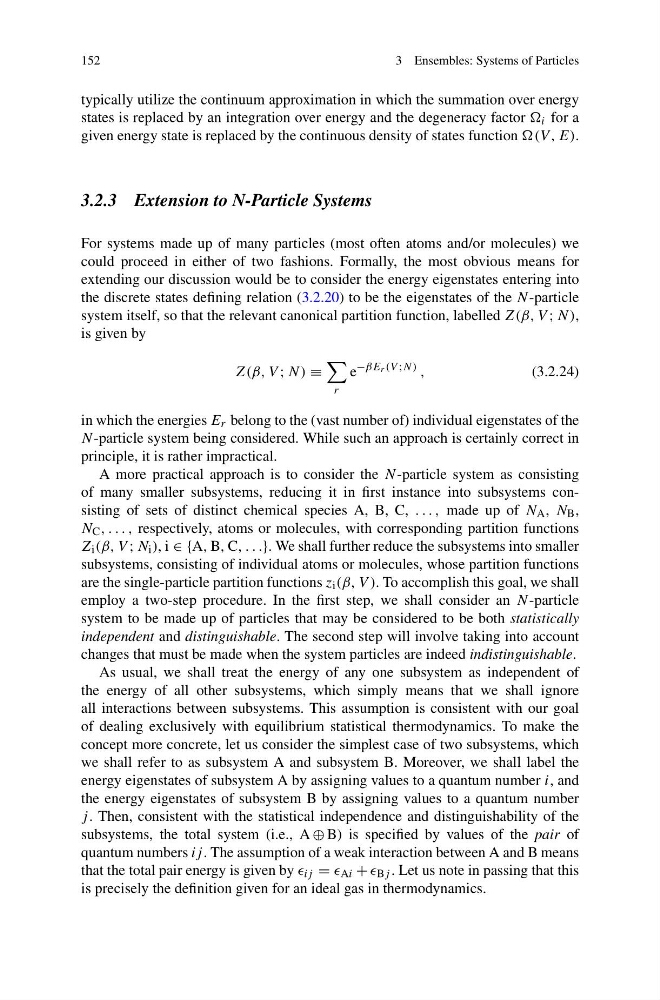
system itself, so that the relevant canonical partition function, labelled Z(β, V ; N),
is given by
Z(β, V ; N) ≡
r
e
−βE r (V ;N) ,
(3.2.24)
in which the energies E r belong to the (vast number of) individual eigenstates of the
N -particle system being considered. While such an approach is certainly correct in
principle, it is rather impractical.
A more practical approach is to consider the N-particle system as consisting
of many smaller subsystems, reducing it in first instance into subsystems consisting of sets of distinct chemical species A, B, C, . . . , made up of N A , N B ,
N C , . . . , respectively, atoms or molecules, with corresponding partition functions
Z i (β, V ; N i ), i ∈ {A, B, C, . . .}. We shall further reduce the subsystems into smaller
subsystems, consisting of individual atoms or molecules, whose partition functions
are the single-particle partition functions z i (β, V ). To accomplish this goal, we shall
employ a two-step procedure. In the first step, we shall consider an N-particle
system to be made up of particles that may be considered to be both statistically
independent and distinguishable. The second step will involve taking into account
changes that must be made when the system particles are indeed indistinguishable.
As usual, we shall treat the energy of any one subsystem as independent of
the energy of all other subsystems, which simply means that we shall ignore
all interactions between subsystems. This assumption is consistent with our goal
of dealing exclusively with equilibrium statistical thermodynamics. To make the
concept more concrete, let us consider the simplest case of two subsystems, which
we shall refer to as subsystem A and subsystem B. Moreover, we shall label the
energy eigenstates of subsystem A by assigning values to a quantum number i, and
the energy eigenstates of subsystem B by assigning values to a quantum number
j . Then, consistent with the statistical independence and distinguishability of the
subsystems, the total system (i.e., A ⊕ B) is specified by values of the pair of
quantum numbers ij . The assumption of a weak interaction between A and B means
that the total pair energy is given by ij = Ai + Bj . Let us note in passing that this
is precisely the definition given for an ideal gas in thermodynamics.
3 Ensembles: Systems of Particles
typically utilize the continuum approximation in which the summation over energy
states is replaced by an integration over energy and the degeneracy factor i for a
given energy state is replaced by the continuous density of states function (V , E).
3.2.3 Extension to N-Particle Systems
For systems made up of many particles (most often atoms and/or molecules) we
could proceed in either of two fashions. Formally, the most obvious means for
extending our discussion would be to consider the energy eigenstates entering into
the discrete states defining relation (3.2.20) to be the eigenstates of the N -particle
system itself, so that the relevant canonical partition function, labelled Z(β, V ; N),
is given by
Z(β, V ; N) ≡
r
e
−βE r (V ;N) ,
(3.2.24)
in which the energies E r belong to the (vast number of) individual eigenstates of the
N -particle system being considered. While such an approach is certainly correct in
principle, it is rather impractical.
A more practical approach is to consider the N-particle system as consisting
of many smaller subsystems, reducing it in first instance into subsystems consisting of sets of distinct chemical species A, B, C, . . . , made up of N A , N B ,
N C , . . . , respectively, atoms or molecules, with corresponding partition functions
Z i (β, V ; N i ), i ∈ {A, B, C, . . .}. We shall further reduce the subsystems into smaller
subsystems, consisting of individual atoms or molecules, whose partition functions
are the single-particle partition functions z i (β, V ). To accomplish this goal, we shall
employ a two-step procedure. In the first step, we shall consider an N-particle
system to be made up of particles that may be considered to be both statistically
independent and distinguishable. The second step will involve taking into account
changes that must be made when the system particles are indeed indistinguishable.
As usual, we shall treat the energy of any one subsystem as independent of
the energy of all other subsystems, which simply means that we shall ignore
all interactions between subsystems. This assumption is consistent with our goal
of dealing exclusively with equilibrium statistical thermodynamics. To make the
concept more concrete, let us consider the simplest case of two subsystems, which
we shall refer to as subsystem A and subsystem B. Moreover, we shall label the
energy eigenstates of subsystem A by assigning values to a quantum number i, and
the energy eigenstates of subsystem B by assigning values to a quantum number
j . Then, consistent with the statistical independence and distinguishability of the
subsystems, the total system (i.e., A ⊕ B) is specified by values of the pair of
quantum numbers ij . The assumption of a weak interaction between A and B means
that the total pair energy is given by ij = Ai + Bj . Let us note in passing that this
is precisely the definition given for an ideal gas in thermodynamics.