

3.2 The Canonical Ensemble: Closed Systems
145
z Si (T ) = 1 + 3e
−111.0/T
+ 5e
−321.1/T
+ 5e
−9063/T
+ · · · ,
for a Si atom, with the ellipsis (· · · ) representing the contributions from all
excited terms/levels with energies greater than that of the 1 D 2 level. The equivalent
expression for a Ge atom is
z Ge (T ) = 1 + 3e
−801.6/T
+ 5e
−2028.5/T
+ 5e
−10252/T
+ · · · .
We shall call our pseudoatom comparator systems Si ∗ and Ge ∗ , each with nondegenerate electronic levels 3 P 0 , 3 P ∗
1 , 3 P ∗
2 . These pseudoatoms will then have partition
functions
z Si ∗ (T ) = 1 + e
−111.0/T
+ e
−321.1/T
+ e
−9063/T
+ · · · ,
and
z Ge ∗ (T ) = 1 + e
−801.6/T
+ e
−2028.5/T
+ e
−10252/T
+ · · · .
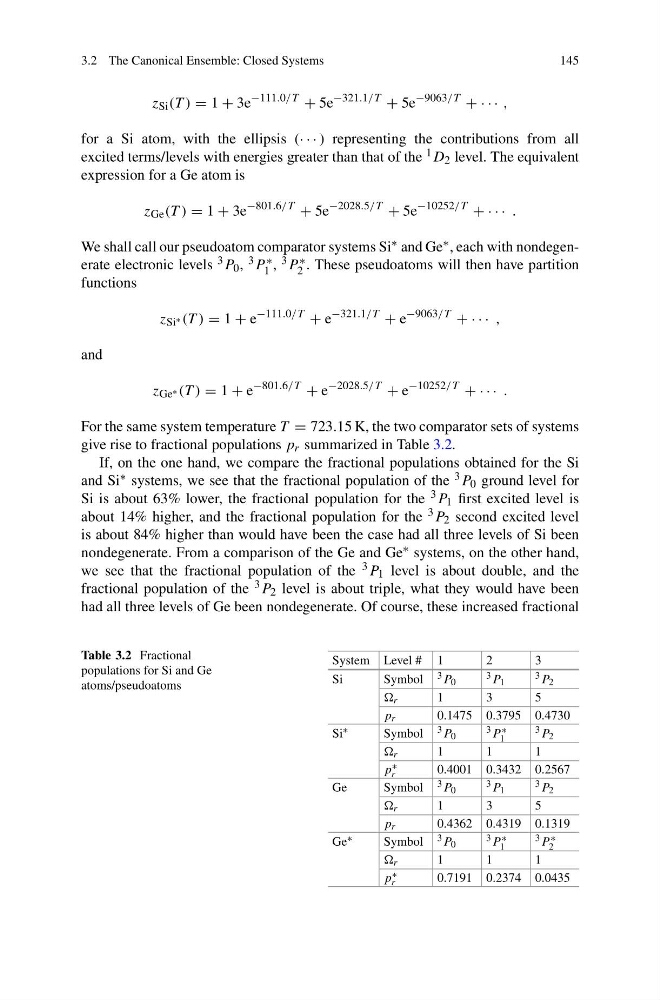
For the same system temperature T = 723.15 K, the two comparator sets of systems
give rise to fractional populations p r summarized in Table 3.2.
If, on the one hand, we compare the fractional populations obtained for the Si
and Si ∗ systems, we see that the fractional population of the 3 P 0 ground level for
Si is about 63% lower, the fractional population for the 3 P 1 first excited level is
about 14% higher, and the fractional population for the 3 P 2 second excited level
is about 84% higher than would have been the case had all three levels of Si been
nondegenerate. From a comparison of the Ge and Ge ∗ systems, on the other hand,
we see that the fractional population of the 3 P 1 level is about double, and the
fractional population of the 3 P 2 level is about triple, what they would have been
had all three levels of Ge been nondegenerate. Of course, these increased fractional
Table 3.2 Fractional
populations for Si and Ge
atoms/pseudoatoms
System Level # 1
2
3
Si
Symbol 3 P 0
3 P 1
3 P 2
r
1
3
5
p r
0.1475 0.3795 0.4730
Si ∗
Symbol 3 P 0
3 P ∗
1
3 P 2
r
1
1
1
p ∗
r
0.4001 0.3432 0.2567
Ge
Symbol 3 P 0
3 P 1
3 P 2
r
1
3
5
p r
0.4362 0.4319 0.1319
Ge ∗
Symbol 3 P 0
3 P ∗
1
3 P ∗
2
r
1
1
1
p ∗
r
0.7191 0.2374 0.0435
145
z Si (T ) = 1 + 3e
−111.0/T
+ 5e
−321.1/T
+ 5e
−9063/T
+ · · · ,
for a Si atom, with the ellipsis (· · · ) representing the contributions from all
excited terms/levels with energies greater than that of the 1 D 2 level. The equivalent
expression for a Ge atom is
z Ge (T ) = 1 + 3e
−801.6/T
+ 5e
−2028.5/T
+ 5e
−10252/T
+ · · · .
We shall call our pseudoatom comparator systems Si ∗ and Ge ∗ , each with nondegenerate electronic levels 3 P 0 , 3 P ∗
1 , 3 P ∗
2 . These pseudoatoms will then have partition
functions
z Si ∗ (T ) = 1 + e
−111.0/T
+ e
−321.1/T
+ e
−9063/T
+ · · · ,
and
z Ge ∗ (T ) = 1 + e
−801.6/T
+ e
−2028.5/T
+ e
−10252/T
+ · · · .
For the same system temperature T = 723.15 K, the two comparator sets of systems
give rise to fractional populations p r summarized in Table 3.2.
If, on the one hand, we compare the fractional populations obtained for the Si
and Si ∗ systems, we see that the fractional population of the 3 P 0 ground level for
Si is about 63% lower, the fractional population for the 3 P 1 first excited level is
about 14% higher, and the fractional population for the 3 P 2 second excited level
is about 84% higher than would have been the case had all three levels of Si been
nondegenerate. From a comparison of the Ge and Ge ∗ systems, on the other hand,
we see that the fractional population of the 3 P 1 level is about double, and the
fractional population of the 3 P 2 level is about triple, what they would have been
had all three levels of Ge been nondegenerate. Of course, these increased fractional
Table 3.2 Fractional
populations for Si and Ge
atoms/pseudoatoms
System Level # 1
2
3
Si
Symbol 3 P 0
3 P 1
3 P 2
r
1
3
5
p r
0.1475 0.3795 0.4730
Si ∗
Symbol 3 P 0
3 P ∗
1
3 P 2
r
1
1
1
p ∗
r
0.4001 0.3432 0.2567
Ge
Symbol 3 P 0
3 P 1
3 P 2
r
1
3
5
p r
0.4362 0.4319 0.1319
Ge ∗
Symbol 3 P 0
3 P ∗
1
3 P ∗
2
r
1
1
1
p ∗
r
0.7191 0.2374 0.0435