

134
3 Ensembles: Systems of Particles
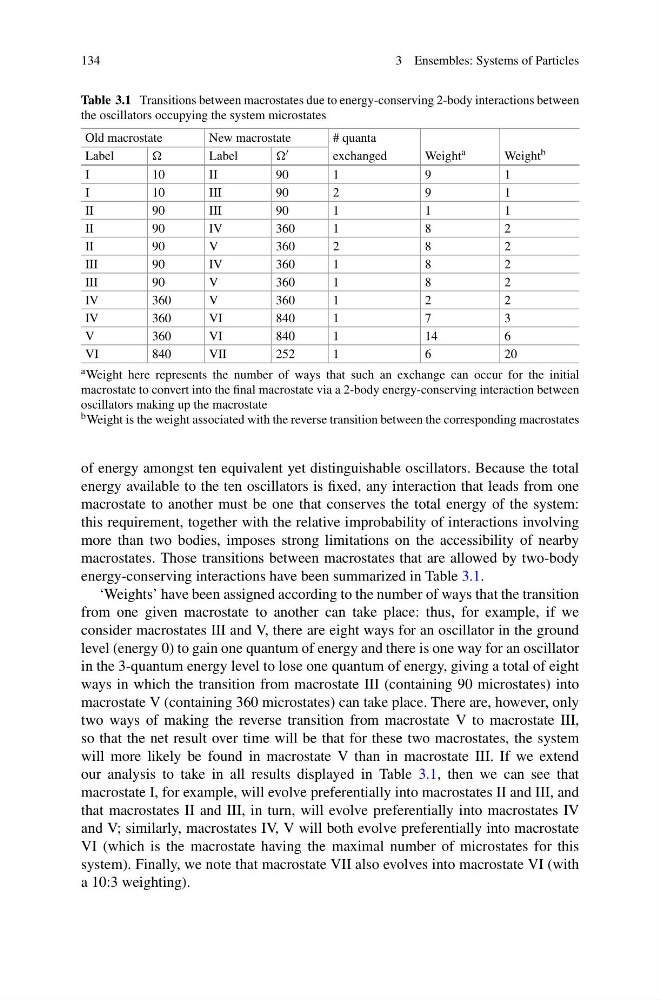
Table 3.1 Transitions between macrostates due to energy-conserving 2-body interactions between
the oscillators occupying the system microstates
Old macrostate
New macrostate
# quanta
Label
Label
exchanged
Weight a
Weight b
I
10
II
90
1
9
1
I
10
III
90
2
9
1
II
90
III
90
1
1
1
II
90
IV
360
1
8
2
II
90
V
360
2
8
2
III
90
IV
360
1
8
2
III
90
V
360
1
8
2
IV
360
V
360
1
2
2
IV
360
VI
840
1
7
3
V
360
VI
840
1
14
6
VI
840
VII
252
1
6
20
a Weight here represents the number of ways that such an exchange can occur for the initial
macrostate to convert into the final macrostate via a 2-body energy-conserving interaction between
oscillators making up the macrostate
b Weight is the weight associated with the reverse transition between the corresponding macrostates
of energy amongst ten equivalent yet distinguishable oscillators. Because the total
energy available to the ten oscillators is fixed, any interaction that leads from one
macrostate to another must be one that conserves the total energy of the system:
this requirement, together with the relative improbability of interactions involving
more than two bodies, imposes strong limitations on the accessibility of nearby
macrostates. Those transitions between macrostates that are allowed by two-body
energy-conserving interactions have been summarized in Table 3.1.
‘Weights’ have been assigned according to the number of ways that the transition
from one given macrostate to another can take place: thus, for example, if we
consider macrostates III and V, there are eight ways for an oscillator in the ground
level (energy 0) to gain one quantum of energy and there is one way for an oscillator
in the 3-quantum energy level to lose one quantum of energy, giving a total of eight
ways in which the transition from macrostate III (containing 90 microstates) into
macrostate V (containing 360 microstates) can take place. There are, however, only
two ways of making the reverse transition from macrostate V to macrostate III,
so that the net result over time will be that for these two macrostates, the system
will more likely be found in macrostate V than in macrostate III. If we extend
our analysis to take in all results displayed in Table 3.1, then we can see that
macrostate I, for example, will evolve preferentially into macrostates II and III, and
that macrostates II and III, in turn, will evolve preferentially into macrostates IV
and V; similarly, macrostates IV, V will both evolve preferentially into macrostate
VI (which is the macrostate having the maximal number of microstates for this
system). Finally, we note that macrostate VII also evolves into macrostate VI (with
a 10:3 weighting).
3 Ensembles: Systems of Particles
Table 3.1 Transitions between macrostates due to energy-conserving 2-body interactions between
the oscillators occupying the system microstates
Old macrostate
New macrostate
# quanta
Label
Label
exchanged
Weight a
Weight b
I
10
II
90
1
9
1
I
10
III
90
2
9
1
II
90
III
90
1
1
1
II
90
IV
360
1
8
2
II
90
V
360
2
8
2
III
90
IV
360
1
8
2
III
90
V
360
1
8
2
IV
360
V
360
1
2
2
IV
360
VI
840
1
7
3
V
360
VI
840
1
14
6
VI
840
VII
252
1
6
20
a Weight here represents the number of ways that such an exchange can occur for the initial
macrostate to convert into the final macrostate via a 2-body energy-conserving interaction between
oscillators making up the macrostate
b Weight is the weight associated with the reverse transition between the corresponding macrostates
of energy amongst ten equivalent yet distinguishable oscillators. Because the total
energy available to the ten oscillators is fixed, any interaction that leads from one
macrostate to another must be one that conserves the total energy of the system:
this requirement, together with the relative improbability of interactions involving
more than two bodies, imposes strong limitations on the accessibility of nearby
macrostates. Those transitions between macrostates that are allowed by two-body
energy-conserving interactions have been summarized in Table 3.1.
‘Weights’ have been assigned according to the number of ways that the transition
from one given macrostate to another can take place: thus, for example, if we
consider macrostates III and V, there are eight ways for an oscillator in the ground
level (energy 0) to gain one quantum of energy and there is one way for an oscillator
in the 3-quantum energy level to lose one quantum of energy, giving a total of eight
ways in which the transition from macrostate III (containing 90 microstates) into
macrostate V (containing 360 microstates) can take place. There are, however, only
two ways of making the reverse transition from macrostate V to macrostate III,
so that the net result over time will be that for these two macrostates, the system
will more likely be found in macrostate V than in macrostate III. If we extend
our analysis to take in all results displayed in Table 3.1, then we can see that
macrostate I, for example, will evolve preferentially into macrostates II and III, and
that macrostates II and III, in turn, will evolve preferentially into macrostates IV
and V; similarly, macrostates IV, V will both evolve preferentially into macrostate
VI (which is the macrostate having the maximal number of microstates for this
system). Finally, we note that macrostate VII also evolves into macrostate VI (with
a 10:3 weighting).