

122
2 Macroscopic Thermodynamics
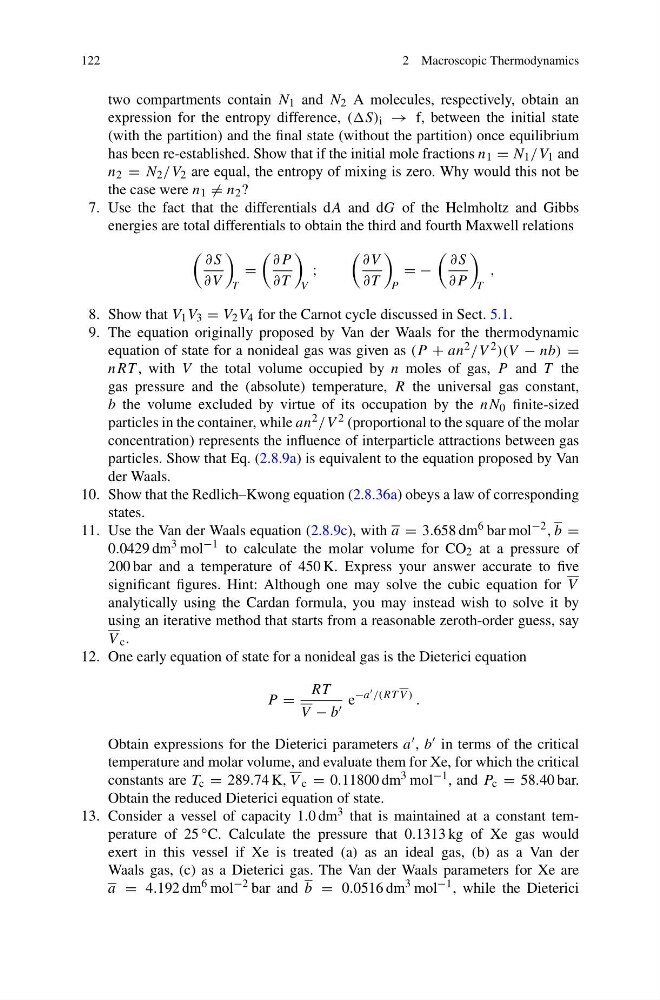
two compartments contain N 1 and N 2 A molecules, respectively, obtain an
expression for the entropy difference, ((S) i → f, between the initial state
(with the partition) and the final state (without the partition) once equilibrium
has been re-established. Show that if the initial mole fractions n 1 = N 1 /V 1 and
n 2 = N 2 /V 2 are equal, the entropy of mixing is zero. Why would this not be
the case were n 1 = n 2 ?
7. Use the fact that the differentials dA and dG of the Helmholtz and Gibbs
energies are total differentials to obtain the third and fourth Maxwell relations
∂S
∂V
T
=
∂P
∂T
V
;
∂V
∂T
P
= −
∂S
∂P
T
,
8. Show that V 1 V 3 = V 2 V 4 for the Carnot cycle discussed in Sect. 5.1.
9. The equation originally proposed by Van der Waals for the thermodynamic
equation of state for a nonideal gas was given as (P + an 2 /V 2 )(V − nb) =
nRT , with V the total volume occupied by n moles of gas, P and T the
gas pressure and the (absolute) temperature, R the universal gas constant,
b the volume excluded by virtue of its occupation by the nN 0 finite-sized
particles in the container, while an 2 /V 2 (proportional to the square of the molar
concentration) represents the influence of interparticle attractions between gas
particles. Show that Eq. (2.8.9a) is equivalent to the equation proposed by Van
der Waals.
10. Show that the Redlich–Kwong equation (2.8.36a) obeys a law of corresponding
states.
11. Use the Van der Waals equation (2.8.9c), with a = 3.658 dm
6 bar mol
−2 , b =
0.0429 dm
3 mol
−1 to calculate the molar volume for CO 2 at a pressure of
200 bar and a temperature of 450 K. Express your answer accurate to five
significant figures. Hint: Although one may solve the cubic equation for V
analytically using the Cardan formula, you may instead wish to solve it by
using an iterative method that starts from a reasonable zeroth-order guess, say
V c .
12. One early equation of state for a nonideal gas is the Dieterici equation
P =
RT
V − b
e
−a /(RT V ) .
Obtain expressions for the Dieterici parameters a , b in terms of the critical
temperature and molar volume, and evaluate them for Xe, for which the critical
constants are T c = 289.74 K, V c = 0.11800 dm
3 mol
−1 , and P c = 58.40 bar.
Obtain the reduced Dieterici equation of state.
13. Consider a vessel of capacity 1.0 dm 3 that is maintained at a constant temperature of 25 ◦ C. Calculate the pressure that 0.1313 kg of Xe gas would
exert in this vessel if Xe is treated (a) as an ideal gas, (b) as a Van der
Waals gas, (c) as a Dieterici gas. The Van der Waals parameters for Xe are
a = 4.192 dm
6 mol
−2 bar and b = 0.0516 dm
3 mol
−1 , while the Dieterici
2 Macroscopic Thermodynamics
two compartments contain N 1 and N 2 A molecules, respectively, obtain an
expression for the entropy difference, ((S) i → f, between the initial state
(with the partition) and the final state (without the partition) once equilibrium
has been re-established. Show that if the initial mole fractions n 1 = N 1 /V 1 and
n 2 = N 2 /V 2 are equal, the entropy of mixing is zero. Why would this not be
the case were n 1 = n 2 ?
7. Use the fact that the differentials dA and dG of the Helmholtz and Gibbs
energies are total differentials to obtain the third and fourth Maxwell relations
∂S
∂V
T
=
∂P
∂T
V
;
∂V
∂T
P
= −
∂S
∂P
T
,
8. Show that V 1 V 3 = V 2 V 4 for the Carnot cycle discussed in Sect. 5.1.
9. The equation originally proposed by Van der Waals for the thermodynamic
equation of state for a nonideal gas was given as (P + an 2 /V 2 )(V − nb) =
nRT , with V the total volume occupied by n moles of gas, P and T the
gas pressure and the (absolute) temperature, R the universal gas constant,
b the volume excluded by virtue of its occupation by the nN 0 finite-sized
particles in the container, while an 2 /V 2 (proportional to the square of the molar
concentration) represents the influence of interparticle attractions between gas
particles. Show that Eq. (2.8.9a) is equivalent to the equation proposed by Van
der Waals.
10. Show that the Redlich–Kwong equation (2.8.36a) obeys a law of corresponding
states.
11. Use the Van der Waals equation (2.8.9c), with a = 3.658 dm
6 bar mol
−2 , b =
0.0429 dm
3 mol
−1 to calculate the molar volume for CO 2 at a pressure of
200 bar and a temperature of 450 K. Express your answer accurate to five
significant figures. Hint: Although one may solve the cubic equation for V
analytically using the Cardan formula, you may instead wish to solve it by
using an iterative method that starts from a reasonable zeroth-order guess, say
V c .
12. One early equation of state for a nonideal gas is the Dieterici equation
P =
RT
V − b
e
−a /(RT V ) .
Obtain expressions for the Dieterici parameters a , b in terms of the critical
temperature and molar volume, and evaluate them for Xe, for which the critical
constants are T c = 289.74 K, V c = 0.11800 dm
3 mol
−1 , and P c = 58.40 bar.
Obtain the reduced Dieterici equation of state.
13. Consider a vessel of capacity 1.0 dm 3 that is maintained at a constant temperature of 25 ◦ C. Calculate the pressure that 0.1313 kg of Xe gas would
exert in this vessel if Xe is treated (a) as an ideal gas, (b) as a Van der
Waals gas, (c) as a Dieterici gas. The Van der Waals parameters for Xe are
a = 4.192 dm
6 mol
−2 bar and b = 0.0516 dm
3 mol
−1 , while the Dieterici