

110
2 Macroscopic Thermodynamics
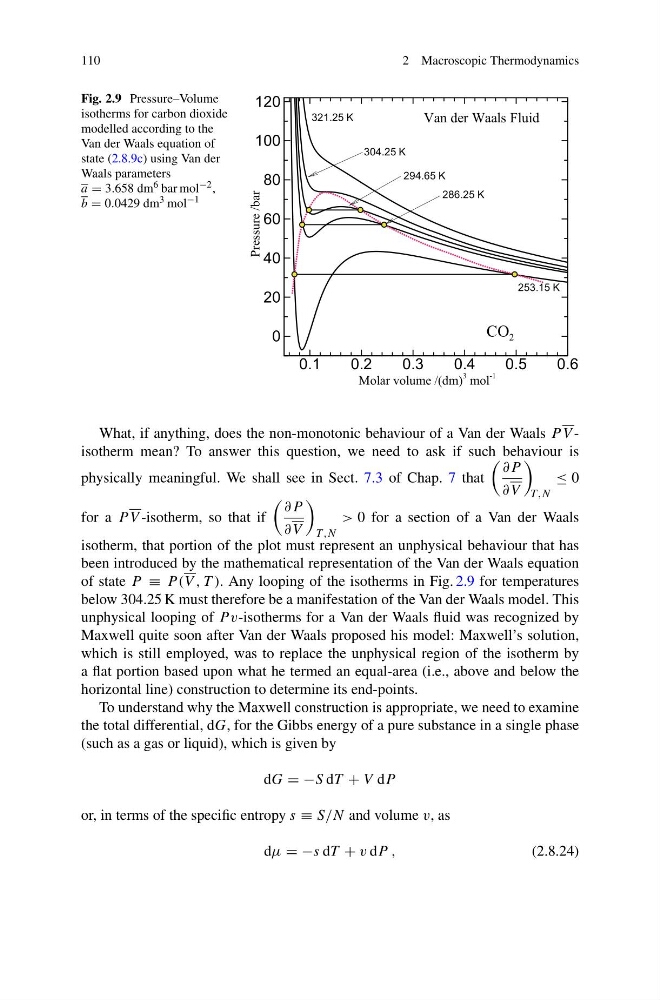
Fig. 2.9 Pressure–Volume
isotherms for carbon dioxide
modelled according to the
Van der Waals equation of
state (2.8.9c) using Van der
Waals parameters
a = 3.658 dm 6 bar mol
−2 ,
b = 0.0429 dm 3 mol
−1
0.1
0.2
0.3
0.4
0.5
0.6
0
20
40
60
80
100
120
Molar volume /(dm)
3 mol
-1
Pressure /bar
Van der Waals Fluid
CO 2
321.25 K
304.25 K
294.65 K
253.15 K
286.25 K
What, if anything, does the non-monotonic behaviour of a Van der Waals P V -
isotherm mean? To answer this question, we need to ask if such behaviour is
physically meaningful. We shall see in Sect. 7.3 of Chap. 7 that
∂P
∂V
T ,N
≤ 0
for a P V -isotherm, so that if
∂P
∂V
T ,N
> 0 for a section of a Van der Waals
isotherm, that portion of the plot must represent an unphysical behaviour that has
been introduced by the mathematical representation of the Van der Waals equation
of state P ≡ P (V , T ). Any looping of the isotherms in Fig. 2.9 for temperatures
below 304.25 K must therefore be a manifestation of the Van der Waals model. This
unphysical looping of P v-isotherms for a Van der Waals fluid was recognized by
Maxwell quite soon after Van der Waals proposed his model: Maxwell’s solution,
which is still employed, was to replace the unphysical region of the isotherm by
a flat portion based upon what he termed an equal-area (i.e., above and below the
horizontal line) construction to determine its end-points.
To understand why the Maxwell construction is appropriate, we need to examine
the total differential, dG, for the Gibbs energy of a pure substance in a single phase
(such as a gas or liquid), which is given by
dG = −S dT + V dP
or, in terms of the specific entropy s ≡ S/N and volume v, as
dμ = −s dT + v dP ,
(2.8.24)
2 Macroscopic Thermodynamics
Fig. 2.9 Pressure–Volume
isotherms for carbon dioxide
modelled according to the
Van der Waals equation of
state (2.8.9c) using Van der
Waals parameters
a = 3.658 dm 6 bar mol
−2 ,
b = 0.0429 dm 3 mol
−1
0.1
0.2
0.3
0.4
0.5
0.6
0
20
40
60
80
100
120
Molar volume /(dm)
3 mol
-1
Pressure /bar
Van der Waals Fluid
CO 2
321.25 K
304.25 K
294.65 K
253.15 K
286.25 K
What, if anything, does the non-monotonic behaviour of a Van der Waals P V -
isotherm mean? To answer this question, we need to ask if such behaviour is
physically meaningful. We shall see in Sect. 7.3 of Chap. 7 that
∂P
∂V
T ,N
≤ 0
for a P V -isotherm, so that if
∂P
∂V
T ,N
> 0 for a section of a Van der Waals
isotherm, that portion of the plot must represent an unphysical behaviour that has
been introduced by the mathematical representation of the Van der Waals equation
of state P ≡ P (V , T ). Any looping of the isotherms in Fig. 2.9 for temperatures
below 304.25 K must therefore be a manifestation of the Van der Waals model. This
unphysical looping of P v-isotherms for a Van der Waals fluid was recognized by
Maxwell quite soon after Van der Waals proposed his model: Maxwell’s solution,
which is still employed, was to replace the unphysical region of the isotherm by
a flat portion based upon what he termed an equal-area (i.e., above and below the
horizontal line) construction to determine its end-points.
To understand why the Maxwell construction is appropriate, we need to examine
the total differential, dG, for the Gibbs energy of a pure substance in a single phase
(such as a gas or liquid), which is given by
dG = −S dT + V dP
or, in terms of the specific entropy s ≡ S/N and volume v, as
dμ = −s dT + v dP ,
(2.8.24)