

108
2 Macroscopic Thermodynamics
≡ 1 + B
VdW
2
(T )ρ + B
VdW
3
(T )ρ
2
+ · · · ,
(2.8.22b)
which gives the (number) density virial expansion for a Van der Waals gas. A
different form for the virial equation, referred to as the pressure virial equation,
can be obtained by making use of the relation between V −1 and P : the result is
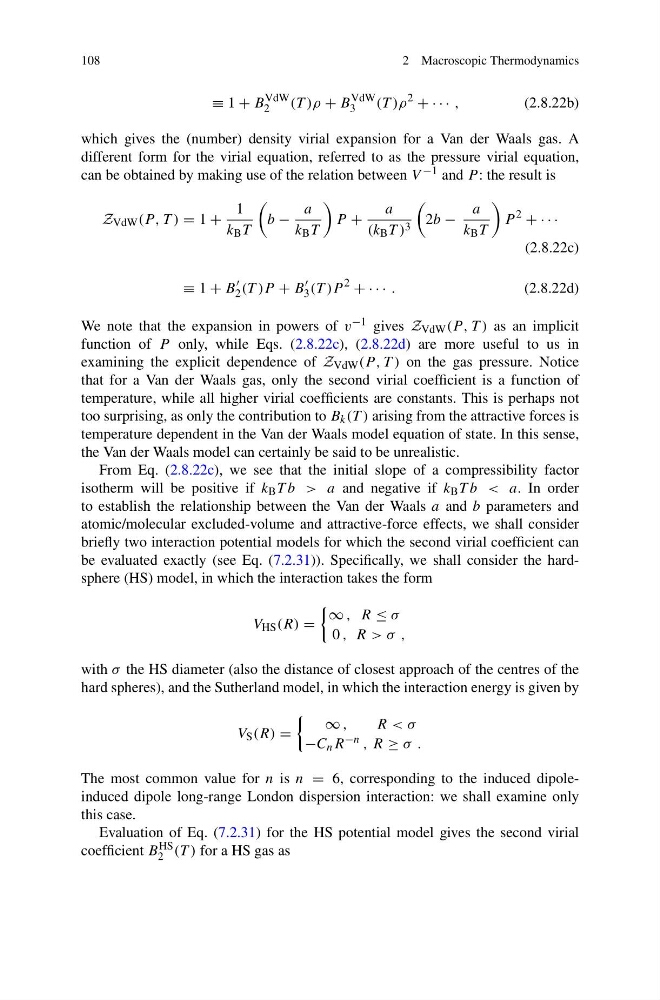
Z VdW (P , T ) = 1 +
1
k B T
b −
a
k B T
P +
a
(k B T ) 3
2b −
a
k B T
P
2
+ · · ·
(2.8.22c)
≡ 1 + B
2 (T )P + B
3 (T )P
2
+ · · · .
(2.8.22d)
We note that the expansion in powers of v −1 gives Z VdW (P , T ) as an implicit
function of P only, while Eqs. (2.8.22c), (2.8.22d) are more useful to us in
examining the explicit dependence of Z VdW (P , T ) on the gas pressure. Notice
that for a Van der Waals gas, only the second virial coefficient is a function of
temperature, while all higher virial coefficients are constants. This is perhaps not
too surprising, as only the contribution to B k (T ) arising from the attractive forces is
temperature dependent in the Van der Waals model equation of state. In this sense,
the Van der Waals model can certainly be said to be unrealistic.
From Eq. (2.8.22c), we see that the initial slope of a compressibility factor
isotherm will be positive if k B T b > a and negative if k B T b < a. In order
to establish the relationship between the Van der Waals a and b parameters and
atomic/molecular excluded-volume and attractive-force effects, we shall consider
briefly two interaction potential models for which the second virial coefficient can
be evaluated exactly (see Eq. (7.2.31)). Specifically, we shall consider the hardsphere (HS) model, in which the interaction takes the form
V HS (R) =
∞ , R ≤ σ
0 , R > σ ,
with σ the HS diameter (also the distance of closest approach of the centres of the
hard spheres), and the Sutherland model, in which the interaction energy is given by
V S (R) =
∞ ,
R <σ
−C n R −n , R ≥ σ .
The most common value for n is n = 6, corresponding to the induced dipoleinduced dipole long-range London dispersion interaction: we shall examine only
this case.
Evaluation of Eq. (7.2.31) for the HS potential model gives the second virial
coefficient B HS
2 (T ) for a HS gas as
2 Macroscopic Thermodynamics
≡ 1 + B
VdW
2
(T )ρ + B
VdW
3
(T )ρ
2
+ · · · ,
(2.8.22b)
which gives the (number) density virial expansion for a Van der Waals gas. A
different form for the virial equation, referred to as the pressure virial equation,
can be obtained by making use of the relation between V −1 and P : the result is
Z VdW (P , T ) = 1 +
1
k B T
b −
a
k B T
P +
a
(k B T ) 3
2b −
a
k B T
P
2
+ · · ·
(2.8.22c)
≡ 1 + B
2 (T )P + B
3 (T )P
2
+ · · · .
(2.8.22d)
We note that the expansion in powers of v −1 gives Z VdW (P , T ) as an implicit
function of P only, while Eqs. (2.8.22c), (2.8.22d) are more useful to us in
examining the explicit dependence of Z VdW (P , T ) on the gas pressure. Notice
that for a Van der Waals gas, only the second virial coefficient is a function of
temperature, while all higher virial coefficients are constants. This is perhaps not
too surprising, as only the contribution to B k (T ) arising from the attractive forces is
temperature dependent in the Van der Waals model equation of state. In this sense,
the Van der Waals model can certainly be said to be unrealistic.
From Eq. (2.8.22c), we see that the initial slope of a compressibility factor
isotherm will be positive if k B T b > a and negative if k B T b < a. In order
to establish the relationship between the Van der Waals a and b parameters and
atomic/molecular excluded-volume and attractive-force effects, we shall consider
briefly two interaction potential models for which the second virial coefficient can
be evaluated exactly (see Eq. (7.2.31)). Specifically, we shall consider the hardsphere (HS) model, in which the interaction takes the form
V HS (R) =
∞ , R ≤ σ
0 , R > σ ,
with σ the HS diameter (also the distance of closest approach of the centres of the
hard spheres), and the Sutherland model, in which the interaction energy is given by
V S (R) =
∞ ,
R <σ
−C n R −n , R ≥ σ .
The most common value for n is n = 6, corresponding to the induced dipoleinduced dipole long-range London dispersion interaction: we shall examine only
this case.
Evaluation of Eq. (7.2.31) for the HS potential model gives the second virial
coefficient B HS
2 (T ) for a HS gas as