

2.8 Thermodynamics of Real Gases
99
P +
aN 2
V 2
(V − Nb) = Nk B T
(2.8.9a)
or, more usefully for present purposes, as
P =
Nk B T
V − Nb
−
aN 2
V 2 ,
(2.8.9b)
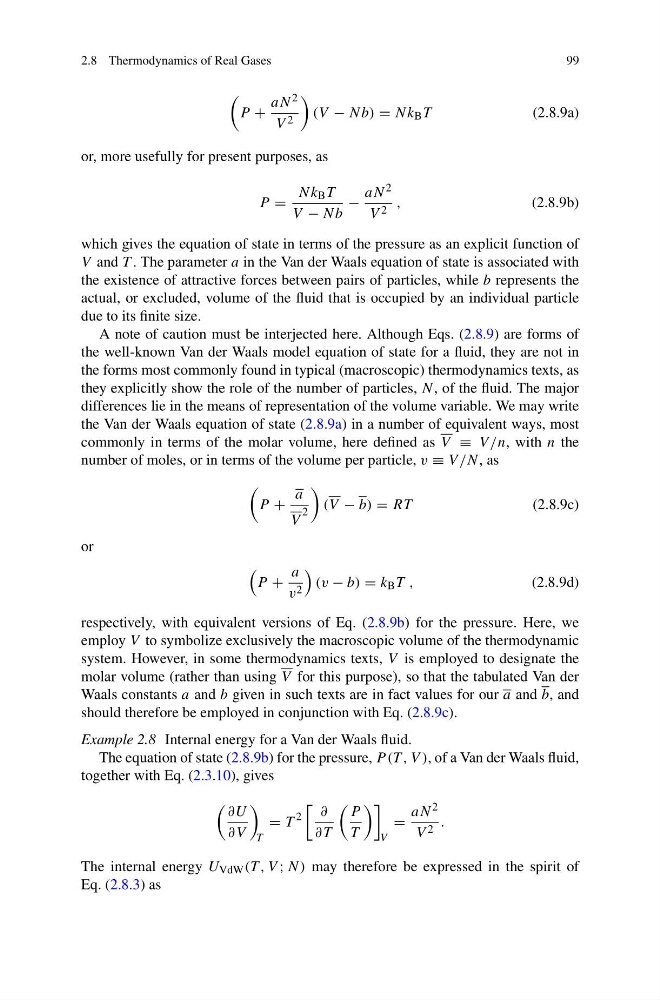
which gives the equation of state in terms of the pressure as an explicit function of
V and T . The parameter a in the Van der Waals equation of state is associated with
the existence of attractive forces between pairs of particles, while b represents the
actual, or excluded, volume of the fluid that is occupied by an individual particle
due to its finite size.
A note of caution must be interjected here. Although Eqs. (2.8.9) are forms of
the well-known Van der Waals model equation of state for a fluid, they are not in
the forms most commonly found in typical (macroscopic) thermodynamics texts, as
they explicitly show the role of the number of particles, N , of the fluid. The major
differences lie in the means of representation of the volume variable. We may write
the Van der Waals equation of state (2.8.9a) in a number of equivalent ways, most
commonly in terms of the molar volume, here defined as V ≡ V /n, with n the
number of moles, or in terms of the volume per particle, v ≡ V /N, as
P +
a
V
2
(V − b) = RT
(2.8.9c)
or
P +
a
v 2
(v − b) = k B T ,
(2.8.9d)
respectively, with equivalent versions of Eq. (2.8.9b) for the pressure. Here, we
employ V to symbolize exclusively the macroscopic volume of the thermodynamic
system. However, in some thermodynamics texts, V is employed to designate the
molar volume (rather than using V for this purpose), so that the tabulated Van der
Waals constants a and b given in such texts are in fact values for our a and b, and
should therefore be employed in conjunction with Eq. (2.8.9c).
Example 2.8 Internal energy for a Van der Waals fluid.
The equation of state (2.8.9b) for the pressure, P (T , V ), of a Van der Waals fluid,
together with Eq. (2.3.10), gives
∂U
∂V
T
= T
2
∂
∂T
P
T
V
=
aN 2
V 2 .
The internal energy U VdW (T , V ; N) may therefore be expressed in the spirit of
Eq. (2.8.3) as
99
P +
aN 2
V 2
(V − Nb) = Nk B T
(2.8.9a)
or, more usefully for present purposes, as
P =
Nk B T
V − Nb
−
aN 2
V 2 ,
(2.8.9b)
which gives the equation of state in terms of the pressure as an explicit function of
V and T . The parameter a in the Van der Waals equation of state is associated with
the existence of attractive forces between pairs of particles, while b represents the
actual, or excluded, volume of the fluid that is occupied by an individual particle
due to its finite size.
A note of caution must be interjected here. Although Eqs. (2.8.9) are forms of
the well-known Van der Waals model equation of state for a fluid, they are not in
the forms most commonly found in typical (macroscopic) thermodynamics texts, as
they explicitly show the role of the number of particles, N , of the fluid. The major
differences lie in the means of representation of the volume variable. We may write
the Van der Waals equation of state (2.8.9a) in a number of equivalent ways, most
commonly in terms of the molar volume, here defined as V ≡ V /n, with n the
number of moles, or in terms of the volume per particle, v ≡ V /N, as
P +
a
V
2
(V − b) = RT
(2.8.9c)
or
P +
a
v 2
(v − b) = k B T ,
(2.8.9d)
respectively, with equivalent versions of Eq. (2.8.9b) for the pressure. Here, we
employ V to symbolize exclusively the macroscopic volume of the thermodynamic
system. However, in some thermodynamics texts, V is employed to designate the
molar volume (rather than using V for this purpose), so that the tabulated Van der
Waals constants a and b given in such texts are in fact values for our a and b, and
should therefore be employed in conjunction with Eq. (2.8.9c).
Example 2.8 Internal energy for a Van der Waals fluid.
The equation of state (2.8.9b) for the pressure, P (T , V ), of a Van der Waals fluid,
together with Eq. (2.3.10), gives
∂U
∂V
T
= T
2
∂
∂T
P
T
V
=
aN 2
V 2 .
The internal energy U VdW (T , V ; N) may therefore be expressed in the spirit of
Eq. (2.8.3) as