

3.5 Rh-Catalyzed C–H Bond Carbonylation
61
2 mol % [Cp*RhCl 2 ] 2
8 mol % AgNO 3
2.0 eq. Cu(OAc) 2
25 mol % K 2 CO 3 , 10 mol % Ac 2 O
toluene, 140 C
+
44 - 63 % yield
R
1
N
R
3
R
2
CO
R
1
N
O
R
2
R
3
Scheme 3.51 Rh(III)-catalyzed oxidative cyclocarbonylation reaction of ketimines
3-263
0.0
(kcal/mol)
3-266
15.0
3-267ts
27.4
3-268
7.5
migratory insertion
20.7
2-272ts
19.4
3-269ts
28.8
3-270
N-H bond cleavage
reductive elimination
3-271
5.5
G(M11-L, toluene)
3-264
3-265
CO
3-274
2.4
3-275ts
6.0
3-276
-41.4
CO
3-277
3-263
N
Ph
N
H
Ph
3-264
3-265
3-267ts
Rh OAc
OAc
3-266
3-268
3-269
3-270
HOAc
HOAc
3-271
3-272ts
CO
3-273
12.9
3-273
3-274
3-275ts
Rh
Cp*
CO
OC
3-276
N Ph
O
3-277
C-H bond cleavage
Rh
AcO
OAc
NH
Ph
Rh
AcO
N
Ph
O
O
CH 3
H
Rh
AcO
N
Ph
H
H
Rh
N
Ph
H
H
O
H 3 C
O
H
Rh
N Ph
H
H
Rh
N Ph
H
H
C
O
Rh
N Ph
O
Rh
N Ph
OC
Rh
N Ph
O
CO
Rh
N Ph
O
CO
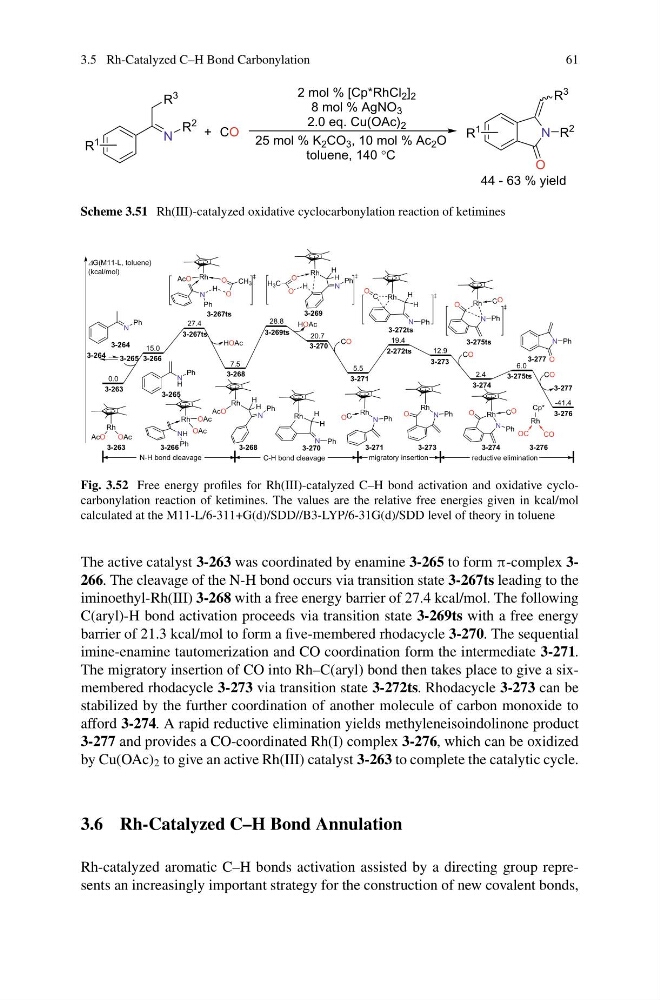
Fig. 3.52 Free energy profiles for Rh(III)-catalyzed C–H bond activation and oxidative cyclocarbonylation reaction of ketimines. The values are the relative free energies given in kcal/mol
calculated at the M11-L/6-311+G(d)/SDD//B3-LYP/6-31G(d)/SDD level of theory in toluene
The active catalyst 3-263 was coordinated by enamine 3-265 to form π-complex 3266. The cleavage of the N-H bond occurs via transition state 3-267ts leading to the
iminoethyl-Rh(III) 3-268 with a free energy barrier of 27.4 kcal/mol. The following
C(aryl)-H bond activation proceeds via transition state 3-269ts with a free energy
barrier of 21.3 kcal/mol to form a five-membered rhodacycle 3-270. The sequential
imine-enamine tautomerization and CO coordination form the intermediate 3-271.
The migratory insertion of CO into Rh–C(aryl) bond then takes place to give a sixmembered rhodacycle 3-273 via transition state 3-272ts. Rhodacycle 3-273 can be
stabilized by the further coordination of another molecule of carbon monoxide to
afford 3-274. A rapid reductive elimination yields methyleneisoindolinone product
3-277 and provides a CO-coordinated Rh(I) complex 3-276, which can be oxidized
by Cu(OAc) 2 to give an active Rh(III) catalyst 3-263 to complete the catalytic cycle.
3.6 Rh-Catalyzed C–H Bond Annulation
Rh-catalyzed aromatic C–H bonds activation assisted by a directing group represents an increasingly important strategy for the construction of new covalent bonds,
61
2 mol % [Cp*RhCl 2 ] 2
8 mol % AgNO 3
2.0 eq. Cu(OAc) 2
25 mol % K 2 CO 3 , 10 mol % Ac 2 O
toluene, 140 C
+
44 - 63 % yield
R
1
N
R
3
R
2
CO
R
1
N
O
R
2
R
3
Scheme 3.51 Rh(III)-catalyzed oxidative cyclocarbonylation reaction of ketimines
3-263
0.0
(kcal/mol)
3-266
15.0
3-267ts
27.4
3-268
7.5
migratory insertion
20.7
2-272ts
19.4
3-269ts
28.8
3-270
N-H bond cleavage
reductive elimination
3-271
5.5
G(M11-L, toluene)
3-264
3-265
CO
3-274
2.4
3-275ts
6.0
3-276
-41.4
CO
3-277
3-263
N
Ph
N
H
Ph
3-264
3-265
3-267ts
Rh OAc
OAc
3-266
3-268
3-269
3-270
HOAc
HOAc
3-271
3-272ts
CO
3-273
12.9
3-273
3-274
3-275ts
Rh
Cp*
CO
OC
3-276
N Ph
O
3-277
C-H bond cleavage
Rh
AcO
OAc
NH
Ph
Rh
AcO
N
Ph
O
O
CH 3
H
Rh
AcO
N
Ph
H
H
Rh
N
Ph
H
H
O
H 3 C
O
H
Rh
N Ph
H
H
Rh
N Ph
H
H
C
O
Rh
N Ph
O
Rh
N Ph
OC
Rh
N Ph
O
CO
Rh
N Ph
O
CO
Fig. 3.52 Free energy profiles for Rh(III)-catalyzed C–H bond activation and oxidative cyclocarbonylation reaction of ketimines. The values are the relative free energies given in kcal/mol
calculated at the M11-L/6-311+G(d)/SDD//B3-LYP/6-31G(d)/SDD level of theory in toluene
The active catalyst 3-263 was coordinated by enamine 3-265 to form π-complex 3266. The cleavage of the N-H bond occurs via transition state 3-267ts leading to the
iminoethyl-Rh(III) 3-268 with a free energy barrier of 27.4 kcal/mol. The following
C(aryl)-H bond activation proceeds via transition state 3-269ts with a free energy
barrier of 21.3 kcal/mol to form a five-membered rhodacycle 3-270. The sequential
imine-enamine tautomerization and CO coordination form the intermediate 3-271.
The migratory insertion of CO into Rh–C(aryl) bond then takes place to give a sixmembered rhodacycle 3-273 via transition state 3-272ts. Rhodacycle 3-273 can be
stabilized by the further coordination of another molecule of carbon monoxide to
afford 3-274. A rapid reductive elimination yields methyleneisoindolinone product
3-277 and provides a CO-coordinated Rh(I) complex 3-276, which can be oxidized
by Cu(OAc) 2 to give an active Rh(III) catalyst 3-263 to complete the catalytic cycle.
3.6 Rh-Catalyzed C–H Bond Annulation
Rh-catalyzed aromatic C–H bonds activation assisted by a directing group represents an increasingly important strategy for the construction of new covalent bonds,