

20
2 Computational Methods in Rh-Catalyzed C–H Functionalization
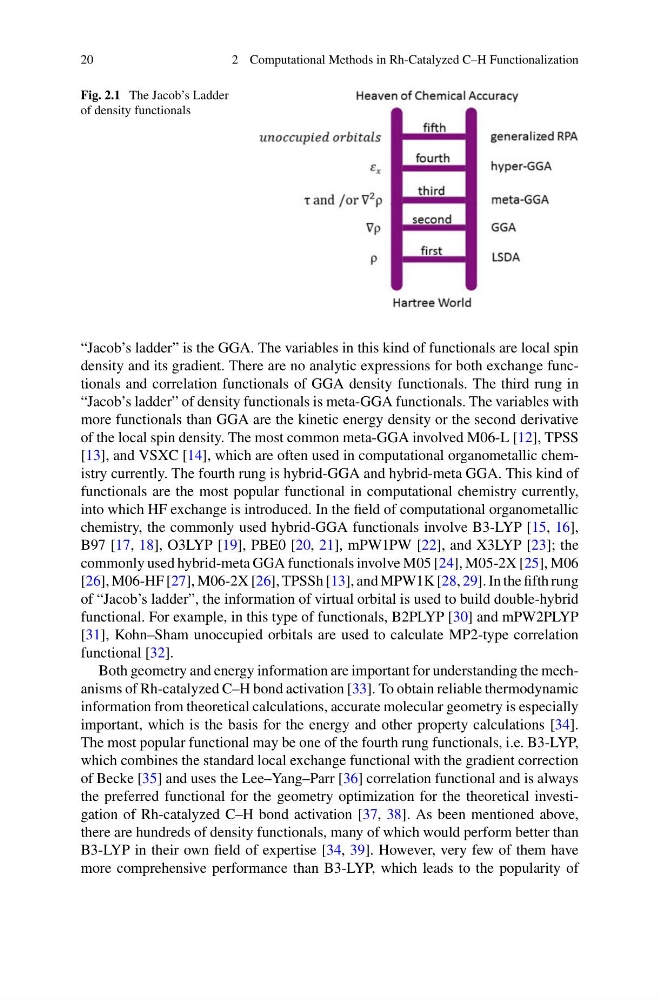
Fig. 2.1 The Jacob’s Ladder
of density functionals
“Jacob’s ladder” is the GGA. The variables in this kind of functionals are local spin
density and its gradient. There are no analytic expressions for both exchange functionals and correlation functionals of GGA density functionals. The third rung in
“Jacob’s ladder” of density functionals is meta-GGA functionals. The variables with
more functionals than GGA are the kinetic energy density or the second derivative
of the local spin density. The most common meta-GGA involved M06-L [12], TPSS
[13], and VSXC [14], which are often used in computational organometallic chemistry currently. The fourth rung is hybrid-GGA and hybrid-meta GGA. This kind of
functionals are the most popular functional in computational chemistry currently,
into which HF exchange is introduced. In the field of computational organometallic
chemistry, the commonly used hybrid-GGA functionals involve B3-LYP [15, 16],
B97 [17, 18], O3LYP [19], PBE0 [20, 21], mPW1PW [22], and X3LYP [23]; the
commonly used hybrid-meta GGA functionals involve M05 [24], M05-2X [25], M06
[26], M06-HF [27], M06-2X [26], TPSSh [13], and MPW1K [28, 29]. In the fifth rung
of “Jacob’s ladder”, the information of virtual orbital is used to build double-hybrid
functional. For example, in this type of functionals, B2PLYP [30] and mPW2PLYP
[31], Kohn–Sham unoccupied orbitals are used to calculate MP2-type correlation
functional [32].
Both geometry and energy information are important for understanding the mechanisms of Rh-catalyzed C–H bond activation [33]. To obtain reliable thermodynamic
information from theoretical calculations, accurate molecular geometry is especially
important, which is the basis for the energy and other property calculations [34].
The most popular functional may be one of the fourth rung functionals, i.e. B3-LYP,
which combines the standard local exchange functional with the gradient correction
of Becke [35] and uses the Lee–Yang–Parr [36] correlation functional and is always
the preferred functional for the geometry optimization for the theoretical investigation of Rh-catalyzed C–H bond activation [37, 38]. As been mentioned above,
there are hundreds of density functionals, many of which would perform better than
B3-LYP in their own field of expertise [34, 39]. However, very few of them have
more comprehensive performance than B3-LYP, which leads to the popularity of
2 Computational Methods in Rh-Catalyzed C–H Functionalization
Fig. 2.1 The Jacob’s Ladder
of density functionals
“Jacob’s ladder” is the GGA. The variables in this kind of functionals are local spin
density and its gradient. There are no analytic expressions for both exchange functionals and correlation functionals of GGA density functionals. The third rung in
“Jacob’s ladder” of density functionals is meta-GGA functionals. The variables with
more functionals than GGA are the kinetic energy density or the second derivative
of the local spin density. The most common meta-GGA involved M06-L [12], TPSS
[13], and VSXC [14], which are often used in computational organometallic chemistry currently. The fourth rung is hybrid-GGA and hybrid-meta GGA. This kind of
functionals are the most popular functional in computational chemistry currently,
into which HF exchange is introduced. In the field of computational organometallic
chemistry, the commonly used hybrid-GGA functionals involve B3-LYP [15, 16],
B97 [17, 18], O3LYP [19], PBE0 [20, 21], mPW1PW [22], and X3LYP [23]; the
commonly used hybrid-meta GGA functionals involve M05 [24], M05-2X [25], M06
[26], M06-HF [27], M06-2X [26], TPSSh [13], and MPW1K [28, 29]. In the fifth rung
of “Jacob’s ladder”, the information of virtual orbital is used to build double-hybrid
functional. For example, in this type of functionals, B2PLYP [30] and mPW2PLYP
[31], Kohn–Sham unoccupied orbitals are used to calculate MP2-type correlation
functional [32].
Both geometry and energy information are important for understanding the mechanisms of Rh-catalyzed C–H bond activation [33]. To obtain reliable thermodynamic
information from theoretical calculations, accurate molecular geometry is especially
important, which is the basis for the energy and other property calculations [34].
The most popular functional may be one of the fourth rung functionals, i.e. B3-LYP,
which combines the standard local exchange functional with the gradient correction
of Becke [35] and uses the Lee–Yang–Parr [36] correlation functional and is always
the preferred functional for the geometry optimization for the theoretical investigation of Rh-catalyzed C–H bond activation [37, 38]. As been mentioned above,
there are hundreds of density functionals, many of which would perform better than
B3-LYP in their own field of expertise [34, 39]. However, very few of them have
more comprehensive performance than B3-LYP, which leads to the popularity of