

2
1 Theoretical View of Rh-Catalyzed C–H Functionalization
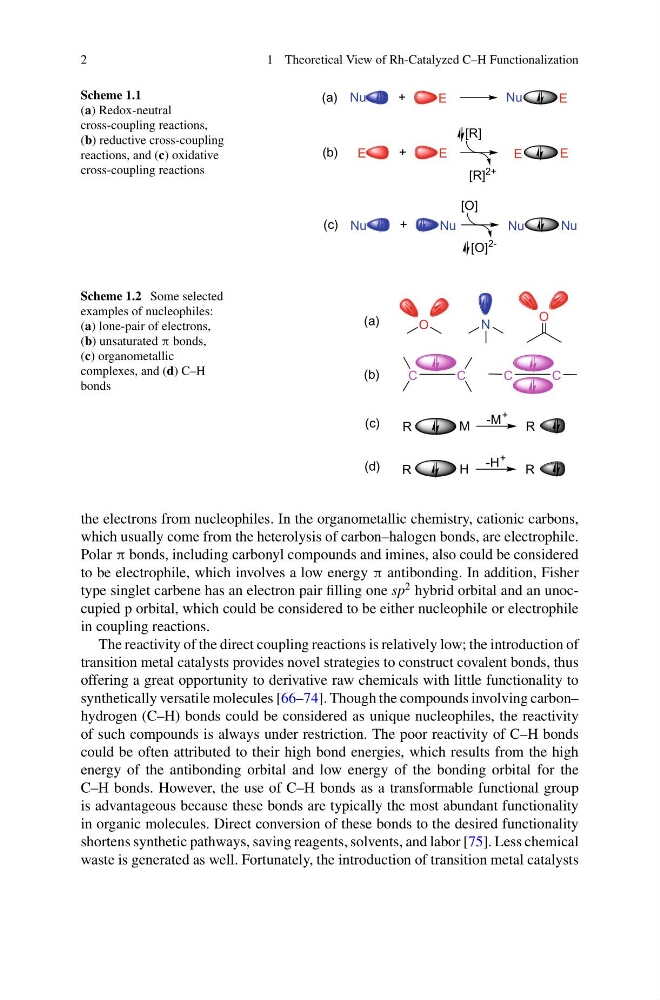
Scheme 1.1
(a) Redox-neutral
cross-coupling reactions,
(b) reductive cross-coupling
reactions, and (c) oxidative
cross-coupling reactions
Nu
+
E
Nu
E
(a)
E
+
E
E
E
(b)
[R]
[R]
2+
Nu
+
Nu
Nu
Nu
(c)
[O]
[O]
2Scheme 1.2 Some selected
examples of nucleophiles:
(a) lone-pair of electrons,
(b) unsaturated π bonds,
(c) organometallic
complexes, and (d) C–H
bonds
(a)
(b)
(c)
O
N
O
C
C
C
C
R
M
R
-M
+
(d)
R
H
R
-H
+
the electrons from nucleophiles. In the organometallic chemistry, cationic carbons,
which usually come from the heterolysis of carbon–halogen bonds, are electrophile.
Polar π bonds, including carbonyl compounds and imines, also could be considered
to be electrophile, which involves a low energy π antibonding. In addition, Fisher
type singlet carbene has an electron pair filling one sp
2 hybrid orbital and an unoccupied p orbital, which could be considered to be either nucleophile or electrophile
in coupling reactions.
The reactivity of the direct coupling reactions is relatively low; the introduction of
transition metal catalysts provides novel strategies to construct covalent bonds, thus
offering a great opportunity to derivative raw chemicals with little functionality to
synthetically versatile molecules [66–74]. Though the compounds involving carbon–
hydrogen (C–H) bonds could be considered as unique nucleophiles, the reactivity
of such compounds is always under restriction. The poor reactivity of C–H bonds
could be often attributed to their high bond energies, which results from the high
energy of the antibonding orbital and low energy of the bonding orbital for the
C–H bonds. However, the use of C–H bonds as a transformable functional group
is advantageous because these bonds are typically the most abundant functionality
in organic molecules. Direct conversion of these bonds to the desired functionality
shortens synthetic pathways, saving reagents, solvents, and labor [75]. Less chemical
waste is generated as well. Fortunately, the introduction of transition metal catalysts
1 Theoretical View of Rh-Catalyzed C–H Functionalization
Scheme 1.1
(a) Redox-neutral
cross-coupling reactions,
(b) reductive cross-coupling
reactions, and (c) oxidative
cross-coupling reactions
Nu
+
E
Nu
E
(a)
E
+
E
E
E
(b)
[R]
[R]
2+
Nu
+
Nu
Nu
Nu
(c)
[O]
[O]
2Scheme 1.2 Some selected
examples of nucleophiles:
(a) lone-pair of electrons,
(b) unsaturated π bonds,
(c) organometallic
complexes, and (d) C–H
bonds
(a)
(b)
(c)
O
N
O
C
C
C
C
R
M
R
-M
+
(d)
R
H
R
-H
+
the electrons from nucleophiles. In the organometallic chemistry, cationic carbons,
which usually come from the heterolysis of carbon–halogen bonds, are electrophile.
Polar π bonds, including carbonyl compounds and imines, also could be considered
to be electrophile, which involves a low energy π antibonding. In addition, Fisher
type singlet carbene has an electron pair filling one sp
2 hybrid orbital and an unoccupied p orbital, which could be considered to be either nucleophile or electrophile
in coupling reactions.
The reactivity of the direct coupling reactions is relatively low; the introduction of
transition metal catalysts provides novel strategies to construct covalent bonds, thus
offering a great opportunity to derivative raw chemicals with little functionality to
synthetically versatile molecules [66–74]. Though the compounds involving carbon–
hydrogen (C–H) bonds could be considered as unique nucleophiles, the reactivity
of such compounds is always under restriction. The poor reactivity of C–H bonds
could be often attributed to their high bond energies, which results from the high
energy of the antibonding orbital and low energy of the bonding orbital for the
C–H bonds. However, the use of C–H bonds as a transformable functional group
is advantageous because these bonds are typically the most abundant functionality
in organic molecules. Direct conversion of these bonds to the desired functionality
shortens synthetic pathways, saving reagents, solvents, and labor [75]. Less chemical
waste is generated as well. Fortunately, the introduction of transition metal catalysts