

100
4 Theoretical View of Rh-Catalyzed C–H Functionalization …
Ar
DG
Rh(III)]Y
4-10
N
R
1
LG
Ar
DG
Rh(III)]Y
N
R
1
4-11
[Rh(III)]Y 2
Ar H
DG
HY
Protonation
4-9
Nitrene
insertion
C-H bond
cleavage
Ar
Rh(III)]Y
N
R
1
DG
4-12
HY
Ar NH
R
1
DG
4-13
LG
Nitrenation
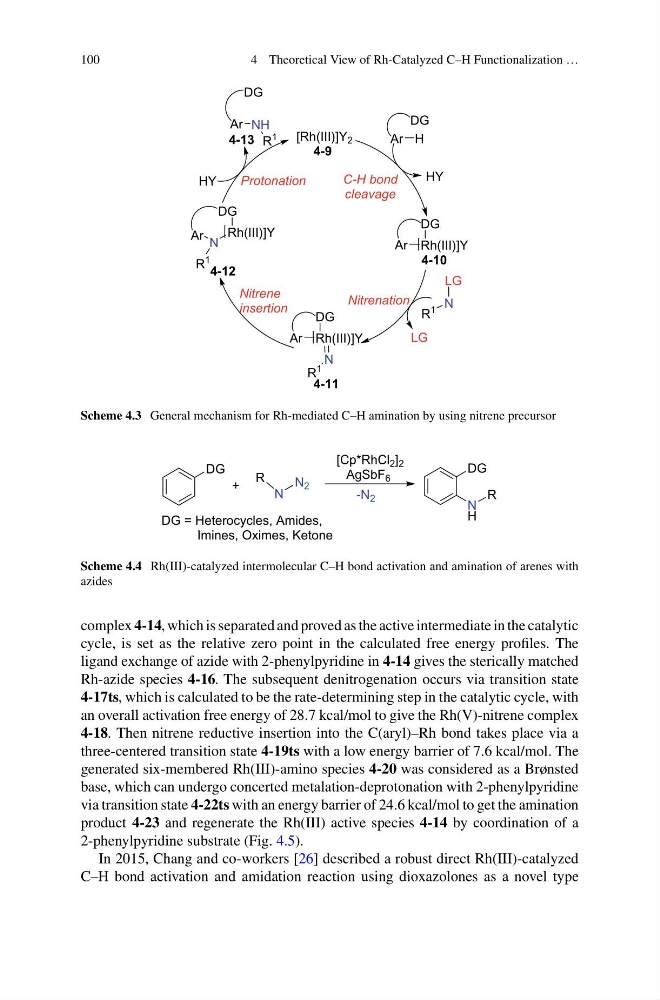
Scheme 4.3 General mechanism for Rh-mediated C–H amination by using nitrene precursor
[Cp*RhCl 2 ] 2
AgSbF 6
+
DG
DG = Heterocycles, Amides,
Imines, Oximes, Ketone
N
R
N 2
-N 2
DG
N
H
R
Scheme 4.4 Rh(III)-catalyzed intermolecular C–H bond activation and amination of arenes with
azides
complex 4-14, which is separated and proved as the active intermediate in the catalytic
cycle, is set as the relative zero point in the calculated free energy profiles. The
ligand exchange of azide with 2-phenylpyridine in 4-14 gives the sterically matched
Rh-azide species 4-16. The subsequent denitrogenation occurs via transition state
4-17ts, which is calculated to be the rate-determining step in the catalytic cycle, with
an overall activation free energy of 28.7 kcal/mol to give the Rh(V)-nitrene complex
4-18. Then nitrene reductive insertion into the C(aryl)–Rh bond takes place via a
three-centered transition state 4-19ts with a low energy barrier of 7.6 kcal/mol. The
generated six-membered Rh(III)-amino species 4-20 was considered as a Brønsted
base, which can undergo concerted metalation-deprotonation with 2-phenylpyridine
via transition state 4-22ts with an energy barrier of 24.6 kcal/mol to get the amination
product 4-23 and regenerate the Rh(III) active species 4-14 by coordination of a
2-phenylpyridine substrate (Fig. 4.5).
In 2015, Chang and co-workers [26] described a robust direct Rh(III)-catalyzed
C–H bond activation and amidation reaction using dioxazolones as a novel type
4 Theoretical View of Rh-Catalyzed C–H Functionalization …
Ar
DG
Rh(III)]Y
4-10
N
R
1
LG
Ar
DG
Rh(III)]Y
N
R
1
4-11
[Rh(III)]Y 2
Ar H
DG
HY
Protonation
4-9
Nitrene
insertion
C-H bond
cleavage
Ar
Rh(III)]Y
N
R
1
DG
4-12
HY
Ar NH
R
1
DG
4-13
LG
Nitrenation
Scheme 4.3 General mechanism for Rh-mediated C–H amination by using nitrene precursor
[Cp*RhCl 2 ] 2
AgSbF 6
+
DG
DG = Heterocycles, Amides,
Imines, Oximes, Ketone
N
R
N 2
-N 2
DG
N
H
R
Scheme 4.4 Rh(III)-catalyzed intermolecular C–H bond activation and amination of arenes with
azides
complex 4-14, which is separated and proved as the active intermediate in the catalytic
cycle, is set as the relative zero point in the calculated free energy profiles. The
ligand exchange of azide with 2-phenylpyridine in 4-14 gives the sterically matched
Rh-azide species 4-16. The subsequent denitrogenation occurs via transition state
4-17ts, which is calculated to be the rate-determining step in the catalytic cycle, with
an overall activation free energy of 28.7 kcal/mol to give the Rh(V)-nitrene complex
4-18. Then nitrene reductive insertion into the C(aryl)–Rh bond takes place via a
three-centered transition state 4-19ts with a low energy barrier of 7.6 kcal/mol. The
generated six-membered Rh(III)-amino species 4-20 was considered as a Brønsted
base, which can undergo concerted metalation-deprotonation with 2-phenylpyridine
via transition state 4-22ts with an energy barrier of 24.6 kcal/mol to get the amination
product 4-23 and regenerate the Rh(III) active species 4-14 by coordination of a
2-phenylpyridine substrate (Fig. 4.5).
In 2015, Chang and co-workers [26] described a robust direct Rh(III)-catalyzed
C–H bond activation and amidation reaction using dioxazolones as a novel type