

98
4 Theoretical View of Rh-Catalyzed C–H Functionalization …
2.5 mol % [Cp*RhCl 2 ] 2
5 mol % Cu(OTf) 2
DCE, 55 °C, 12h
61 - 90 % yield
+
DG
R
I
O
O
OH
DG
R
O
O
I
N
Rh
Cp*
Cl
4-1
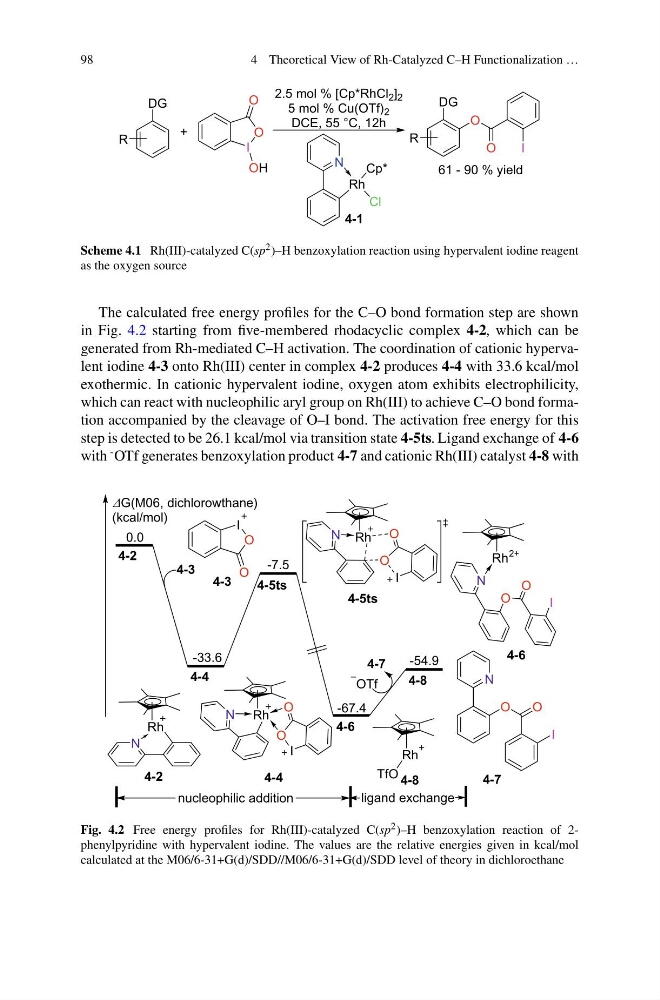
Scheme 4.1 Rh(III)-catalyzed C(sp 2 )–H benzoxylation reaction using hypervalent iodine reagent
as the oxygen source
The calculated free energy profiles for the C–O bond formation step are shown
in Fig. 4.2 starting from five-membered rhodacyclic complex 4-2, which can be
generated from Rh-mediated C–H activation. The coordination of cationic hypervalent iodine 4-3 onto Rh(III) center in complex 4-2 produces 4-4 with 33.6 kcal/mol
exothermic. In cationic hypervalent iodine, oxygen atom exhibits electrophilicity,
which can react with nucleophilic aryl group on Rh(III) to achieve C–O bond formation accompanied by the cleavage of O–I bond. The activation free energy for this
step is detected to be 26.1 kcal/mol via transition state 4-5ts. Ligand exchange of 4-6
with
- OTf generates benzoxylation product 4-7 and cationic Rh(III) catalyst 4-8 with
N
Rh
4-2
0.0
(kcal/mol)
4-4
-33.6
4-5ts
-7.5
4-6
-67.4
4-8
-54.9
G(M06, dichlorowthane)
nucleophilic addition
4-3
4-2
O
I
O
4-3
4-4
4-5ts
N
Rh
2+
O
O
I
4-6
4-7
OTf
N
O
O
I
4-7
Rh
TfO 4-8
ligand exchange
N Rh
O
I
O
N Rh
O
I
O
Fig. 4.2 Free energy profiles for Rh(III)-catalyzed C(sp 2 )–H benzoxylation reaction of 2phenylpyridine with hypervalent iodine. The values are the relative energies given in kcal/mol
calculated at the M06/6-31+G(d)/SDD//M06/6-31+G(d)/SDD level of theory in dichloroethane
4 Theoretical View of Rh-Catalyzed C–H Functionalization …
2.5 mol % [Cp*RhCl 2 ] 2
5 mol % Cu(OTf) 2
DCE, 55 °C, 12h
61 - 90 % yield
+
DG
R
I
O
O
OH
DG
R
O
O
I
N
Rh
Cp*
Cl
4-1
Scheme 4.1 Rh(III)-catalyzed C(sp 2 )–H benzoxylation reaction using hypervalent iodine reagent
as the oxygen source
The calculated free energy profiles for the C–O bond formation step are shown
in Fig. 4.2 starting from five-membered rhodacyclic complex 4-2, which can be
generated from Rh-mediated C–H activation. The coordination of cationic hypervalent iodine 4-3 onto Rh(III) center in complex 4-2 produces 4-4 with 33.6 kcal/mol
exothermic. In cationic hypervalent iodine, oxygen atom exhibits electrophilicity,
which can react with nucleophilic aryl group on Rh(III) to achieve C–O bond formation accompanied by the cleavage of O–I bond. The activation free energy for this
step is detected to be 26.1 kcal/mol via transition state 4-5ts. Ligand exchange of 4-6
with
- OTf generates benzoxylation product 4-7 and cationic Rh(III) catalyst 4-8 with
N
Rh
4-2
0.0
(kcal/mol)
4-4
-33.6
4-5ts
-7.5
4-6
-67.4
4-8
-54.9
G(M06, dichlorowthane)
nucleophilic addition
4-3
4-2
O
I
O
4-3
4-4
4-5ts
N
Rh
2+
O
O
I
4-6
4-7
OTf
N
O
O
I
4-7
Rh
TfO 4-8
ligand exchange
N Rh
O
I
O
N Rh
O
I
O
Fig. 4.2 Free energy profiles for Rh(III)-catalyzed C(sp 2 )–H benzoxylation reaction of 2phenylpyridine with hypervalent iodine. The values are the relative energies given in kcal/mol
calculated at the M06/6-31+G(d)/SDD//M06/6-31+G(d)/SDD level of theory in dichloroethane