

76
3 Giant Magnetoresistance (GMR)
a free electron gas exhibits no MR. MR can be described by models, which involve
multiple carriers and it is the topology of the Fermi surface that decides its high field
behaviour.
In fact, the effect of MR could be realized in diversified ways. We may
mention some varieties of MR take place in bulk of non-magnetic metals
and semiconductors. For instance, in case of metals MR phenomena, which
happen to take place, are geometrical magnetoresistance, Shubnikov de Haas
oscillations, or as already mentioned common positive MR. Noteworthy, in case
of magnetic metals, some other kinds of MR effects are observable, such as the
very general negative magnetoresistance in ferromagnetic material and anisotropic
magnetoresistance (AMR). Furthermore, in the last few decades (starting from 1970s)
in multicomponent heterostructure or multilayer systems, giant magnetoresistance
(GMR), tunnel magnetoresistance (TMR), colossal magnetoresistance (CMR) and
extraordinary magnetoresistance (EMR) have been discovered. Thus MR can be
mainly categorized into following varieties: (i) ordinary MR; (ii) anisotropic MR
(AMR); (iii) giant MR (GMR); (iv) tunnel MR (TMR).
Magnetoresistance types
MR (%)
Ordinary magnetoresistance
~0.1
Anisotropic magnetoresistance (AMR)
~1–2
Giant magnetoresistance (GMR)
~10–50
Tunnel magnetoresistance (TMR)
*~100–600
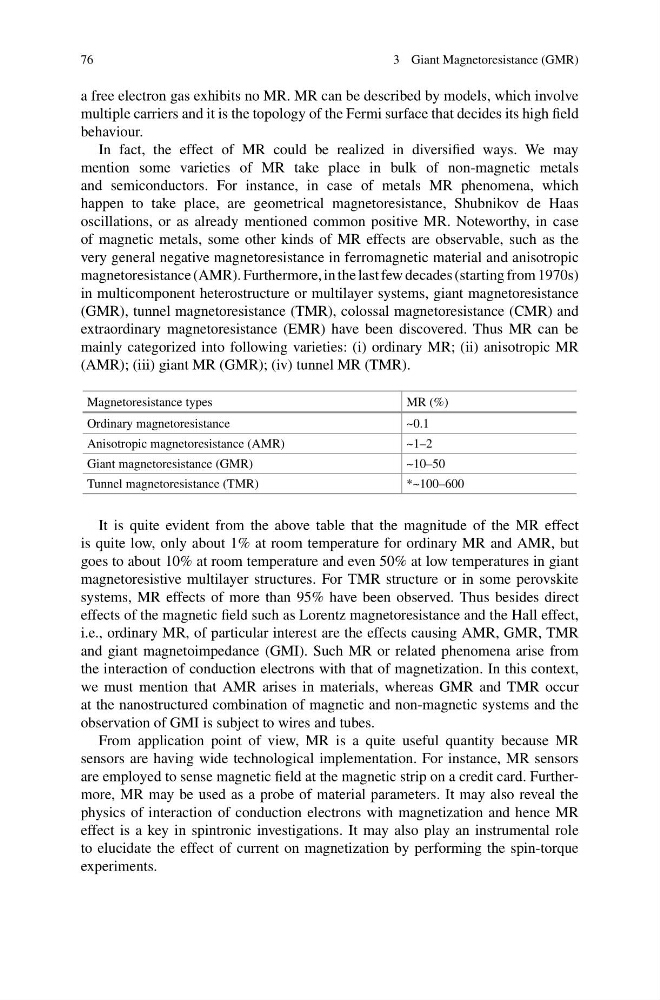
It is quite evident from the above table that the magnitude of the MR effect
is quite low, only about 1% at room temperature for ordinary MR and AMR, but
goes to about 10% at room temperature and even 50% at low temperatures in giant
magnetoresistive multilayer structures. For TMR structure or in some perovskite
systems, MR effects of more than 95% have been observed. Thus besides direct
effects of the magnetic field such as Lorentz magnetoresistance and the Hall effect,
i.e., ordinary MR, of particular interest are the effects causing AMR, GMR, TMR
and giant magnetoimpedance (GMI). Such MR or related phenomena arise from
the interaction of conduction electrons with that of magnetization. In this context,
we must mention that AMR arises in materials, whereas GMR and TMR occur
at the nanostructured combination of magnetic and non-magnetic systems and the
observation of GMI is subject to wires and tubes.
From application point of view, MR is a quite useful quantity because MR
sensors are having wide technological implementation. For instance, MR sensors
are employed to sense magnetic field at the magnetic strip on a credit card. Furthermore, MR may be used as a probe of material parameters. It may also reveal the
physics of interaction of conduction electrons with magnetization and hence MR
effect is a key in spintronic investigations. It may also play an instrumental role
to elucidate the effect of current on magnetization by performing the spin-torque
experiments.
3 Giant Magnetoresistance (GMR)
a free electron gas exhibits no MR. MR can be described by models, which involve
multiple carriers and it is the topology of the Fermi surface that decides its high field
behaviour.
In fact, the effect of MR could be realized in diversified ways. We may
mention some varieties of MR take place in bulk of non-magnetic metals
and semiconductors. For instance, in case of metals MR phenomena, which
happen to take place, are geometrical magnetoresistance, Shubnikov de Haas
oscillations, or as already mentioned common positive MR. Noteworthy, in case
of magnetic metals, some other kinds of MR effects are observable, such as the
very general negative magnetoresistance in ferromagnetic material and anisotropic
magnetoresistance (AMR). Furthermore, in the last few decades (starting from 1970s)
in multicomponent heterostructure or multilayer systems, giant magnetoresistance
(GMR), tunnel magnetoresistance (TMR), colossal magnetoresistance (CMR) and
extraordinary magnetoresistance (EMR) have been discovered. Thus MR can be
mainly categorized into following varieties: (i) ordinary MR; (ii) anisotropic MR
(AMR); (iii) giant MR (GMR); (iv) tunnel MR (TMR).
Magnetoresistance types
MR (%)
Ordinary magnetoresistance
~0.1
Anisotropic magnetoresistance (AMR)
~1–2
Giant magnetoresistance (GMR)
~10–50
Tunnel magnetoresistance (TMR)
*~100–600
It is quite evident from the above table that the magnitude of the MR effect
is quite low, only about 1% at room temperature for ordinary MR and AMR, but
goes to about 10% at room temperature and even 50% at low temperatures in giant
magnetoresistive multilayer structures. For TMR structure or in some perovskite
systems, MR effects of more than 95% have been observed. Thus besides direct
effects of the magnetic field such as Lorentz magnetoresistance and the Hall effect,
i.e., ordinary MR, of particular interest are the effects causing AMR, GMR, TMR
and giant magnetoimpedance (GMI). Such MR or related phenomena arise from
the interaction of conduction electrons with that of magnetization. In this context,
we must mention that AMR arises in materials, whereas GMR and TMR occur
at the nanostructured combination of magnetic and non-magnetic systems and the
observation of GMI is subject to wires and tubes.
From application point of view, MR is a quite useful quantity because MR
sensors are having wide technological implementation. For instance, MR sensors
are employed to sense magnetic field at the magnetic strip on a credit card. Furthermore, MR may be used as a probe of material parameters. It may also reveal the
physics of interaction of conduction electrons with magnetization and hence MR
effect is a key in spintronic investigations. It may also play an instrumental role
to elucidate the effect of current on magnetization by performing the spin-torque
experiments.