

2.10 Spin Valve
61
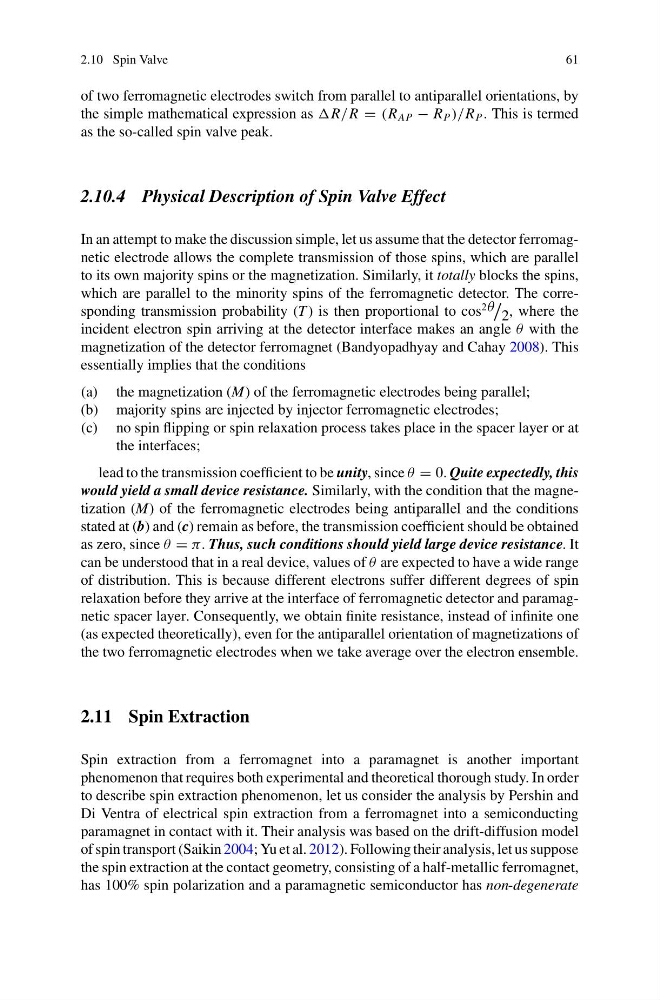
of two ferromagnetic electrodes switch from parallel to antiparallel orientations, by
the simple mathematical expression as R/R = (R AP − R P )/R P . This is termed
as the so-called spin valve peak.
2.10.4 Physical Description of Spin Valve Effect
In an attempt to make the discussion simple, let us assume that the detector ferromagnetic electrode allows the complete transmission of those spins, which are parallel
to its own majority spins or the magnetization. Similarly, it totally blocks the spins,
which are parallel to the minority spins of the ferromagnetic detector. The corresponding transmission probability (T ) is then proportional to cos
2θ
2 , where the
incident electron spin arriving at the detector interface makes an angle θ with the
magnetization of the detector ferromagnet (Bandyopadhyay and Cahay 2008). This
essentially implies that the conditions
(a) the magnetization (M) of the ferromagnetic electrodes being parallel;
(b) majority spins are injected by injector ferromagnetic electrodes;
(c) no spin flipping or spin relaxation process takes place in the spacer layer or at
the interfaces;
lead to the transmission coefficient to be unity, since θ = 0. Quite expectedly, this
would yield a small device resistance. Similarly, with the condition that the magnetization (M) of the ferromagnetic electrodes being antiparallel and the conditions
stated at (b) and (c) remain as before, the transmission coefficient should be obtained
as zero, since θ = π. Thus, such conditions should yield large device resistance. It
can be understood that in a real device, values of θ are expected to have a wide range
of distribution. This is because different electrons suffer different degrees of spin
relaxation before they arrive at the interface of ferromagnetic detector and paramagnetic spacer layer. Consequently, we obtain finite resistance, instead of infinite one
(as expected theoretically), even for the antiparallel orientation of magnetizations of
the two ferromagnetic electrodes when we take average over the electron ensemble.
2.11 Spin Extraction
Spin extraction from a ferromagnet into a paramagnet is another important
phenomenon that requires both experimental and theoretical thorough study. In order
to describe spin extraction phenomenon, let us consider the analysis by Pershin and
Di Ventra of electrical spin extraction from a ferromagnet into a semiconducting
paramagnet in contact with it. Their analysis was based on the drift-diffusion model
of spin transport (Saikin 2004; Yu et al. 2012). Following their analysis, let us suppose
the spin extraction at the contact geometry, consisting of a half-metallic ferromagnet,
has 100% spin polarization and a paramagnetic semiconductor has non-degenerate
61
of two ferromagnetic electrodes switch from parallel to antiparallel orientations, by
the simple mathematical expression as R/R = (R AP − R P )/R P . This is termed
as the so-called spin valve peak.
2.10.4 Physical Description of Spin Valve Effect
In an attempt to make the discussion simple, let us assume that the detector ferromagnetic electrode allows the complete transmission of those spins, which are parallel
to its own majority spins or the magnetization. Similarly, it totally blocks the spins,
which are parallel to the minority spins of the ferromagnetic detector. The corresponding transmission probability (T ) is then proportional to cos
2θ
2 , where the
incident electron spin arriving at the detector interface makes an angle θ with the
magnetization of the detector ferromagnet (Bandyopadhyay and Cahay 2008). This
essentially implies that the conditions
(a) the magnetization (M) of the ferromagnetic electrodes being parallel;
(b) majority spins are injected by injector ferromagnetic electrodes;
(c) no spin flipping or spin relaxation process takes place in the spacer layer or at
the interfaces;
lead to the transmission coefficient to be unity, since θ = 0. Quite expectedly, this
would yield a small device resistance. Similarly, with the condition that the magnetization (M) of the ferromagnetic electrodes being antiparallel and the conditions
stated at (b) and (c) remain as before, the transmission coefficient should be obtained
as zero, since θ = π. Thus, such conditions should yield large device resistance. It
can be understood that in a real device, values of θ are expected to have a wide range
of distribution. This is because different electrons suffer different degrees of spin
relaxation before they arrive at the interface of ferromagnetic detector and paramagnetic spacer layer. Consequently, we obtain finite resistance, instead of infinite one
(as expected theoretically), even for the antiparallel orientation of magnetizations of
the two ferromagnetic electrodes when we take average over the electron ensemble.
2.11 Spin Extraction
Spin extraction from a ferromagnet into a paramagnet is another important
phenomenon that requires both experimental and theoretical thorough study. In order
to describe spin extraction phenomenon, let us consider the analysis by Pershin and
Di Ventra of electrical spin extraction from a ferromagnet into a semiconducting
paramagnet in contact with it. Their analysis was based on the drift-diffusion model
of spin transport (Saikin 2004; Yu et al. 2012). Following their analysis, let us suppose
the spin extraction at the contact geometry, consisting of a half-metallic ferromagnet,
has 100% spin polarization and a paramagnetic semiconductor has non-degenerate