

50
2 Basic Elements of Spintronics
Thus, it comes out that spin orientations associated with different wavevectors states
(ks) can have arbitrary angle between them.
2.6.2 Elliott–Yafet Mode of Spin Scattering Mechanism
On this background, let us consider a collision event takes place between an electron
and a non-magnetic scatterer. The scatterer may be a non-magnetic impurity, device
boundary or phonon. Let us suppose k is the wavevector of the electron in the crystal.
As a result of such scattering phenomenon, the momentum (p) and hence k of the
electron gets changed given that p = èk. This in turn causes the change in the spin
orientation of that electron as well, since the spin orientations associated with the
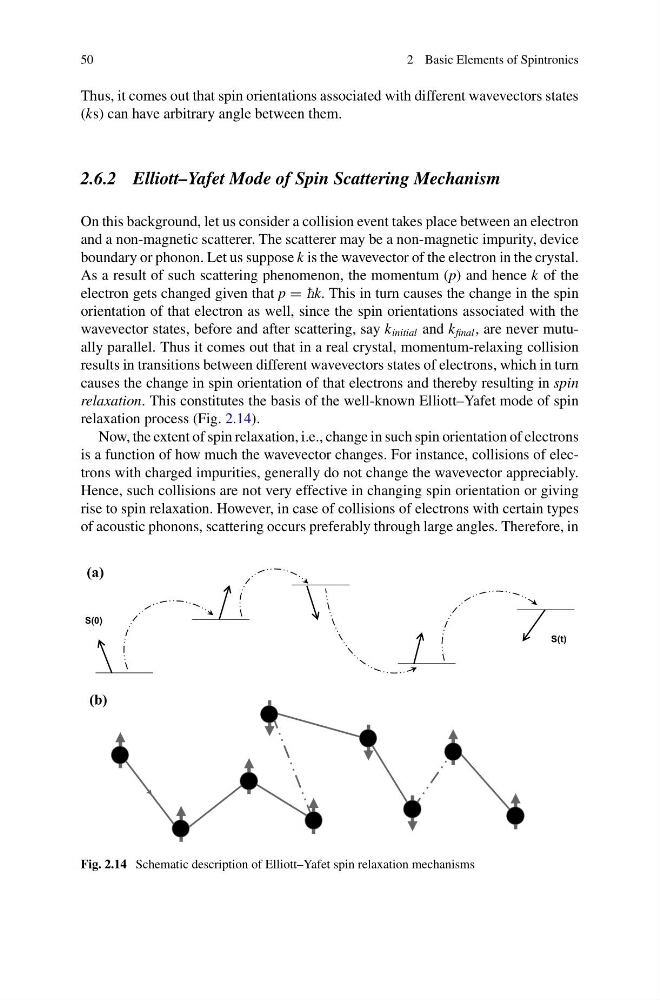
wavevector states, before and after scattering, say k initial and k final , are never mutually parallel. Thus it comes out that in a real crystal, momentum-relaxing collision
results in transitions between different wavevectors states of electrons, which in turn
causes the change in spin orientation of that electrons and thereby resulting in spin
relaxation. This constitutes the basis of the well-known Elliott–Yafet mode of spin
relaxation process (Fig. 2.14).
Now, the extent of spin relaxation, i.e., change in such spin orientation of electrons
is a function of how much the wavevector changes. For instance, collisions of electrons with charged impurities, generally do not change the wavevector appreciably.
Hence, such collisions are not very effective in changing spin orientation or giving
rise to spin relaxation. However, in case of collisions of electrons with certain types
of acoustic phonons, scattering occurs preferably through large angles. Therefore, in
(a)
(b)
S(0)
S(t)
Fig. 2.14 Schematic description of Elliott–Yafet spin relaxation mechanisms
2 Basic Elements of Spintronics
Thus, it comes out that spin orientations associated with different wavevectors states
(ks) can have arbitrary angle between them.
2.6.2 Elliott–Yafet Mode of Spin Scattering Mechanism
On this background, let us consider a collision event takes place between an electron
and a non-magnetic scatterer. The scatterer may be a non-magnetic impurity, device
boundary or phonon. Let us suppose k is the wavevector of the electron in the crystal.
As a result of such scattering phenomenon, the momentum (p) and hence k of the
electron gets changed given that p = èk. This in turn causes the change in the spin
orientation of that electron as well, since the spin orientations associated with the
wavevector states, before and after scattering, say k initial and k final , are never mutually parallel. Thus it comes out that in a real crystal, momentum-relaxing collision
results in transitions between different wavevectors states of electrons, which in turn
causes the change in spin orientation of that electrons and thereby resulting in spin
relaxation. This constitutes the basis of the well-known Elliott–Yafet mode of spin
relaxation process (Fig. 2.14).
Now, the extent of spin relaxation, i.e., change in such spin orientation of electrons
is a function of how much the wavevector changes. For instance, collisions of electrons with charged impurities, generally do not change the wavevector appreciably.
Hence, such collisions are not very effective in changing spin orientation or giving
rise to spin relaxation. However, in case of collisions of electrons with certain types
of acoustic phonons, scattering occurs preferably through large angles. Therefore, in
(a)
(b)
S(0)
S(t)
Fig. 2.14 Schematic description of Elliott–Yafet spin relaxation mechanisms